Times of Israel
Edelstein: I left Likud because I couldn’t defend its agenda, seek ‘broad’ coalition
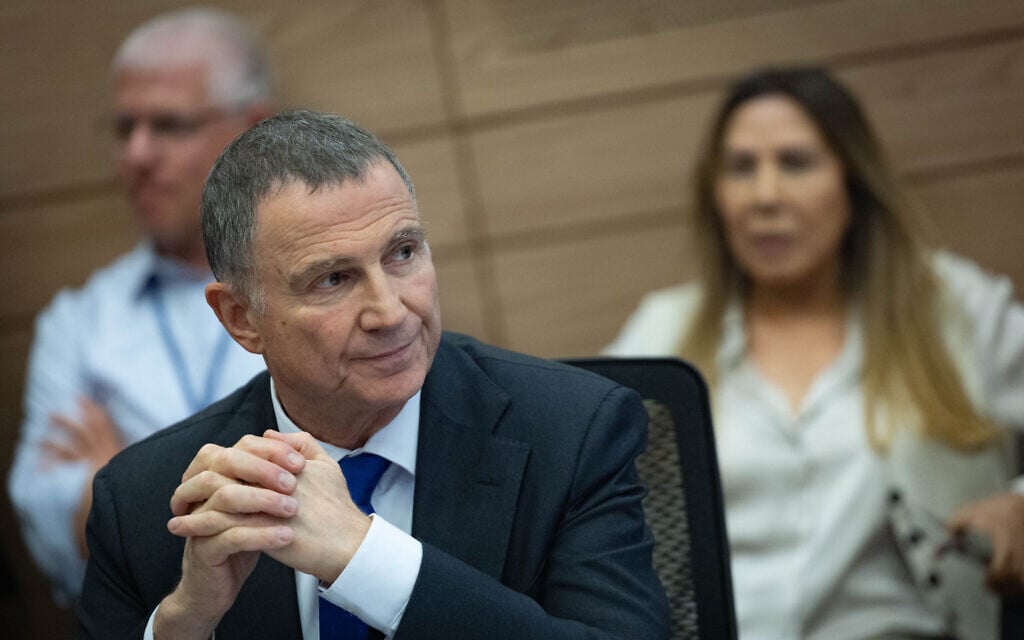
Senior lawmaker Yuli Edelstein explained his decision to depart Prime Minister Benjamin Netanyahu’s Likud party in an interview aired Saturday, a day after he made public his decision to leave, saying that he could no longer campaign for a party that continues to back draft exemptions for ultra-Orthodox men, as doing so would be a betrayal of his principles.
“If you succeed in the primaries, you then have to stand on the stage and say, ‘Vote Likud, we will…,’ and I don’t know how to finish that sentence,” Edelstein said in an interview with Channel 12’s “Meet the Press.”
“What will we do? Continue to allow freeloading?” he questioned, in apparent reference to the government’s failure to fulfill its obligation to draft members of the ultra-Orthodox public into the army.
Short clips of Edelstein’s interview were aired on Friday, in which he announced that he would not run in the Likud primaries ahead of elections later this year. Instead, he said, he would be forging “a new political path.”
The Likud primaries are scheduled for August 4, ahead of the national election, which must take place no later than October 27, 2026.
Get The Times of Israel's Daily Edition
by email and never miss our top stories
By signing up, you agree to the terms
“There are members who, right now, are surprised to hear what I’m saying,” Edelstein said of his decision not to run in the primaries. “They’ll say: ‘Yuli, what are you doing? We’ve supported him for decades, we would have supported him this time around, too — why is he doing this?'”
Apologizing to these Likud voters, Edelstein said: “There is no other way.”
“We need to make a change in this country… the State of Israel has always come before my party.”
Looking to the future, the longtime lawmaker said he intends to establish a new political framework rather than join an existing party, although he declined to name it yet.
“There is a fairly large public that is hungry for this message. The public has shifted right – you see it in all the polls,” he said, arguing that many right-wing voters are seeking a “responsible right” that would advance ultra-Orthodox conscription, judicial reform, and better address the security needs of Israel’s north and south.
Edelstein explained that he is seeking a “broad Zionist government” that is “not dependent on non-Zionist factions,” including Arab and ultra-Orthodox parties, adding that he would even be willing to take the “tenth spot” on a joint electoral list if it prevented the center-right vote from splintering.
Edelstein, who has been a party mainstay since 2003, once enjoyed firm support within the Likud, even winning the party’s 2019 primary, placing him second only to Netanyahu on the Likud’s electoral slate ahead of that year’s March election, which was the first of five that Israel had between 2019 and 2022.
In 2021, when the Likud was briefly out of power, Edelstein announced he would challenge Netanyahu for the party leadership, but ultimately withdrew the bid. When the Likud next held primaries ahead of Israel’s most recent election, in late 2022, Edelstein dropped from second to 18th place on the party’s electoral slate.
Lapid: Bennett is better suited to lead than me at present
Meanwhile, Opposition Leader Yair Lapid also appeared in an interview on Channel 12’s “Meet the Press” aired Saturday, during which he assailed Netanyahu’s handling of the war with Iran, and defended his decision to take second place behind former prime minister Naftali Bennett on their joint slate, Together, in the upcoming election.
The Yesh Atid leader said that had he been calling the shots during the war with Iran, “I would have bombed all the main energy installations, all the oil fields,” arguing that the government had made a mistake in refraining from such attacks.
“If you want to topple the Iranian government, you need to take out the Iranian economy, and afterwards the next [Iranian] government would need to build it again from scratch over years,” Lapid continued, adding that he expressed this opinion to Netanyahu during security briefings he received as opposition leader during the war.
Lapid said that Netanyahu merely “mumbled” in response.
Turning to politics and his union with Bennett, Lapid said that Bennett is more suited to lead the country at this moment than he is, because, he ventured, Israel needs a right-wing leader at the moment.
“Naftali Bennett is the right person at the right time,” said Lapid, insisting that this was not a dig at Together’s main rival in the opposition camp, Gadi Eisenkot’s centrist Yashar party.
“I’m not saying he’s better or more fitting than Gadi Eisenkot, I’m saying he’s better and more fitting than me at this moment,” he clarified.
He continued: “We need right now a leader from the right. I need someone who was prime minister, who was defense minister, who was education minister, who was economy minister, who established a government, who dismantled a government, who lost, not just who won, and he is a person of the right… I put myself, my party, and my trust behind him.”
Recent polling has shown that Eisenkot’s Yashar party is pushing past the Bennett-Lapid union towards the forefront of the anti-Netanyahu movement. A Channel 12 poll last week placed Likud at 24 seats, still the largest party, with Eisenkot at 22 and Bennett at 17.
That poll put the Zionist anti-Netanyahu bloc at 58 seats total, beating out the current coalition’s projected 52 seats. Neither the Zionist opposition or coalition are projected to win the 61 seats needed to form a government.
When polled about who they would prefer as prime minister, the most popular contender against Netanyahu is Eisenkot, as opposed to Bennett or Liberman.
When up against Eisenkot, Netanyahu polls at 37% support against Eisenkot’s 36%. Netanyahu is preferred by 40% of those surveyed when placed against either Bennett or Liberman, who poll at 32% and 23%, respectively.
Stav Levaton contributed to this report.
View original source — Times of Israel ↗
Related stories

The Punch
PoliticsJul 4, 2026 · 1 min
Saraki pledges support for UNILORIN first-class scholar’s Italy trip
The Punch
The Punch
PoliticsJul 4, 2026 · 1 min
Tinubu flags off N137bn road rehabilitation projects in Borno
The Punch

Philippine Daily Inquirer
PoliticsJul 4, 2026 · 1 min
Ombudsman: Senate sgt-at-arms ‘dismissed’
Philippine Daily Inquirer

Philippine Daily Inquirer
PoliticsJul 4, 2026 · 1 min
Palace: Better if VP Sara Duterte appears at trial to prove innocence
Philippine Daily Inquirer