The Guardian
What Australia can learn from the rise of populists around the world to avoid following Hanson down her rabbit hole |…
We must face it. The political system has changed. Playing catch-up won’t bring back the old order.
At its heart is an epochal transformation in the means of communication. In its wake this has remade the skill set required for political success.
Chasing the 24/7 news cycle is not enough. That is a game designed to be won by populists who are instinctively emotional, angry, personal and ubiquitous. They never shut up.
It’s an unequal match for most traditional politicians and a media once considered the “feedback mechanism of democratic system management” – the fourth estate. It was regulated and operated with professional norms to ensure accuracy, independence and authority.
It wasn’t perfect but owners, editors, journalists and even politicians took this quasi-institutional role seriously. At its best profitability or public ownership ensured independence – at its worst owners exploited the political influence of media ownership for personal gain.
In its place is a business-political model has evolved which cares nothing about accountability. It has refined the worst of the old system into an extraordinary influence and money-making machine.
This approach is now shared by populists and social media platforms – activate anger, fear and threat to mobilise and monetise. Some of the richest people in the world are happy to throw their money at ensuring the populists who thrive on, and foster, volatility prevail.
Grifters have used this support and these methods to foster populist rebellions in once stable republics. The starting point almost everywhere was to undermine trust in the media and journalists. Over the past decade the Reuters Institute has shown how trust has plummeted. It hovers near 40% in most countries – in Australia a little better, the UK a little worse and the US a catastrophic 25%.
Trust was the first casualty, truth the second. Who knows what to believe.
A quarter of the world’s democracies are now led by authoritarian populists who have a tenuous relationship to truth. Many are lining their own pockets. Almost none have supported media systems that are able to hold power to account.
It is an age of magical thinking. These leaders and their entourage will do nothing for, and care even less for, those who feel, with justification, that they are missing out in an increasingly unequal, unfair world.
As Liam Byrne, the British Labour MP for East Birmingham writes in his pithy new book, Why Populists Are Winning and How to Beat Them, the key is a deception of extraordinary proportions: “Its appeal is a simple trick: to tell people their anger at a rigged system is justified – but then redirect that anger towards a different target. Not just the elite but the outsider; the migrant, the minority. And the prescription of every extremist down the ages: a strong man to stop the rot.”
Except that the data shows that the economies of nations led by populists do not thrive, instead GDP shrinks. Populist leaders, as Byrne writes, “buy applause on credit”, meddle in the economy and have no solutions beyond their self-aggrandisement.
Byrne’s careful analysis resonates in an Australian context. He identifies five categories of supporters of British populists – those who want to burn the system down, those who feel left behind and ignored, traditional conservatives, a melancholy middle more heartbroken than angry, and civic pragmatists who want governments to do more and soon. The people who tell pollsters they are considering voting for One Nation fit these categories.
Traditional conservative parties suffer first as the Liberal and National parties are finding here, but the damage touches all. The tone of political discourse is debased; cynicism and pessimism replace hope.
Australia is facing this a little later than other countries. The fact that the Rudd government intervened, rather than use austerity as a tool, during the global financial crisis was a big save. But as the voice referendum showed, Australians are as susceptible as anyone to digital disinformation. And that is the populists’ defining skill as soon as they have the money to buy it.
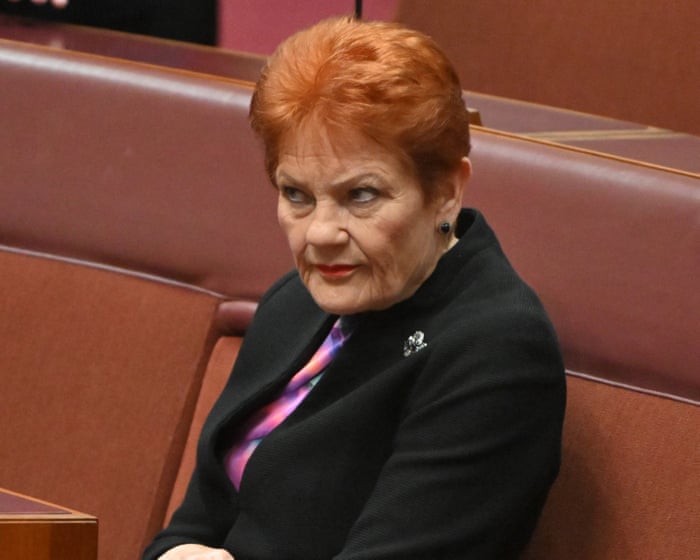
Now rather than following Pauline Hanson down her rabbit hole, Australia can learn from the disasters elsewhere. The removal of Karl Stefanovic, after he followed the money into a far-right love fest, was a good sign that things can be done differently.
New rules and modes of communicating, listening, imagining and acting need to be developed. Methods that ensure representative democracy as we once knew it (at its best) can morph in this very different world into a truly representative system.
A system that rewards courage, not rage. Outcomes, not just process. Co-design, not pretend consultation. Where the noise of politics is not a way of avoiding real political strategy, in hard uncertain times.
The representative democracy we know today is essentially a creation of the 19th century. Times change. Australia has been better than many nations in refining and expanding the system, ensuring universal suffrage and compulsory voting, fair electoral boundaries, a judiciary and public service largely free of political influence.
But it’s not perfect. In an information age, information is as tightly held as ever, special interests prevail, the party system predominates and sends every debate into a zero-sum game – even though less than 1% of citizens are members of a political party.
The lesson, Byrne writes, is “democracy dies when its defenders lose their nerve. Mainstream politics must connect with the surge tide of anger that populists rise and rebuild a radical centre … we cannot simply take shelter from the storm. We must sail the tempest.”
View original source — The Guardian ↗
Related stories

The Punch
PoliticsJul 4, 2026 · 1 min
I look forward to receiving Pope Leo XIV, Tinubu tells Vatican diplomat
The Punch
The Punch
PoliticsJul 4, 2026 · 1 min
Saraki pledges support for UNILORIN first-class scholar’s Italy trip
The Punch
The Punch
PoliticsJul 4, 2026 · 1 min
Tinubu flags off N137bn road rehabilitation projects in Borno
The Punch

TASS
PoliticsJul 4, 2026 · 1 min
Putin, Trump held telephone conversation
TASS