Indian Express
Barmer mosque razings spark legal battle, unite residents across faith
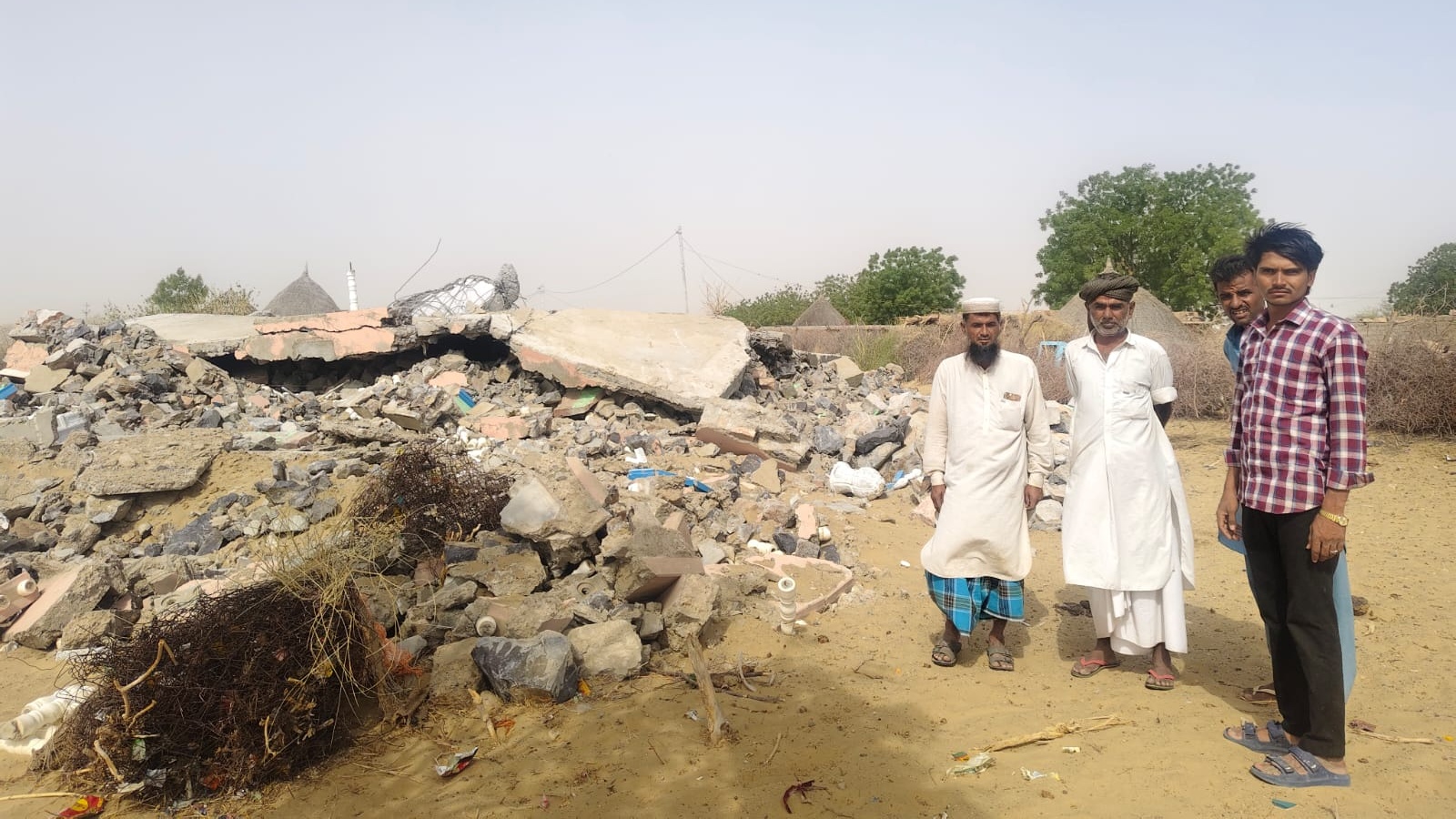
In one corner of Barmer’s Kerkori village, Hishamuddin Sindhi surveys the wreckage before him: concrete slabs, bricks, construction debris piled together. All that remains is a tall, white minaret. “We built it with such hardship but now it’s gone. This is the only mosque within a 10-km radius. Where are we supposed to go now?” says Hishamuddin, the mosque’s maulvi.
Fellow resident Harla Ram Meghwal still can’t make sense of what is happening. “We offered food to the Muslims after they stopped cooking to protest the demolition,” he says. “I don’t understand what the government is getting out of this. These are our brothers.”
This mosque is one of 12 that a writ petition in the Rajasthan High Court claims were demolished between June 18 and 20 across eight border villages in Barmer and four in Bikaner.
The demolitions are all within a 15-km radius of the international border and have triggered widespread protests.
Over the past week, hundreds of residents, both Hindu and Muslim, have banded together under ‘Sarv Dharm Shanti Sabha,’ held marches, submitted memos to the administration.
Officially, the notices cite land use violations, claiming the mosques stood on Gochar, or pastoral, land. On May 27, Union Home Minister Amit Shah had directed authorities to strictly enforce a zero-tolerance policy against illegal structures within 15 km of the international border and demolish them.
Residents, however, claim the notices appeared suddenly and the demolitions were carried out without due process. They allege no other structures have been demolished.
Story continues below this ad
“They should have at least given us a warning. We would have paid the fine as well,” says Abdul Sindhi, a resident of Siyai village. Says Safi Jamil, Barmer president of the All India Majlis-e-Ittehadul Muslimeen (AIMIM): “They are trying to create a rift between Hindus and Muslims but this seems to be failing. Many Hindus are supporting us and participated in the rally.”
Paradiya sarpanch Sorta Ram Meghwal, who joined the Sarv Dharm Shanti Sabha rally, says there are many structures, including temples, on Gochar land.
“We’re not supporting encroachments, but if the government has decided to demolish one set of structures, it should do the same for others too. When you are a minority, you cannot raise your voice against injustice, but it shakes the democratic foundations of this country. Hindus and Muslims have lived harmoniously in Barmer all these years, such incidents make people bitter towards each other. They should follow the raj dharma, not rajneeti. Otherwise, we will take to the streets and fill jails,” he says.
Barmer Collector Chinmay Gopal; Superintendent Chuna Ram Jat; and Rajasthan Director General of Police (Law & Order) Sanjay Kumar Agarwal declined to comment. The Border Security Force declined to respond.
Story continues below this ad
For residents, the notices came as a shock but have also become a unifying force.
“When the administration left, every Hindu in my village was at my house expressing grief over the mosque. No Muslim cooked food for four days after the demolition and Hindus used to send food for us,” Hishamuddin says.
On November 13, 2024, the Supreme Court held that demolitions without due process violate the rule of law and said affected parties must receive prior notice and at least 15 days to respond. Residents claim that although the notices — under Section 91 of the Rajasthan Land Revenue Act, 1956 — were dated earlier in the month, they received them only a day before the demolitions.
At Kerkori, residents claim they received the June 11 notice only on June 17. Issued under Section 91 of the 1956 law, it alleged encroachment on Gochar land and directed the mosque’s maulvi, Hishamuddin Sindhi, to vacate the land or appear before the court on June 18.
Story continues below this ad
“The patwari brought the notice around 7:30 pm,” says Hishamuddin Sindhi. “I was still at the masjid. We’ve been worshipping at this mosque for the last 30 years.”
The villagers then held a meeting and headed to the local tehsil office the next day. By then, residents say, the bulldozers rolled in.
“Seven big trucks and 6-7 police jeeps came to the village. The demolition drive lasted two hours,” says village resident Rafiq Sindhi.
Residents say the mosque was rebuilt as a pucca structure two years ago with village donations. “We kept a locked box inside the mosque to collect donations. By contributing small amounts over five years, we were able to build a modest pucca mosque, now demolished,” says Sulieman Sindhi, another resident.
Story continues below this ad
In Malana, 3 km from the international border, there’s a wall of silence around the demolition, though a pile of rubble marks where the village mosque once stood. A resident says the notice was served on June 17 and the structure was flattened the next day. In Siyai, 15 km away, local resident Faizu Khan walks through the wreckage. Behind him stands a turquoise-painted minaret with a gold finial. On June 20, a day after the village received the demolition notice, the 40-year-old Siyai mosque was razed.
The demolitions form the basis of a writ petition by Peer Mohammad Shah Jilani Dargah Samiti in the Rajasthan High Court. Court documents show that at the July 3 hearing, the petitioners said the notices were served in a “cyclostyled and mechanical manner, reflecting a predetermined approach, particularly under Section 22 of the 1954 Act”, and that national security could not override the principles of natural justice.
The state government claimed the matter involved national security. It also said permission from the Collector is mandatory for establishing religious structures, and that “some petitioners had failed to obtain such permission before constructing premises within the 50-kilometre border belt”.
The case will now be heard on July 7.
The Opposition has sought to corner the ruling BJP, accusing it of trying to stir the communal pot ahead of the panchayat polls.
Story continues below this ad
“Tharwasis (the people of Thar) will remain united,” says Ummeda Ram Beniwal, Congress MP from Barmer’s Baytu Lok Sabha constituency, while Sheo MLA Ravindra Singh Bhati says: “National security is important but not at the cost of social harmony”.
When contacted, BJP state president Madan Rathore says he’s “unaware of any mosque demolition cases in Rajasthan”. He adds: “If anything of that sort has happened, it must have been due to illegal encroachment on government land. We don’t harass anyone on the basis of religion or caste.”
Says Nand Kishore, sarpanch of Ranasar village in Barmer: “This area has never seen communal tensions. If the government wants to remove structures on pastoral land, it should do so for everyone. One community should not be targeted. I know a lot of BJP workers and their members are not happy with these incidents.”
View original source — Indian Express ↗
Related stories

TechRadar
TechnologyJul 5, 2026 · 1 min
OpenAI wants to give the US government a piece of the company — but don't assume you'll get a slice too
TechRadar

CNA
TechnologyJul 5, 2026 · 1 min
Taylor Swift’s aunt shares details of singer’s secret wedding to Travis Kelce
CNA

Indian Express
TechnologyJul 5, 2026 · 1 min
England face Azteca hurdle: Why playing at a high altitude is so difficult
Indian Express

Indian Express
TechnologyJul 4, 2026 · 1 min
Mumbai floods: Roads shut, train, Metro services hit, red alert issued
Indian Express