Indian Express
India’s mango story: Chef Kishi Arora on memories, from Alphonso to Langra
Every morning this summer, I walk up to my terrace and count to three. Three Amrapali mangoes hang from a tree I planted the year my father died.
Earlier this year, it was covered in blossoms, the kind that make you pull out your phone and call your mother. Then, Delhi’s storms arrived, as they always do, and took most of the flowers with them. Three survived. They are getting bigger and heavier by the day, which is how I know the wait is almost over.
He loved mangoes. When he passed away in 2018, we planted an Amrapali and a Harsingar over his ashes at the dham in Meerut that meant so much to him. Around the same time, almost without thinking, I planted the same two trees on my terrace in Delhi. One pair rooted in a place of memory. Another pair woven into my everyday life, mine to watch through every season, every storm, every June that came and left without giving me anything. This year, finally, the terrace Amrapali gave me fruit.
At home, mangoes are an entire season (Photo: Kishi Arora)
I keep doing the count.
He was from Muzaffarnagar, my mother is from Banaras, I grew up in Ghaziabad and landed in Delhi, and work eventually took me South and West and everywhere in between. Somewhere across all of it, without meaning to, I built a map. Not of highways or hill stations but of mangoes. Every place I have loved has one attached to it. Every person I have lost or kept close is somewhere in that list.
It was my father who introduced me to Rataul. Small, intensely fragrant, almost unreasonably flavourful for its size. Not as famous as Alphonso or Kesar but fiercely loved by those who know it. You soften it between your palms, make a small opening at the tip and drink it. No knife, no bowl, no ceremony. He ate it the way people eat things they grew up with: fast, without explaining it to anyone, as though stopping to admire it would ruin the whole thing.
Every family has a food that makes a person immediately present. Rataul is mine for him. I cannot see one at a mandi without being, briefly and completely, back in a time when he was still here.
Banaras is my mother’s side, which means it is where my nani and nana lived, and where some of my most stubborn memories were made.
Every summer, my nana would return home carrying boxes of Langra. Before anyone could touch them, the mangoes had to be soaked in buckets of water to cool. As children, we found this rule unreasonable. We would circle those buckets every 20 minutes, certain that collective impatience might somehow speed things along. It never did.
When they were finally declared ready — cool and sweet, fragrant and fibrous — the wait felt worth it. I am well into adulthood and the sight of a Langra still puts me right back in that house. The particular quality of afternoon light. The sound of water in a bucket. The specific restlessness of children who have been told to be patient and are choosing, deliberately, not to be.
What’s your favourite variety?
Before Delhi, there was Ghaziabad. Nearly a decade of it. Cousins, long summer holidays, mangoes at almost every meal.
Chausa was the favourite because there was simply no dignified way to eat it. Sticky hands, sticky chin, occasionally sticky elbows, all expected and entirely fine. Nobody thought to use a fork. Nobody wanted to. Chausa is probably the most honest mango. It doesn’t pretend to be elegant and it doesn’t need to be.
Safeda and Dasheri showed up differently at our house. Blended, chilled, poured into a tall glass by my mother, who makes one of the best mango shakes I have ever had. The moment you take a sip, a little mango moustache forms above your lip. We still laugh every time it happens, which tells you something about how often we still make it. I know I am biased about the shake itself. I do not think it changes the fact.
A thali comprising grilled a mango (Photo: Kishi Arora)
Panna in Madhya Pradesh has its own category in my memory. The religion my parents follow has its headquarters dham there and we made that journey often, outside of any holiday plan. After temple came bhog, then family time spread out over the afternoon, and then my father would lead us to his pakorewala.
His pakorewala. Not ours. His. He had found this man the way my father found most things he loved, quietly, without announcement, and then behaved as if everyone obviously already knew about him.
Because this was not your standard onion and potato situation, whatever the sabziwala had went into the batter. Pumpkin. Bitter gourd. Drumstick leaves. Amaranth. Things that had no business being pakoras and yet, once fried, made complete sense. Between an open-minded father with strong opinions on flavour and a pakodewala willing to try anything, something genuinely good kept coming out of that oil.
And then there were the aam ke pakode.
Raw mango, light batter, hot oil. Crispy outside, the mango inside going soft and tangy and almost jammy from the heat. Sour and hot and a little sweet all at once. I have never found them anywhere else. The kind of dish that exists because two people, one with an idea and one with a kadhai, decided to just go for it.
I make them at home every season now. They are good but not the same.
Work later took me to Bengaluru and Mumbai, and both cities added their own stops to the map. The Bengaluru memory is a specific one. I was there setting up a bakery, deep in recipe development, the kind of work where your palate is tired and everything starts tasting like butter and sugar. In the middle of all of it, my client handed me a Badami mango. Just like that, no preamble. Karnataka’s quieter answer to Alphonso and, in that moment, possibly the best thing I had eaten all trip. Badami did not need the contrast to taste good. It just did.
Mango pickle (Photo: Kishi Arora)
Kerala changed my understanding of what this fruit could do in a kitchen.
Until then, the only savoury mango I knew was my mother’s cooking. Raw mango sabzi. Raw mango in kadhi. Stuffed into a paratha. All of it deeply familiar, all of it made from the raw fruit. The idea of cooking a ripe mango into something savoury had simply never occurred to me. Then I came across Mambazha Pulissery. Ripe mango with coconut, yogurt and spices. It sounded, frankly, like an act of chaos. Then, I tasted it. Sweet, tangy and oddly grounding, it made the kind of quiet sense that only dishes cooked for generations tend to make. It also showed me how narrow my picture of this fruit had been. Kerala alone has countless local varieties growing in backyards and homesteads, known within particular communities, unnamed on any national list. India’s mango story is so much larger than the dozen varieties most of us can name from memory.
One discovery that has stayed very close: Jardalu from Bihar.
The fragrance stopped me the first time I tasted it. Some mangoes lead with sweetness, some with texture, some with a colour that makes a promise the flavour then keeps. Jardalu announces itself through scent alone. Before you have even taken a bite, something has already happened to you. I loved it enough to track down a grafted sapling for my terrace. It grows up there now alongside my Amrapali, small and unhurried, waiting to write its own chapter.
At home, mangoes are an entire season. Not just a fruit.
Nothing says summer quite like a perfectly ripe mango.
Before the sweet ones arrive, raw mangoes take over the kitchen. Aam panna appears on the counter. Chutneys get made. Aam ka hing waala achar, my mother’s recipe with no oil and no sun-drying required, shows up on the table and tastes more like summer than almost anything else I know.
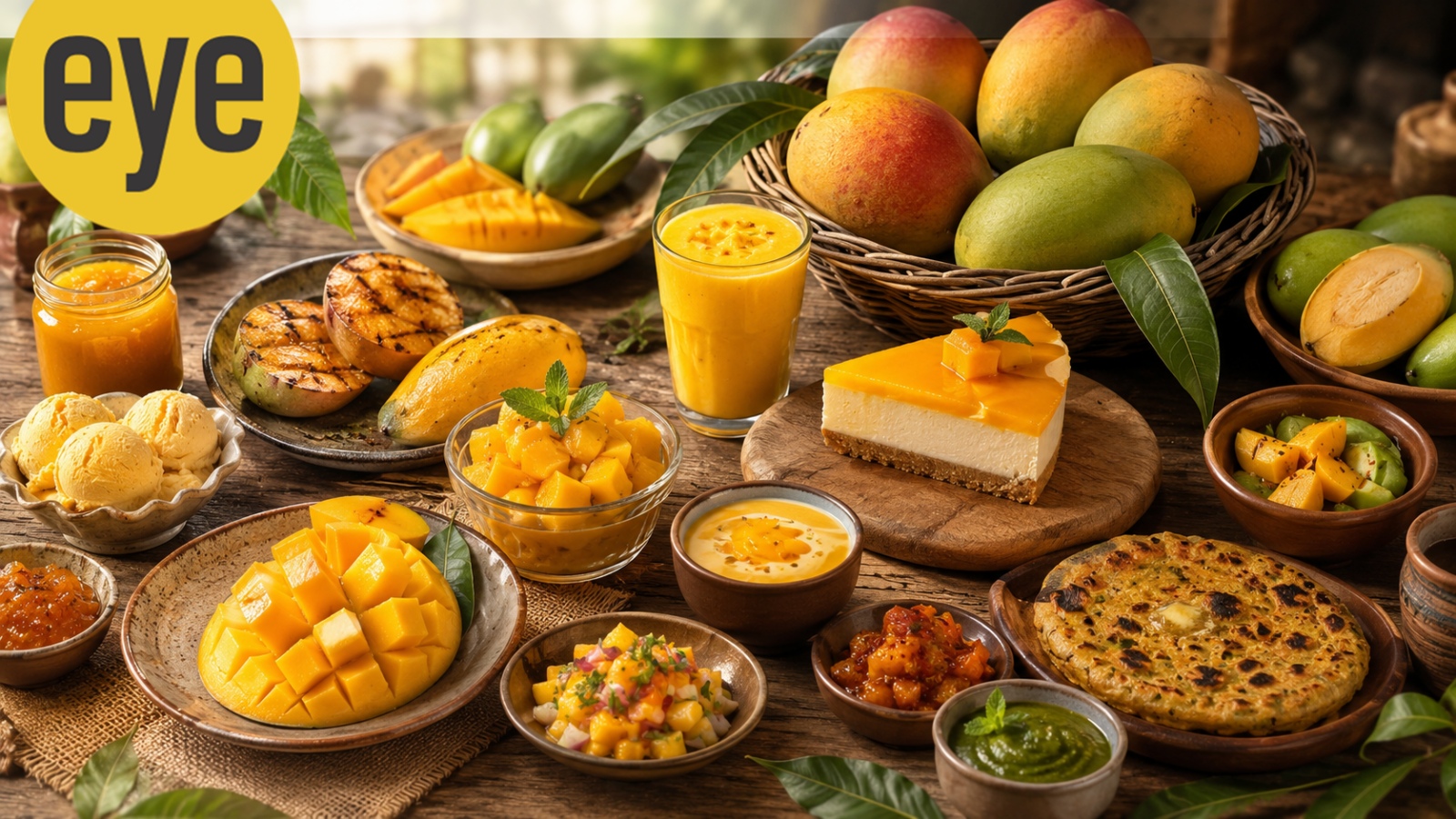
Then, everything shifts. Some become aamras with hot puris, a combination that has never once needed improving. Others go into cakes and cheesecakes. And sometimes, I grill mango and serve it with yuzu honey, something I started doing almost by accident during a recipe session and have not stopped since. The heat caramelises the fruit and the citrus cuts straight through, in a way that surprises you every single time. That is what makes this fruit so remarkable. It belongs equally to the entirely traditional and the completely new, without straining in either direction.
The three Amrapali mangoes on my terrace are still ripening as I write this.
They might just be the biggest Amrapali I ever eat. The plant has put everything it has into these three — seven years of waiting and not one ounce of energy wasted on anything else. Whether they will be sweet or not, I do not know. That is a question to be answered only once they are picked and cut open. And somehow, that feels right. The best things usually make you wait for the answer.
I will eat them quietly. Probably alone, on the terrace, before Delhi gets too loud. Somewhere between Muzaffarnagar and Banaras, Ghaziabad and Delhi, Panna and Bengaluru, Kerala and Bihar, mangoes stopped being just a fruit I looked forward to every year.
They became the map itself.
Kishi Arora is a Culinary Institute of India-trained chef, founder of Foodaholics, content creator and urban gardener
View original source — Indian Express ↗
Related stories

The Punch
WorldJul 5, 2026 · 1 min
Lagos reaffirms support for vulnerable residents
The Punch
The Punch
WorldJul 5, 2026 · 1 min
Violence displaces 3.5 million across Lake Chad Basin – UNHCR
The Punch
The Punch
WorldJul 5, 2026 · 1 min
FCMB posts N177bn profit, pays N23bn dividend
The Punch
The Punch
WorldJul 5, 2026 · 1 min
APC state chairmen move to strengthen grassroots structures
The Punch