CNA
NDP 2026: What it takes to fly the Singapore flag through Kallang Basin for the first time
Singapore
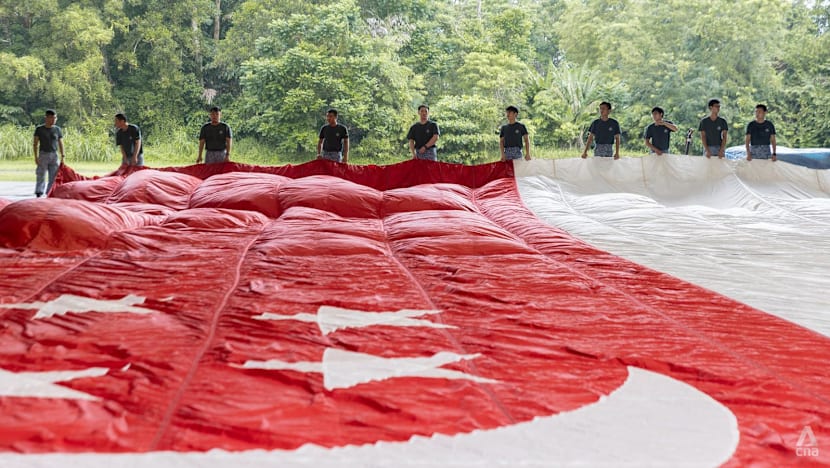
Across three sites, nearly 90 people, including regulars, national servicemen and Singapore Armed Forces volunteers, are involved in preparing the flags.
New: You can now listen to articles.
This audio is generated by an AI tool.
05 Jul 2026 12:00PM
(Updated: 05 Jul 2026 01:00PM)
SINGAPORE: Flying into the Kallang Basin for the first time, Lieutenant (LTA) Tan Yao Bin felt a sense of satisfaction that he could not describe.
At 950 ft above ground, he had a clear view of the central business district, people having picnics at Marina Barrage and residents jogging along the Singapore River.
“And then you compare it to past photos of how Marina Bay used to look like, and then you actually realise that, wow, actually we've come a very long way,” he said.
“I think it's something that everybody is very proud of.”
LTA Tan is a co-pilot of an Apache AH-64 – one of the two helicopters that will escort the Chinook CH-47 and the Singapore flag during the National Day Parade’s (NDP) state flag flypast this year.
The flag will be flown through the Kallang precinct for the first time, in line with this year’s parade being held at the National Stadium. Unlike in recent years, the state flag will not be flown through the heartlands.
“We want to be able to bring the state flag to the people at the Kallang precinct, so that we can all celebrate National Day together,” said lead pilot and commanding officer Lieutenant Colonel (LTC) Cai Weijun.
He was speaking to the media at Sembawang Airbase in late June, ahead of the parade on Aug 9.
Six aircraft will be involved in the flypast, including one Chinook CH-47 carrying the main flag, escorted by two Apache AH-64 in a victory formation.
Two other Chinook CH-47 and one Apache AH-64 will be backup.
PREPARING THE FLAG
Preparation for the flypast starts with getting the state flag ready for rigging.
The state flag is 30m by 20m wide – larger than the size of two tennis courts – and weighs about 320kg. When attached with ballasts and cables, the total weight climbs to 1,360kg.
In total, 15 flags are deployed to three different sites.
Pulau Sudong is the primary pick-up site, while Sembawang Air Base and Paya Lebar Air Base are back-ups, in case of unsuitable weather conditions for flying.
Across the three sites, a crew of nearly 90 people, including regulars, national servicemen and Singapore Armed Forces volunteers, is involved in flag preparation.
Every week before a show, the crew inspects the flags to ensure they do not have foreign objects or tears.
Each flag is graded from one to four, with one representing the best condition. The better flags will be used for previews and the National Day Parade, while the rest are used for training. The prepared flags are ferried to Pulau Sudong to be picked up by helicopters.
On deployment day, one flag is laid out at the designated pick-up point on the runway and rigged to the helicopter using cables and ballasts.
As the helicopter passes the runway, it will lift the flag off the ground.
For Military Expert 2 (ME2) Soo Yi Xun, this year’s flag in-charge, the precision in flag preparation comes down to folding instead of rolling it, which ensures consistency when it is unfurled.
“When the flag is in the sky, and it starts to unfurl, if certain areas are too tight, then it might start to tangle and not open up, so that's where the damage will come,” he said.
A NEW ROUTE
Preparing for this year’s flypast requires “more deliberate planning and rehearsals”, given the challenges of the new route, said LTC Cai.
The state flag will be flown in from the south of Singapore, pushing towards Marina East Jetty area, up to Dunman High School before making a left turn into Kallang Basin and another long left turn through Sheares Bridge.
LTC Cai said the most challenging part is navigating the series of left turns while managing the winds.
The crew must ensure that the flag arrives at the target time of 6.55pm, refined weekly depending on parade rehearsals, and is timed with the national anthem.
“The route was particularly difficult because of the surrounding buildings at the Kallang basin. We have tried different profiles, different flight routes, different heights … and we've landed on this particular profile because it best presents the state flag at the show centre at 950ft running from west to east.”
Flying the flag at 950ft is higher than usual. This is to ensure the flag remains visible through the opening in the west side of the National Stadium when its roof is closed. For example, the altitude was 800ft when the flypast went through Marina Bay last year.
“We need to be very precise to make sure that the flag appears at the right aspect, in particular, to the president's seat as well,” LTC Cai said.
Asked about the limited view from inside the National Stadium, LTC Cai said the team will do their best to present the flag at the “longest possible exposure” across the window.
“I understand there will also be telecasting of the flag into the stadium, so that if the flag appears smaller to some people, they can actually see on the big screen,” he said.
LTC Cai added that flight engineers play an important role in ensuring that the formation is tight.
Aircraft engineers understand and know the limits of an aircraft and ensure that the show goes on safely, said ME2 Premraj S/O Royston, an air force engineer.
As the engineer on board, ME2 Premraj monitors how quickly the Chinook and Apache helicopters close the distance between them.
“We fly very closely together, and maintaining the closures will ensure that the formation flypath looks exactly how we want it to look,” he said, adding that the engineers also ensure that aircraft systems are working since they are flying over areas that they do not normally fly during day-to-day training.
For ME2 Premraj, being part of the NDP has been a dream since young. It is particularly special this year, as he has spent half of his career overseas and recently returned home.
“Being able to fly onboard after so many (years) of looking at the flag on ground level, I think it's very emotional,” he said.
“It strikes me in a way that I don't really know how to describe, but it's something I'm looking forward to.”
Source: CNA/er(mi)
Related stories

The Punch
WorldJul 5, 2026 · 1 min
Anambra agency destroys ₦50m illicit drugs, arrests suspects
The Punch
The Punch
WorldJul 5, 2026 · 1 min
Trabzonspor reject Fulham’s new Nwaiwu bid
The Punch
The Punch
WorldJul 5, 2026 · 1 min
U17 WWC: Ifeanyi nets winner as Flamingos edge Benin 3-2
The Punch
ABC News
WorldJul 5, 2026 · 1 min
Earthquake rocks community along Victoria's Great Ocean Road
ABC News