BBC
Why do lorries still keep hitting railway bridges?
For rail passengers, it can be galling to hear or read that your train has been delayed, putting your journey, your day, back into a land of uncertainty.
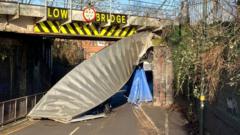
That is the obvious consequence when a vehicle, especially a lorry, hits a bridge carrying the service in question. It can lead to days of disruption, gridlocked roads - and also cost millions of pounds to fix.
Bridge strikes, as Network Rail calls them, have been factor for decades and, recently, one caused major disruption in Warwickshire, delaying trains across the country while engineers checked the structure was safe.
But why do they keep happening?
Between April 2024 and March 2025 there were 1,666 reported bridge strikes across the country's rail network, according to Network Rail, with crashes costing the operator about £23m a year in repairs.
For Mike Craney, who has spent more than two decades driving lorries, such strikes are frustrating because, he believes, they should easily be avoided.
The experienced driver, from Birmingham, who now lives in Cannock, Staffordshire, still remembers the moment, shortly after passing his test, when he almost became a statistic himself.
Davies said other factors included drivers relying on car sat-navs, unsuitable diversion routes and, in some cases, motorists deciding to "take a chance".
"Driver training must be front and centre," he said.
"Drivers also need to understand the consequences because a bridge strike can jeopardise their own career, the business they work for and other people's livelihoods."
David Wymer, a retired civil engineer from near Wolverhampton, who worked on bridge strikes across Staffordshire, said strikes were often likely caused by human error, but he believed there could be other contributing factors.
"Sometimes loads move during the journey, sometimes vehicles haven't been measured correctly, and sometimes bridges could be marked incorrectly," he said.
"It's a bigger issue for Network Rail than anyone else."
Related stories

The Punch
WorldJul 5, 2026 · 1 min
Real Madrid sign Dutch defender Dumfries from Inter Milan
The Punch
The Punch
WorldJul 5, 2026 · 1 min
FG denies spending ₦8tn outside budget, says IMF report misrepresented
The Punch
The Punch
WorldJul 5, 2026 · 1 min
Bauchi gov mourns aide, ex-deputy governor’s children killed in car crash
The Punch
South China Morning Post
WorldJul 5, 2026 · 1 min
Fires ravage France, Spain, Portugal forests as Europe’s temperatures rise again
South China Morning Post