BBC
One city, many flags: London's World Cup loyalties
One city, many flags: London's World Cup loyalties
ByNora Fakim
London
Who do you cheer for when your heart is in more than one place? For many Londoners, the World Cup is more than just football - it's a reflection of identity, family and belonging in one of the most diverse cities in the world.
Born and raised in south-east London to a Moroccan mother, I have often asked myself that same question. When international tournaments come around, I find myself thinking about which team truly represents me.
To find out if I was alone, I travelled across the capital meeting people whose loyalties are shaped by more than one country.
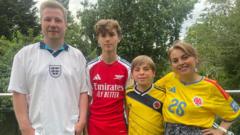
My first stop was Mottingham, south-east London, where I met a Colombian-English family preparing for a busy football schedule.
They were getting ready for the England-Panama match, followed that same evening with Colombia playing Portugal. Empanadas were being prepared.
When asked who they would support if Colombia played England, opinions were divided.
With a cheeky smile, Martin, 10, immediately said: "Colombia! I'd support them as I fit in with their culture a bit better as I'm very extra."
His 15-year-old brother Thomas said he would support England.
"I feel more English and I live here," he said.
Their English father, Paul, said: "I'd support England, but I'd feel bad."
But his Colombian wife, Jimena, struck back: "If there's another England-Colombia game, I'm not going to watch it with you. I'm going to watch it with my fellow Colombians."
It was interesting to see how the two brothers, who were both born in London, felt more Colombian or more English.
It reminded me of me and my sister. We both grew up in Beckenham with a Moroccan mother and a Mauritian father. People would often tell us we were different.
"Nora's more Moroccan" or "your sister's more British". But I never saw it that way. I felt 100% British, 100% Moroccan, 100% Mauritian and, above all, 100% Beckenham.
In west London, I visited Sas at her restaurant Barcha Barcha.
The chef was born in France to Tunisian parents and now lives in south London. For her, identity is fluid, shaped by experience as much as heritage.
"I'm conflicted when it comes to the World Cup," she said. "I would say I support Tunisia first, then England, then France."
She said living in London had made her feel unexpectedly at home and described the city as welcoming and open in a way she had not experienced elsewhere.
"There really is the freedom of religion here," she said. "When I first arrived in London, I was so surprised to see a banker, who was Sikh, wearing the turban. It was amazing as this would never happen in France."
Sas made me think about how identity is not always about where you're born, or your nationality - it is where you feel you belong.
Her daughter Almas said she supported "England first, then Tunisia, then France".
Sitting in the restaurant was Milly Lamiri, 27. She is half Tunisian and half English and said London was a "very patriotic city".
"In Tunisia it's just a bunch of men at coffee shops having one eye on the TV and one eye on the card game," she said.
Everyone has their own reason for backing a team. For me, it was football legend Zinedine Zidane.
Growing up in Beckenham, seeing a French footballer with North African roots become one of the world's greatest made me feel proud of my own identity.
Back in the 1990s, apart from my mother, I rarely saw anyone with North African heritage where I lived.
Today, questions around identity shape the fans and the players.
BBC sports broadcaster Chris Slegg told me that more players from London were now choosing to represent countries other than England.
"Three players in particular come to mind who grew up in London and could have played for England but are starring in other countries this World Cup," he said.
"USA forward Folarin Balogun, and he actually played for England under 21s.
"Ghana striker Antoine Semenyo, born in Chelsea, raised in Greenwich, could have also played for France.
"France winger and surely a future Ballon d'Or contender Michael Olise, born in Hammersmith, could have also represented Algeria or Nigeria but he chose France."
In Croydon Box Park, South Africa were playing against Canada and identity was on the menu.
"I'm supporting South Africa because of my partner," one fan said.
"I'm British-born but my cultural and ethnic heritage is from Vietnam and China. I would have a conflict if either of them played against England."
His partner said she would never support England even though she had a British passport.
"When England played Ghana, I was rooting for Ghana because Africa is in my heart," she said.
Another South African fan at the match, Faith Chabinu, said: "I live in London now but the beauty is I can still support these African teams and everyone is OK with that."
My final stop was Brixton. A place shaped by generations of people who have brought cultures, traditions and identities from all over the world. It felt like the perfect place to ask what all of this said about modern London.
Isabella Silvers, whose weekly newsletter Mixed Messages explores "the mixed-race experience", said London was a fascinating city.
"We have so many cultures and people supporting different countries here," she said.
"Football is a chance for people to come together, to find that connection to heritages they may sometimes feel a bit distant from.
"It's a way to find connection to the diaspora around the world and be really proud of something which otherwise may leave you feeling racism and discrimination on a personal level and on a systemic level.
"So football is a chance to find that pride, find that community and maybe support a team that may get to the final."
What I have realised is that identity is not just a passport or a football shirt. It is shaped by family, culture, memories and the places that make us feel at home.
In London, those stories come together every day and the World Cup simply makes them visible.
I may never choose just one team, and in a city like London, maybe I can support them all.
Listen to the best of BBC Radio London on Sounds and follow BBC London on Facebook, external, X, external and Instagram, external. Send your story ideas to [email protected], external
Related stories

The Punch
SportsJul 5, 2026 · 1 min
World Cup: Ballon d’Or winner need not play for European club – Organiser
The Punch
The Punch
SportsJul 5, 2026 · 1 min
VIDEO: Davido defends wearing pins for abducted pupils at world cup event
The Punch
Sky Sports
SportsJul 5, 2026 · 1 min
Wakefield score nine tries in Magic Weekend demolition of Castleford
Sky Sports
ESPNcricinfo
SportsJul 5, 2026 · 1 min
Bosch applies the humpty as Essex fell Surrey
ESPNcricinfo