Times of India
The long journey to your tap: How India's biggest cities get their water
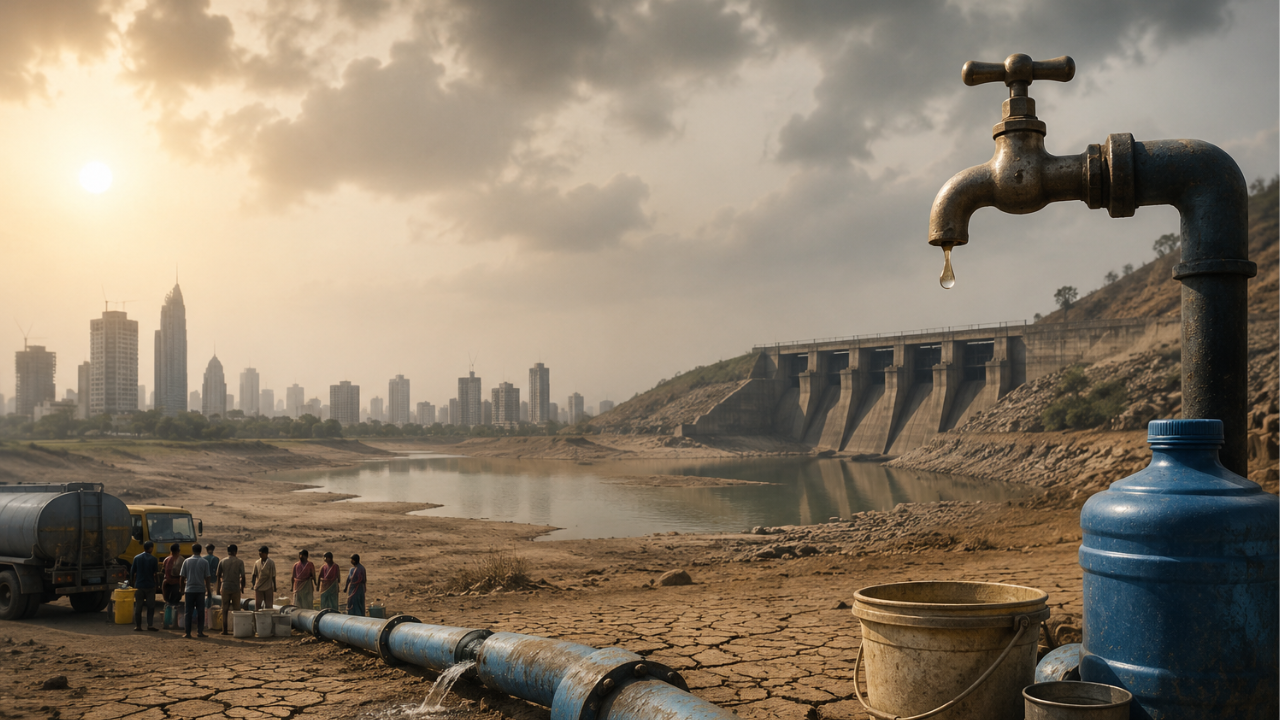
India's major reservoirs are holding just 26 per cent of their live capacity
There's a particular kind of math millions of Indians have learned this summer: how many buckets can you fill before the tap pressure drops, or which day of the week the water actually comes.
It's no longer an emergency routine. It's just routine.Behind it is a number that should worry more people than it does. India's major reservoirs are holding just 26 per cent of their live capacity, according to the Central Water Commission's weekly bulletin dated July 2 says that the water level in the country's 166 major reservoirs works out to just over 47.7 billion cubic metres, against a total live capacity of 183.5 billion cubic metres.
On paper, that's only 1.4 per cent below the 10-year average for this time of year.
But it's a far steeper drop from where things stood twelve months ago, this year's storage is barely 61 per cent of last year's level.
India's reservoirs are running low
Thirteen states are currently running below their own 10-year norms, and the shortfalls aren't evenly spread. West Bengal's reservoirs are about 62 per cent short of where they should be. Mizoram's are down 54 per cent. Karnataka is short by 46 per cent, alongside fellow southern states Kerala, Tamil Nadu and Telangana, all sitting 16 to 46 per cent below normal. These aren't marginal dips; they're the kind of numbers that force state governments to start rationing before summer even peaks.
The monsoon was supposed to fix this. In some ways it has arrived as heavy rain has already triggered flooding in parts of the country, but the geography of that rainfall has been uneven. Many of the catchment areas that feed the worst-hit reservoirs simply haven't seen enough of it, which is why storage levels remain below normal even as the season gets underway elsewhere.The consequences are already visible on the ground. By July 2, roughly 41 per cent of the country was experiencing some level of drought, according to the India Drought Monitor.
The Union Agriculture Ministry has contingency plans ready for 12 states it considers severely affected.This is the backdrop against which India's cities are now trying to answer a far older question: where does the water actually come from?
Delhi runs on a schedule, not a tap
Delhi's water problem isn't really about scarcity of sources, it's about a supply that hasn't kept pace with a city that keeps growing. So how does the national capital get its water?In parts of Delhi, running water isn't a given, it's rather a schedule.
Residents in several colonies still wait for a tanker to arrive rather than turning on a tap, and in the unauthorised settlements that ring the city, piped supply has only recently begun to reach some streets at all. Even where pipes exist, pressure and timing vary enough that filling a storage tank remains a daily task rather than a formality.
Image: ANI
The agency responsible for making up that gap is the Delhi Jal Board, which handles the sourcing, treatment and distribution of the capital's drinking water, including bulk supply to the NDMC and the Cantonment Board.
Delhi draws on four sources for raw water, the Ganga and Yamuna river basins, the Indus basin via the Bhakra Beas Management Board, and groundwater pumped through Ranney wells and tubewells. Together, these currently produce about 900 million gallons a day, close to the system's maximum capacity, reaching roughly 93 per cent of the city through the existing network.That figure sounds high until it's set against Delhi's population, which was projected to reach nearly 25 million by 2021 and could approach 32 million by 2030, growth that is steadily eroding how much water is available per person, even as total supply stays roughly flat.
Delhi's raw water allocation is also fixed by interstate agreement, most notably the 1994 Yamuna Water Sharing pact with Himachal Pradesh, Haryana, Uttar Pradesh and Punjab, which caps how much river water the city can draw regardless of demand.
Three upstream dams, at Renuka, Kishau and Lakhwar-Vyasi, were proposed decades ago to store monsoon flows for exactly this kind of shortfall, but construction on two of them hasn't started.So while a court-ordered canal upgrade at Munak has helped recover water once lost to seepage, and new treatment plants have come up at Bawana, Okhla and Dwarka, the city is still, in effect, running close to its ceiling, expanding supply to new colonies largely by redistributing what already exists, rather than adding meaningfully more.
Poll
Which city do you think is facing a more severe water scarcity issue?
DelhiMumbaiBengaluru
3k+ users shared opinion today
5k+ users already voted today
Share Opinion
Mumbai's water math: Sourced far, lost close
Mumbai's water problem isn't about distance from its sources, the city has been chasing those for over 150 years. It's about what happens between the source and the tap. So how does India's financial capital get its water?Mumbai currently consumes around 4,000 million litres a day, according to the BMC, drawn from seven lakes strung across 650 km of transmission lines and 6,000 km of service mains within the city.
Even at that scale, supply falls short by nearly 565 MLD. But the more telling number is loss, not shortage: non-revenue water, water that's pumped and treated but never billed, has climbed past 30 per cent, up from 20 per cent in 2009.
A lot of treated water also disappears each day to leaks and illegal connections alone, a bigger drain than the actual demand-supply gap.
.
The city's relationship with distant water sources goes back to 1860, when the Vihar scheme on the Mithi river, then 20 km outside the city, began supplying about 32 MLD to a population of 0.7 million.
Shortages by 1885 pushed Mumbai further upstream to Tulsi Lake, then Powai. Tansa followed in 1948, and eventually the city reached 175 km out to the Vaitarna river. Each expansion bought time rather than solving the underlying problem, and the pattern hasn't changed: the BMC's own Environment Status Report for 2024-25 projects the demand-supply gap will widen to 6,424 MLD by 2041, with desalination and Advanced Tertiary Treatment plants now being planned to close it.In the meantime, the gap is filled informally. Tankers draw from borewells across the city. Roughly 40 per cent of Mumbai's population lives in slums with no piped connection at all, relying entirely on groundwater, and increasingly, so do gated colonies, construction sites and commercial hubs. Rapid urbanisation, expanding at nearly 4 per cent a year, has paved over the catchments and wetlands that once recharged that groundwater, leaving the city more exposed to flooding, seawater intrusion and summer shortages at once.
Rooftop rainwater harvesting has been mandatory for larger buildings since 2002, extended to buildings over 300 sq m in 2007, but it remains a patch on a system still built around water brought in from far away.
Bengaluru's uphill battle for water
Bengaluru's water problem is one of geography working against growth as the city sits on a plateau with no major river running through it, entirely dependent on water pumped uphill from far away. So where does Bengaluru actually get its water?For much of its history, it didn't need to look far. Until the late nineteenth century, the city ran on a network of lakes, tanks, open wells and traditional "Kalyani systems" — Dharmambudhi, Sampangi, Ulsoor and Sankey tanks among them.
As Bengaluru grew, these local sources stopped being enough. The Arkavathi Water Supply Scheme, built in 1896 around the Hesaraghatta Reservoir, gave the city its first filtered piped water supply.
The Thippagondanahalli Reservoir followed in 1933, adding capacity from the same Arkavathi river system. But the Arkavathi basin's reliability didn't hold, repeated monsoon failures and shrinking inflows meant that by the late 1980s, it could no longer keep pace with the city's demand.
Image: PTI
That shortfall pushed Bengaluru toward the Cauvery river, roughly 100 km away and nearly 300 metres lower in elevation than the city itself, water that now has to be pumped uphill in stages before it reaches any tap. The Cauvery scheme has been expanded in phases since to keep up with the city's growth, and today supplies the bulk of Bengaluru's piped water, with groundwater filling much of what's left.That combination is precisely where the strain shows up. Bengaluru's water demand keeps growing faster than either of its two main sources can comfortably absorb.
Summers compress the problem further: groundwater tables drop sharply just as demand peaks, putting pressure on both the Cauvery pipeline and whatever local aquifers residents and builders are still drawing from. Erratic rainfall and climate variability add uncertainty to a system that already has little slack.
And unlike Delhi's fixed-allocation problem or Mumbai's leakage problem, Bengaluru's challenge is more structural, a fast-growing city trying to meet rising demand with sources that were never built for this scale of urbanisation, and a landscape that makes every litre of that water expensive to move.There's also a structural gap in who's connected to the formal system at all. "Another major challenge is that many areas, particularly on the city's outskirts, still depend on private borewells and tanker water instead of obtaining formal BWSSB connections," says Dr N Manjula, IAS, Chairperson of the Bengaluru Water Supply & Sewerage Board. "During periods of water scarcity, these sources become unreliable, resulting in sudden spikes in demand for the public water supply system.
"The fix being discussed isn't a single new source, but a different relationship with the ones the city already has. "Our vision is to transform Bengaluru from a city that depends primarily on freshwater into a globally recognised, water-secure city, where Cauvery water, treated wastewater, groundwater, rainwater harvesting, smart technologies, and citizen participation work together as one integrated urban water management system," says Dr N Manjula.
"This is the only sustainable path to securing Bengaluru's water future for the next generation."
From Palta to the tap: Kolkata's long supply chain
Kolkata's water problem isn't a shortage of source — the Hooghly runs right through the city. It's a treatment system old enough to have outlived several of its own upgrades. So how does Kolkata get its water?The city has drawn its drinking water from the Hooghly since the 1860s, treated at what's now called the Indira Gandhi Water Treatment Plant, better known by its original name, Palta Water Works.
Spread across 480 acres, Palta was built between 1864 and 1870 as Kolkata's first water intake point, starting out with a modest capacity of 6 million gallons a day. The filtration method hasn't changed much in principle since: water is settled in tanks, then passed through slow sand filters, a process that was expanded in stages, 24 more filter beds between 1888 and 1893, another set in 1905, and a further round between 1920 and 1936.
Image: PTI
What's notable is how well the old system has held up. Slow sand filtration doesn't need daily maintenance, a single bed can run for 100 to 120 days before it needs cleaning, because a biological layer forms on top of the sand and does most of the work, filtering out turbidity, colour and microorganisms on its own. Rapid gravity filters were added later, in 1952 and again in 1968, to speed up parts of the process, but the older beds are still in use today.By the early 2000s, Kolkata was running short by close to 50 million gallons a day, which pushed KMC into a fresh round of expansion at Palta and Garden Reach. That expansion has continued well past the deadlines originally set for it. The Indira Gandhi Water Treatment Plant at Barrackpore now has a generation capacity of 1,180 MLD, alongside smaller plants at Watgunge, Jorabagan and Jai Hind, plus 839.4 MLD from Garden Reach and around 110 MLD drawn from deep tube wells.The bigger problem isn't generation capacity, it's what happens after the water leaves the plant. KMC currently supplies an average of eight hours of water a day, reaching about 82.7 per cent of households through pipes, with another 10 per cent relying on the city's roughly 9,000 tubewells. And what does reach the city isn't shared evenly: an Asian Development Bank study found supply ranging from as little as 40 litres per person a day in some areas to 310 litres in others, a gap wide enough that averages don't mean much on the ground.
Meanwhile, Kolkata's groundwater is increasingly over-pumped and contaminated, and the wetlands that once absorbed excess water and recharged aquifers are steadily being built over. The Hooghly still flows through the city; what's disappearing is everything around it that used to make that water go further.
View original source — Times of India ↗
Related stories

The Punch
WorldJul 5, 2026 · 1 min
Mixed reactions trail NYSC reforms
The Punch

Straits Times
WorldJul 5, 2026 · 1 min
French wildfires jeopardise finish line of Tour de France's third stage
Straits Times
The Punch
WorldJul 5, 2026 · 1 min
UNIBEN unveils N100bn development fund to upgrade infrastructure, research
The Punch
The Punch
WorldJul 5, 2026 · 1 min
PFIPC scandal: CDHR demands Gbajabiamila step aside pending probe
The Punch