Indian Express
UPSC Key: Modified UDAN Scheme, UAPA and India-Israel BIA
Preliminary Examination: Current events of national importance, Economic and social development.
Mains Examination: General Studies-II, III: Government policies and interventions for development in various sectors and issues arising out of their design and implementation, Infrastructure-Energy, Ports, Roads, Airports, Railways etc.
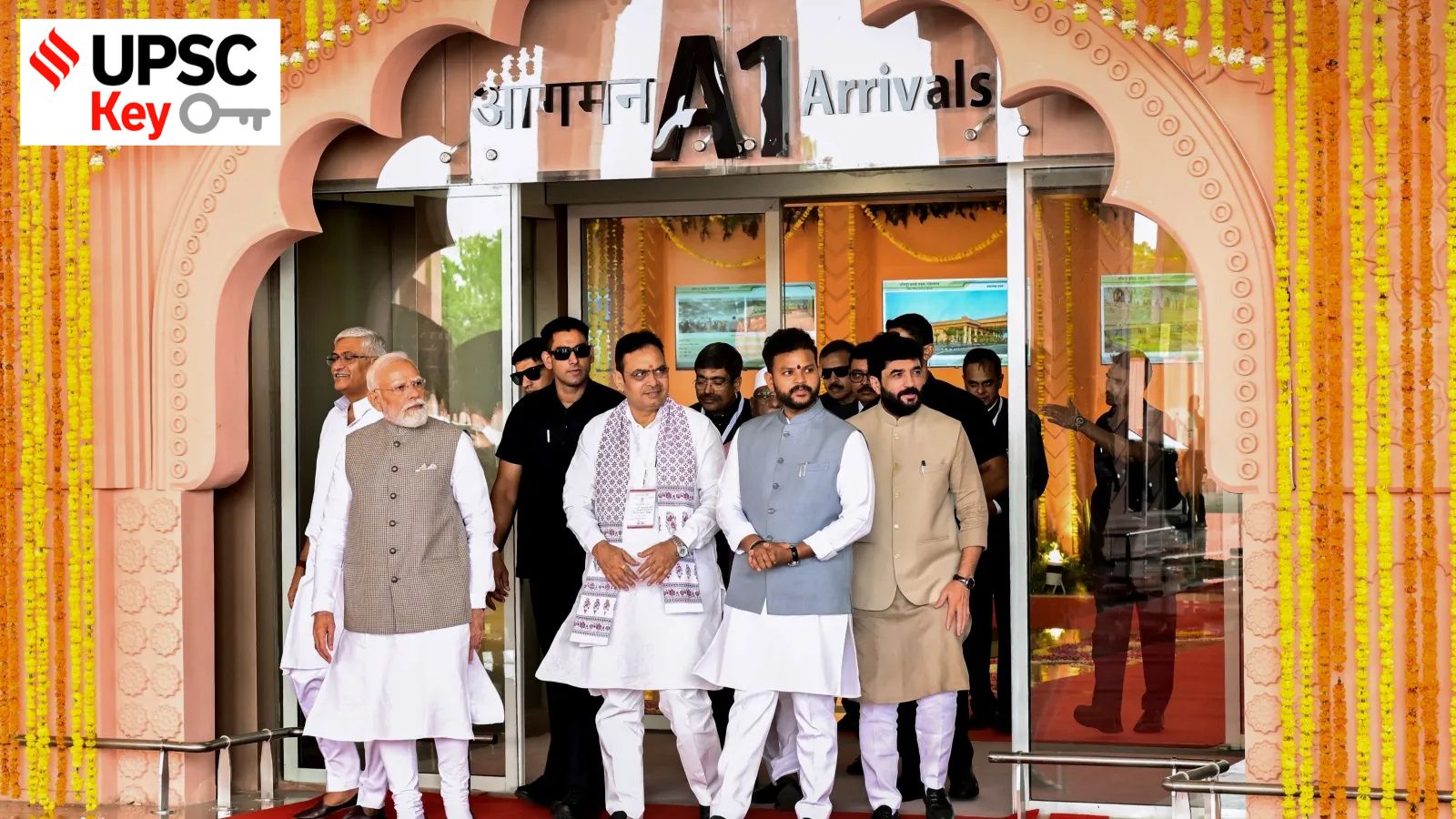
What’s the ongoing story: Prime Minister Narendra Modi launched the next phase of UDAN (Ude Desh ka Aam Nagrik) and inaugurated Jodhpur Airport’s New Terminal Building (NTB) in Jodhpur Saturday.
Key Points to Ponder:
— What is the UDAN scheme?
— What are the key features of the Modified UDAN Scheme?
— What has changed after the UDAN scheme?
— What is the significance of the civil aviation sector?
— What are the challenges faced by the aviation sector in India?
— How can India become a leading aviation hub?
— What are the various schemes of the government related to the aviation industry?
— Know about HAL Dhruv.
Key Takeaways:
— On the occasion, Union Minister of Civil Aviation Ram Mohan Naidu Kinjarapu said that the launch of the Modified UDAN Scheme “marks the beginning of a new chapter in India’s aviation journey”.
— Launched in October 2016, the UDAN Scheme has operationalised 669 routes and 95 airports, heliports and water aerodromes, covering over 1.66 crore passengers. This March, the Union Cabinet had approved the Modified UDAN Scheme with an outlay of approximately Rs 29,000 crore over the next ten years to accelerate aviation-led development.
— The Modified UDAN Scheme focuses on expanding regional aviation infrastructure through the development of 100 aerodromes from existing unserved airstrips with an investment of Rs 12,159 crore.
— It also provides Rs 2,577 crore towards Operations and Maintenance support for regional airports, development of 200 modern helipads with an investment of Rs 3,661 crore, and continued Viability Gap Funding of Rs 10,043 crore to sustain regional airline operations.
— The scheme also promotes the induction of indigenous aircraft and helicopters, including HAL Dhruv and Dornier platforms, for operations in underserved and remote regions.
— Modi also inaugurated the New Terminal Building at Jodhpur Airport developed by the Airports Authority of India at a cost of Rs 480 crore. Spread across 23,342 square metres, the terminal is designed to handle 1,500 passengers during peak hours and 20 lakh passengers annually.
Do You Know:
— India is the world’s third-largest market in the aviation sector. UDAN is an initiative by the government to connect the country’s under-served and unserved airports. While under-served airports are those which do not have more than a flight a day, unserved airports are those where there are no operations. The objective of UDAN scheme is to connect small and medium cities with big cities through air service.
Other Important Articles Covering the same topic:
📍What is UDAN?
📍What makes long-haul, low-cost air travel a tough nut to crack?
UPSC Prelims Practice Question Covering similar theme:
(1) Consider the following statements with reference to the UDAN scheme:
1. It was launched in October 2016.
2. Its objective is to connect small and medium cities with big cities through air service.
Which of the statements given above is/are correct?
(a) 1 only
(b) 2 only
(c) Both 1 and 2
(d) Neither 1 nor 2
Previous year UPSC Mains Question Covering similar theme:
Examine the development of Airports in India through joint ventures under Public–Private Partnership (PPP) model. What are the challenges faced by the authorities in this regard? (UPSC CSE 2017)
FRONT
Hafiz Saeed and aides among 23 added to terror list under UAPA, total count 80
Syllabus:
Preliminary Examination: Indian Polity and Governance – Constitution, Political System, Panchayati Raj, Public Policy, Rights Issues.
Mains Examination: General Studies-II, III: Government policies and interventions, Role of external state and non-state actors in creating challenges to internal security.
What’s the ongoing story: The Centre Saturday designated as terrorists 23 operatives of Pakistan-based terror organisations including Jaish-e-Mohammed (JeM) and Lashkar-e-Taiba (LeT), citing their involvement in terror recruitment, infiltration, training, supply of arms through drones, and planning of attacks in Jammu and Kashmir.
Key Points to Ponder:
— What are the key features of the Unlawful Activities (Prevention) Act (UAPA), 1967?
— What amendments were introduced in UAPA by the Centre in 2019?
— What is the objective of the UAPA?
— What are the conditions of bail under the UAPA?
— What is the significance of designating an individual as a terrorist under the UAPA? How does it strengthen India’s counter-terrorism framework?
— What are the challenges posed by cross-border terrorism to India’s internal security?
— What steps have been taken by the government to counter terrorism?
— India’s counter-terrorism doctrine—Know its evolution.
— What are the key pillars of India’s counter-terror policy?
Key Takeaways:
— This raises the total count of designated terrorists to 80. Following the amendment to the Unlawful Activities (Prevention) Act, 1967 (UAPA) by the Centre in 2019, 57 individuals had been designated as terrorists in 2024 under Section 35 of the Act and listed in its Fourth Schedule.
— Among the 23 are the son-in-law of LeT founder Hafiz Muhammad Saeed and his close associates, three involved in the 2016 terror attack on an Army camp in Nagrota, and two involved in the 2018 terror attack on the Sunjwan Military Station.
— According to the MHA, formally designating these individuals as terrorists will not only help dismantle the terror ecosystem by curbing their financial networks, movements, recruitment capabilities, and terror-linked activities, but will also send a strong message of deterrence against anti-national and terrorist acts.
— It will also enhance the capacity of security and law enforcement agencies to initiate coordinated legal, investigative, and preventive actions at both national and international levels.
— The listing of these terrorists comes at a time when multiple security and investigation agencies continue to track cross-border terror networks using drones, encrypted communication platforms, and online recruitment channels to sustain terror activities in Jammu and Kashmir.
Do You Know:
— Section 15 of the UAPA defines “terrorist act” and is punishable with imprisonment for a term of at least five years to life. In case the terrorist act results in death, the punishment is death or imprisonment for life.This is an offence that describes violent acts that are serious in nature.
— The provision reads: “Whoever does any act with intent to threaten or likely to threaten the unity, integrity, security, [economic security], or sovereignty of India or with intent to strike terror or likely to strike terror in the people or any section of the people in India or in any foreign country,…”
— The provision describes the use of “bombs, dynamite or other explosive substances; causing death or loss/ damage/ destruction of property; disruption of any supplies or services essential to the life of the community in India; damage to the monetary stability of India by way of production or smuggling or circulation of high quality counterfeit Indian paper currency, coin or of any other material” as terrorist acts.
— The Centre recently unveiled India’s first counter-terrorism policy, ‘Prahaar’, a comprehensive framework built on zero tolerance, intelligence-led prevention and coordinated response to extremist violence. The policy seeks to deny terrorists, their financiers and supporters access to funds, weapons and safe havens – both within the country and abroad.
Other Important Articles Covering the same topic:
📍From Bengaluru techie to Hafiz Saeed’s son-in-law: The 23 operatives designated as terrorists by Centre
Previous year UPSC Mains Question Covering similar theme:
Indian Government has recently strengthened the anti-terrorism laws by amending the unlawful Activities (Prevention) Act (UAPA), 1967 and the NIA act. Analyze the changes in the context of prevailing security environment while discussing the scope and reasons for opposing the UAPA by human rights organizations. (UPSC CSE 2019).
Biggest cities offer better salaries, more regular jobs for women, but stark gender disparity in income favours men
Syllabus:
Preliminary Examination: Economic and Social Development-Sustainable Development, Poverty, Inclusion, Demographics, Social Sector Initiatives, etc.
Mains Examination: General Studies-I, III: Social empowerment, Inclusive growth and issues arising from it.
What’s the ongoing story: India’s biggest cities seem to offer better opportunities for women to get salaried or regular jobs than urban India as a whole.
Key Points to Ponder:
— What is the labour force participation rate (LFPR)?
— What is the Worker Population Ratio (WPR)?
—What is the female LFPR in India?
— What are the key highlights of the latest Periodic Labour Force Survey (PLFS) 2025?
— What are the factors contributing to lower female labour force participation rate in India?
— What are the factors responsible for gender wage disparities in labour markets?
— How does the lower female labour force participation rate impact the economy?
— What policy interventions could most effectively improve women’s participation in the workforce?
Key Takeaways:
— According to the latest report on ‘Labour Market Dynamics in Million-plus Cities’ published by the National Statistics Office, women participation in such stable jobs is stronger in cities with one million-plus population compared with urban India as a whole.
— Women also surpass men in such jobs by a notable margin, i.e., 65.1% of all employed women in million plus cities have a regular or salaried job compared with 56.4% all employed men. Gender disparities in income, however, prevail in big cities as much or more than they do in urban India.
— The report shows that women participation in regular or salaried jobs at 65.1% is also much stronger in 46 cities which have more than a million people as per Census 2011 compared with 50.9% in urban India.
— While this is true, it is also a fact that women’s worker population ratio (WPR) continues to languish. While men’s WPR in million-plus cities is 72.6%, that for women is 25.5%. This is not very different from that of urban India, as a whole (73% for men, and 25.9% for women). WPR is the percentage of persons employed among the persons in the population.
— In terms of income in regular jobs, while both men and women earn at least 10% more in million-plus cities compared with urban India, the income gap widens in the million-plus cities. — Across urban India, men in regular salaried jobs earn an average Rs 27,984 a month against Rs 21,664 for women, a gap of Rs 6,320. In the country’s 46 largest cities, the gap widens to Rs 7,000, with men earning an average Rs 30,707 a month compared to Rs 23,707 for women. Women salaries as a percentage of men’s salaries is 77.2% both in million-plus cities and in urban India.
— In a handful of cities, though, women have achieved near pay parity with men in regular salaried jobs. Prayagraj tops the list, where women earn 131.2% of male salaries (Rs 42,254 against Rs 32,214), followed by Srinagar at 124% (Rs 33,869 vs Rs 27,323), Lucknow at 117.1% (Rs 31,744 vs Rs 27,098), Patna at 111.1% (Rs 31,013 vs Rs 27,902), Meerut at 105.9% (Rs 20,057 vs Rs 18,946) and Varanasi at 102.4% (Rs 20,821 vs Rs 20,331).
— The findings are part of the National Statistics Office’s latest Periodic Labour Force Survey (PLFS) 2025, which for the first time presents labour market estimates for the 46 million-plus cities in India.
— The survey points to a persistent gender divide in workforce participation. Across urban India, 65 per cent of women aged 30-59 are classified as NEET (Not in Employment, Education or Training), compared with just 4.4 per cent of men. In the country’s million-plus cities, the figure rises to 67 per cent for women, while remaining almost unchanged at 4.3 per cent for men.
— For nearly seven in ten women outside the workforce in million-plus cities, childcare and household responsibilities are the primary reason for not seeking employment. Among men, continuing education and health-related issues account for the overwhelming majority of those outside the labour force. Overall, the female labour force participation rate stands at 27.7 per cent across urban India and falls further to 25.5 per cent in the country’s 46 million-plus cities.
Do You Know:
— Labour force participation rate refers to the part of the population that supplies or offers to supply labour for pursuing economic activities for the production of goods and services and therefore, includes both ‘employed’ and ‘unemployed’ persons.
Other Important Articles Covering the same topic:
📍How gender remains a primary barrier to women’s workforce participation
NATION
Draft emission cut targets issued for iron, steel sector
Syllabus:
Preliminary Examination: Current events of national importance and Environment.
Mains Examination: General Studies-II, III: Government policies and interventions, Conservation, environmental pollution and degradation, environmental impact assessment.
What’s the ongoing story: The Centre has once again issued a draft notification to set greenhouse gas emission intensity (GEI) targets for the intensive iron and steel sector and to align them under India’s carbon credit trading system (CCTS).
Key Points to Ponder:
— What is Greenhouse Gas Emission Intensity?
— What is the emissions intensity in India?
— India’s previous nationally-determined contributions (NDC) target and present upgraded NDC target-what has changed?
— Read about India’s carbon credit trading system and its significance.
— How does a carbon market-based mechanism incentivise industrial decarbonisation?
— Why are some sectors such as iron and steel considered difficult to decarbonise?
— What kind of challenges faced by India in the actual clean energy transition?
Key Takeaways:
— The Ministry of Environment, Forest and Climate Change (MoEFCC) issued the draft on June 26 and made it public on July 2. It has set emission reduction targets for 255 industrial units, including the sector’s giants such as JSW Steel, Tata, SAIL (Steel Authority of India), and ArcelorMittal Nippon Steel, among others.
— Draft targets for the iron and steel sector were already issued on June 23, 2025, along with aluminium (second aluminium), petroleum refinery, petrochemical and textile sectors. While final targets for other sectors were notified in January 2026, the Environment Ministry has issued a revised draft for the iron and steel sector with marginal changes to the targets, but without any explanation for the fresh draft.
— The draft notification lists 2023-24 as the year for baseline product output and baseline emission intensity, and 2026-27 as the compliance-year target for individual steel plants, sponge iron units and ferro-alloy manufacturers. A 60-day window has been given to submit objections and suggestions on the draft.
— The draft defined targets in terms of tonnes of carbon dioxide equivalent (tCO2e), which is used to measure the impact of all greenhouse gases and not just CO2, based on their warming potential. The draft has set GEI targets only for 2026-27, while the 2025-26 column has been left blank.
— GEI is the amount of greenhouse gases (GHG) emitted per unit of product output, such as the quantum of gases released while producing cement. The CCTS was launched in 2023 to create a framework that incentivises emission reduction through a market-based mechanism and to help achieve India’s climate action goals.
— The Centre has already finalised emission reduction targets for eight sectors – aluminium, cement, chlor-alkali, pulp and paper, secondary aluminium, petroleum refinery, petrochemical and textile.
— The CCTS, which was notified in 2023, created an overarching framework for the Indian carbon market. The objective was to slash or avoid GHG emissions from sectors whose processes emit more pollutants and whose operations are hard to decarbonise.
— Each obligated industry is assigned a GEI target based on emissions per unit of output. Those industries that meet or outperform their target earn carbon credit certificates, which can be sold to industries that are falling short. Industries that do not comply must pay environmental compensation, which is equal to twice the average carbon credit traded price.
Do You Know:
— On March 25, India revealed its climate targets for 2035, promising to make further progress in cutting the carbon intensity of its economy, expanding the deployment of renewable energy, and creating carbon sinks through forests and trees.
— India said it would ensure that at least 60% of its electricity installed capacity in 2035 was based on non-fossil fuel sources, up from the 50% target it had set for 2030.
— It has promised to attain at least a 47% reduction in emissions intensity, or emissions per unit of GDP, on 2005 levels, which is two percentage points more than its current target of 45% for 2030.
— It has also promised to create a carbon sink that is at least 3.5 to 4 billion tonnes of CO2-equivalent larger than what existed in 2005.
— Each of the new targets marks a progression over existing commitments for 2030, a mandatory requirement under the 2015 Paris Agreement.
— Notably, under Paris Agreement 2025, every country is obligated to decide upon, and implement, a set of climate actions that help the global fight against climate change. These are referred to as nationally-determined contributions, or NDCs.
Other Important Articles Covering the same topic:
📍India targets 47% emission intensity cut, 60% electricity capacity from non-fossils by 2035
📍India’s new climate targets are modest but significant
Previous year UPSC Prelims Questions Covering similar theme:
(2) The term ‘Intended Nationally Determined Contributions’ is sometimes seen in the news in the context of (UPSC CSE, 2016)
(a) pledges made by the European countries to rehabilitate refugees from the war-affected Middle East
(b) plan of action outlined by the countries of the world to combat climate change
(c) capital contributed by the member countries in the establishment of Asian Infrastructure Investment
(d) Bank plan of action outlined by the countries of the world regarding Sustainable Development Goals
(3) Consider the following statements: (UPSC CSE, 2023)
Statement-I: Carbon markets are likely to be one of the most widespread tools in the fight
against climate change.
Statement-II: Carbon markets transfer resources from the private sector to the State.
Which one of the following is correct in respect of the above statements?
(a) Both Statement-I and Statement-II are correct and Statement-II is the correct explanation for Statement-I
(b) Both Statement-I and Statement-II are correct and Statement-II is not the correct explanation for Statement-I
(c) Statement-I is correct but Statement-II is incorrect
(d) Statement-I is incorrect but Statement-II is correct
ECONOMY
Amid slowing CASA growth, banks turn to costly solutions
Syllabus:
Preliminary Examination: Current events of national importance and economic development.
Mains Examination: General Studies-III: Indian Economy and issues relating to planning, mobilization of resources, growth, development.
What’s the ongoing story: Credit growth has picked up over the past few months, but banks have struggled to grow their deposit base to match it.
Key Points to Ponder:
— What are Current Account and Savings Account (CASA) deposits?
— What are the factors behind the low CASA deposits in recent years in India?
— What is the credit-to-deposit ratio?
— What do you understand by asset-liability mismatch?
— Why is slowing deposit mobilisation a matter of concern?
— What are mutual funds? What are the risks associated with it?
— Know about the term deposits and Certificates of Deposit (CDs).
— What efforts have been taken to tackle the challenge of slow deposit mobilisation?
— What are the issues and challenges faced by the Indian Banking Sector?
— Read about the Reserve Bank of India and its functions.
Key Takeaways:
— Growth in current account and savings account (CASA) deposits has particularly slowed, with retail investors now having a range of avenues to put their savings in, such as stocks and mutual funds. These avenues provide much better returns than traditional CASA accounts and have become more accessible over time due to digitisation and regulatory bodies’ simplification of norms.
— CASA deposits are low-cost for banks and are used to fund loans, the major source of revenue. They are considered a reliable and “sticky” source of funds for banks due to low churn, as such depositors aren’t likely to shift this money to other banks easily.
— Due to this mismatch in growth, the gap between credit and deposit growth has widened from 1.8 percentage points in December to 5.4 percentage points as of June 15, according to data from the RBI.
— This has led to the credit-to-deposit ratio of banks — which is the percentage of a bank’s deposits deployed as loans — widening to 82.5% as of June 15 from around 75% in mid-2025. The slowdown was also noted in the Reserve Bank of India’s Financial Stability Report released last week.
— As CASA deposits have slowed, banks have shifted to other sources of funds such as term deposits and CDs.
— Term deposits refer to financial instruments where one locks in their money for a particular tenure to earn interest in return. This includes retail options such as fixed and recurring deposits. — A CD is a type of term deposit used by corporates and institutions to raise money through the money markets.
— CASA deposits have always been a reliable funding source for banks due to their low cost (around 3-4% interest rate) and “stickiness”. Term deposits and CDs, on the other hand, are much higher-cost (7-8% interest rate) options that ultimately squeeze the margins of banks.
— Thus, while banks have found shorter-term funding solutions as CASA growth has dried up, the over-reliance on such temporary fixes is a double-edged sword.
— While it helps manage liquidity and fund the booming credit growth for now, a hike in interest rates by the RBI or an external crisis may hit the sector hard if CASA growth is not rejuvenated.
Other Important Articles Covering the same topic:
📍As gap widens between credit and deposit growth, banks turn to a costly solution
📍Why the gap between bank credit and deposits is worrying
Previous year UPSC Prelims/Mains Question Covering similar theme:
(4) Consider the following statements:
Statement 1: The banking sector has been struggling with slower growth in deposits compared to credit.
Statement 2: As the gap increases between deposits and credit, it creates an asset-liability mismatch for lenders.
Which one of the following is correct in respect of the above statements?
(a) Both Statement 1 and Statement 2 are correct and Statement 2 is the correct explanation for Statement 1.
(b) Both Statement 1 and Statement 2 are correct and Statement 2 is not the correct explanation for Statement 1.
(c) Statement 1 is correct but Statement 2 is incorrect.
(d) Statement 1 is incorrect but Statement 2 is correct.
India-Israel bilateral investment agreement comes into effect
Syllabus:
Preliminary Examination: Current events of national and international importance.
Mains Examination: General Studies-II: Bilateral, regional and global groupings and agreements involving India and/or affecting India’s interests.
What’s the ongoing story: The India-Israel Bilateral Investment Agreement (BIA), which will ensure a secure and predictable investment climate between the two countries, came into force from Saturday, the finance ministry said. The pact, which will provide protection to the two-way investments, is expected to contribute to increased cross-border investment activity.
Key Points to Ponder:
— How has the India-Israel relationship evolved?
— What are the areas of cooperation between both nations?
— What are the key highlights of the India-Israel Bilateral Investment Agreement?
— What is the significance of bilateral investment treaties?
— What are the major defense cooperation agreements between India and Israel?
— What is India’s stand on the Israel-Palestine issue?
— What is the significance of peace in the West Asia region from India’s perspective?
Key Takeaways:
— The two countries inked the treaty on September 8 last year. Under the pact, India has cut down the local remedies exhaustion period for Israeli investors to three years.
— Local remedies for exhaustion mean that investors must first try to resolve their disputes using the legal system of the host country before they can take the matter to international arbitration. Normally, India keeps a five-year period for this.
— The India-Israel BIA also includes portfolio investments, a deviation from such treaties in the past. Israel is the first OECD (Organization for Economic Cooperation and Development) member with which India has inked this agreement.
— The agreement is expected to pave the way for increased bilateral investments between the two countries. Between April 2000 and March 2026, India received $371.35 million in foreign direct investment (FDI) from Israel.
— The implementation of the pact is important, as both countries are also negotiating a free trade pact. The negotiations for the trade pact are going slow due to the West Asia crisis.
— India is also negotiating bilateral investment treaties with other countries, including Saudi Arabia, Qatar, Oman, Switzerland, Russia, Australia, and the European Union. These investment treaties help in protecting and promoting investments in each other’s countries.
— The government had earlier announced revamping the current model of BITs to make it more investor-friendly and attract foreign players.
Do You Know:
— India established diplomatic relations with Israel in 1992. Since then, trade between the two countries has been rising significantly.
— Shubhajit Roy writes- “India has a very deep strategic relationship with Israel, especially in the context of defence and security partnership. In the last decade or so, it has grown and has been made public — unlike in the past.”
Other Important Articles Covering the same topic:
📍Israel and India sign bilateral investment pact
📍17 pacts signed as Modi, Netanyahu hold talks; tech key to partnership
📍India and Israel, trusted partners in times of need
Previous year UPSC Prelims Question Covering similar theme:
(5) The term “two-state solution” is sometimes mentioned in the news in the context of the affairs of (UPSC CSE 2018)
(a) China
(b) Israel
(c) Iraq
(d) Yemen
Previous year UPSC Mains Question Covering similar theme:
“India’s relations with Israel have, of late, acquired a depth and diversity, which cannot be rolled back.” Discuss (UPSC CSE 2018)
ALSO IN NEWS
• Integrated Parachute tests for Gaganyaan a success: ISRO
— The Indian Space Research Organisation (ISRO) Friday successfully conducted Integrated Parachute tests required to validate deceleration systems, which will be used in the Gaganyaan’s Crew Module splashdown at sea. Crew Module is a special, pressurised space vehicle which houses the astronauts during take-off, space flights and splashdowns.
— ISRO Saturday said it was developing a solid motor based Sub-Orbital Launch Vehicle for Experiments (SOLVE). This is a special test rocket that can perform numerous experiments under various test conditions. During such tests, the Crew Module is separated from the vehicle at an altitude of 10 to 17 km.
• Pirated movies, OTT content: Govt notice to Telegram, seeks report in 15 days
— The Ministry of Information and Broadcasting on Saturday issued a notice to Telegram over the alleged widespread dissemination of pirated films, OTT content, and other audio-visual material through its platform, while directing the messaging app to take corrective action and submit an action-taken report within 15 days.
— The Ministry has directed Telegram to act against repeat infringers, including channels, groups, bots, accounts, administrators, and associated entities, while seeking details of its grievance redressal mechanism for producers, OTT platforms, and law-enforcement agencies.
— Reminding Telegram that, as an intermediary, it is required to observe due diligence under the Information Technology Act and the Information Technology Rules, the I&B Ministry has stated that Telegram should not be waiting for the government to identify each piracy channel and also emphasised that a purely reactive, channel-by-channel takedown approach may not be sufficient to demonstrate due diligence as required under the IT Act, 2000, and the IT Rules, 2021.
— The I&B Ministry had underlined that copyright infringement is not just a civil violation but a criminal offence in India under the Copyright Act, 1957, and the Cinematograph Act, 1952, and the continued availability of pirated content, evasive compliance, or an incomplete response may invite further examination and action under the legal framework.
• AI-hallucinated judgments: Why Supreme Court set aside a tribunal order
— Six AI-hallucinated judgments formed the basis for the Supreme Court’s striking down of an order passed by the National Company Law Tribunal (NCLT) on Thursday.
— Three of the cited judgments did not exist, while the remaining three either did not contain the propositions attributed to them or did not correspond to the context for which they were cited.
— The bench of Justices P S Narasimha and Alok Aradhe observed on July 2 that while the use of AI judgments could be “gratifying, even inspiring,” AI may eventually “infiltrate our intellectual work ethic and before long, render us dependent on its vast capabilities.”
• How UP got control over Kashi Vishwanath 44 years ago
— Shyamlal Yadav writes- “In Uttar Pradesh, revelations of alleged embezzlement in the Ram Mandir in Ayodhya have once again highlighted the vulnerabilities in the management of temples. It echoes a case of theft from nearly 44 years ago at the Kashi Vishwanath Temple in Varanasi. The theft in January 1983 not only exposed deep-rooted mismanagement but also became a turning point, prompting a change in the management of the temple and setting a historic precedent.
— On the intervening night of January 4 and 5, 1983, the golden Argha — the base encircling the Shivlinga, weighing approximately 2.6 kilograms of gold — was stolen from the Kashi Vishwanath Temple. The incident, in the heart of Varanasi, sparked immediate outrage, leaving the government at the Centre and the state feeling uneasy.
— The fallout extended far beyond criminal proceedings. Public criticism mounted quickly against the mahant-led management system that had been in place for centuries. Facing growing pressure, the state government acted decisively. On January 28, 1983, an ordinance was promulgated, transferring management of the temple to a government-constituted trust.
— Later, on September 7, 1983, Social Welfare Minister Gulab Sehra introduced a bill in the UP Assembly to replace the ordinance. The bill passed swiftly and received assent from the President on October 12, 1983, becoming the Uttar Pradesh Sri Kashi Vishwanath Temple Act, 1983, which became effective retroactively from January 28. The Act established a board of trustees, comprising prominent religious figures and senior government officials, along with an executive committee for day-to-day operations.
ANSWER KEY
1. (c) 2. (b) 3. (b) 4. (a) 5. (b)
Subscribe to our UPSC newsletter. Stay updated with the latest UPSC articles by joining our Telegram channel – Indian Express UPSC Hub, and follow us on Instagram and X.
🚨 Click Here to read the UPSC Essentials magazine for June 2026. Share your views and suggestions in the comment box or at [email protected]🚨
View original source — Indian Express ↗
Related stories

Nepali Telecom
TechnologyJul 5, 2026 · 1 min
Government to implement investigation committee’s report on Ncell share purchase
Nepali Telecom

The Next Web
TechnologyJul 5, 2026 · 1 min
US control of frontier AI hangs over NATO’s Ankara summit
The Next Web

Indian Express
TechnologyJul 5, 2026 · 1 min
UPSC Essentials daily subject quiz : International Relations MCQs (Week 169) — Check out answers with explanations
Indian Express

The Next Web
TechnologyJul 5, 2026 · 1 min
Citi boss Jane Fraser says 2 AI races will decide banking’s future
The Next Web