Indian Express
Cape Verde: How a tiny African nation scripted 2026 World Cup’s underdog story
“Size defines nothing in football.” Argentina’s talisman and arguably the greatest footballer on the planet, Lionel Messi, would probably agree with this pithy assessment by Pedro “Bubista” Brito, the head coach of what has become the 2026 FIFA World Cup’s most celebrated underdog story.
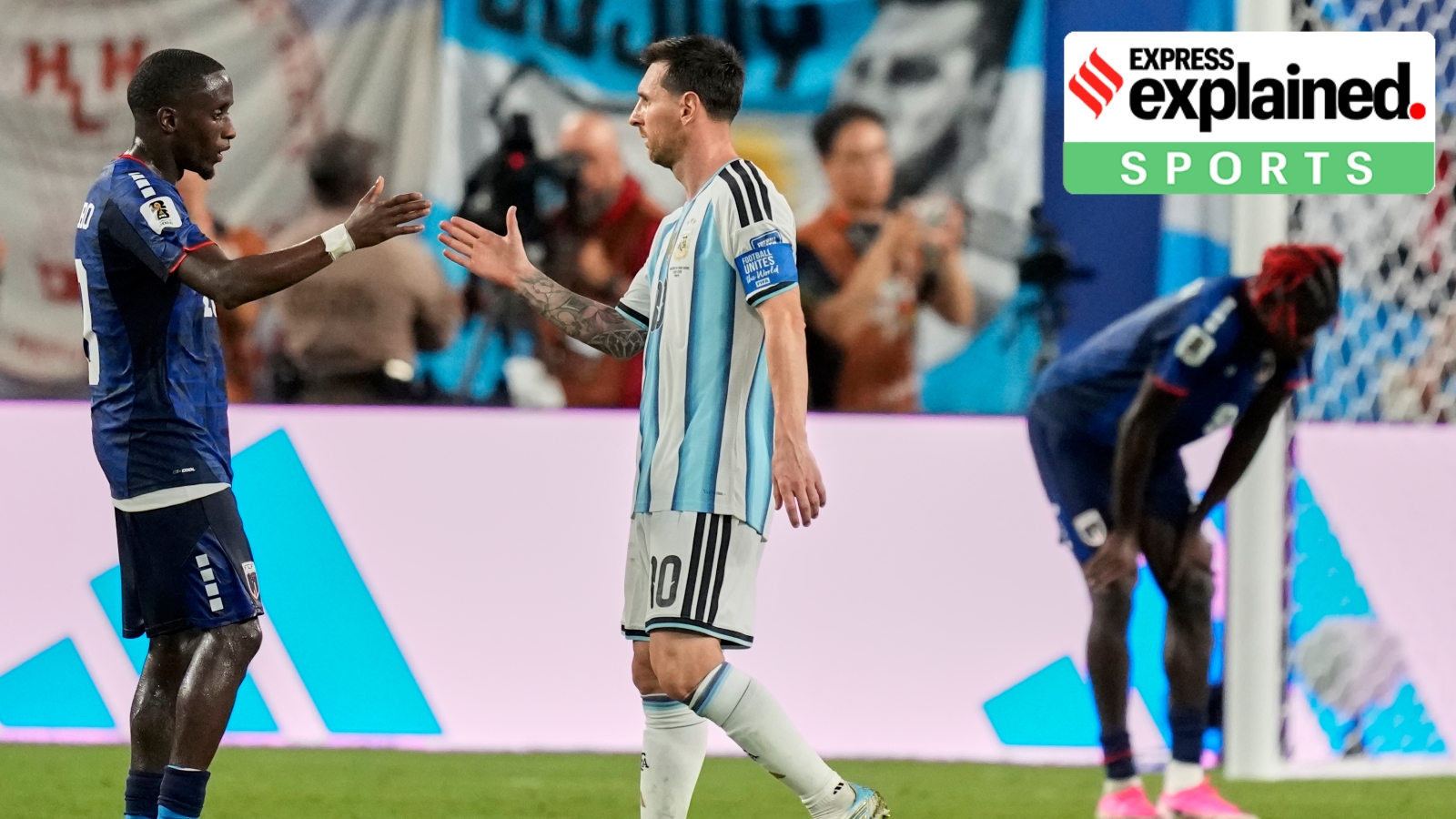
When Cape Verde managed to hold Argentina to a 1-1 scoreline at the end of 90 minutes in their Round of 32 knockout match late Friday, there were some who might have believed that the phrase “third time’s the charm” would work for the tiny African island nation, which had already denied victory to two former world champions — Spain and Uruguay — in the group stage.
This belief would be reinforced after Cape Verde’s left-back Sidny Lopes Cabral scored a goal-of-the-tournament contender to make it 2-all in the 103rd minute, after Lisandro Martinez had nudged the defending champions ahead in the second minute of extra time. Alas, it was not to be: Argentine defender Cristian Romero rose above everyone else to head home a 111th-minute winner off the arm of Cape Verde centre-back Diney Borges, resuming normal service and breaking the hearts of many pining for an unlikely underdog tale.
But the result ensured that the Blue Sharks — the nickname Cape Verde’s football team goes by — had etched its place on the world football map.
Archipelago in the Atlantic
The Cape Verde Islands, officially called the Republic of Cabo Verde, is an archipelago of 10 islands — nine of them inhabited — and various islets located some 450 km off the west coast of Africa in the Atlantic Ocean.
Cape Verde, an archipelago of 10 islands and various islets some 450 km off the west African coast.
Like many African countries, Cape Verde too has had a tryst with colonisation: the islands were uninhabited until the Portuguese discovered it in 1456. Over the next few years, Portuguese settlers arrived and brought African slaves with them to work on plantations. By the 16th century, it became a hub for transatlantic slave trade.
This history meant that Cape Verdeans are of mixed African and European origin. It shows in the languages spoken there: while Portuguese is the official language, most local people also speak Crioulo, a Creole dialect based on archaic Portuguese but influenced by other languages.
Story continues below this ad
The rise of anti-colonialist nationalisms across Asia and Africa in the 20th century did not bypass the island nation. To suppress calls for independence, Portugal first changed Cape Verde’s colonial status to an overseas province in 1951. But that failed to quell growing unrest and on July 5, 1975, Cape Verde’s newly elected National Assembly received the instruments of independence from Portugal. After almost a decade-and-a-half of one-party rule, the country finally conducted its first multi-party general election in 1991.
Since then, Cape Verde has been a stable electoral democracy. The incumbent President, José Maria Neves, has been at the helm since 2021 — he previously served as Prime Minister from 2001 to 2016.
World Cup exploits
The Blue Sharks joined FIFA — the global footballing body — only in 1985. But that it managed to qualify for the World Cup with a stellar qualifying record (7 wins, 2 draws and 1 loss in 10 games) and their subsequent performance in the tournament itself seems to have vindicated FIFA’s decision to go in for an expanded 48-team format and enable smaller countries to shine on the global stage.
Cape Verde are only the third smallest nation (by population) in the history of the World Cup finals — after Iceland (which played in 2018) and fellow 2026 debutants Curacao. Although the team’s players mostly ply their trade in Europe’s lower leagues, the team derives strength from its compact organisation and tactical discipline.
Story continues below this ad
That was on display as they first held European giants and 2010 winner Spain to a 0-0 draw courtesy of their 40-year-old goalkeeper Vozhinha’s heroic exploits, followed by a tenacious 2-2 draw against two-time champions Uruguay. A third consecutive draw against Saudi Arabia in their final group stage, coupled with other results, meant that the Blue Sharks sailed through to the knockout stages unbeaten in their first-ever World Cup appearance.
That a country with a resident population of just over 500,000 has managed such a feat is down to history: unfavourable climate and few natural resources forced natives to emigrate abroad over the years, with over one million people of Cape Verdean ancestry presently living in the US, Europe, and even African countries such as Senegal.
As things turned out, this diaspora came to Cape Verde’s service: more than half (14) of the 26-member squad came from these communities, with those selected hailing from France, Portugal, the Netherlands, and Ireland.
Even as Cape Verde’s players slumped on the pitch after giving it their all for 120 minutes on Friday night, former Scotland international James McFadden’s verdict on BBC Radio summed it all: “Cape Verde have lost, but they’ve won. They have shown courage, togetherness, unity and unwavering belief in what they are and what they can do. The story of this tournament is Cape Verde. That is what you want to see in a football side.”
View original source — Indian Express ↗
Related stories
The Guardian
TechnologyJul 5, 2026 · 1 min
FBI seized more than 600 drones flying over World Cup games in US cities
The Guardian
Times of Israel
TechnologyJul 5, 2026 · 1 min
In first, government vows to disobey High Court ruling, setting up constitutional crisis
Times of Israel
Dawn
TechnologyJul 5, 2026 · 1 min
IT minister stresses proposed telecom bill needed as existing laws insufficient for 5G, other modern tech
Dawn

The Verge
TechnologyJul 5, 2026 · 1 min
Where to preorder Grand Theft Auto VI
The Verge