Times of Israel
IDF veteran who self-immolated begs Knesset: Prioritize combat soldiers, not Torah study
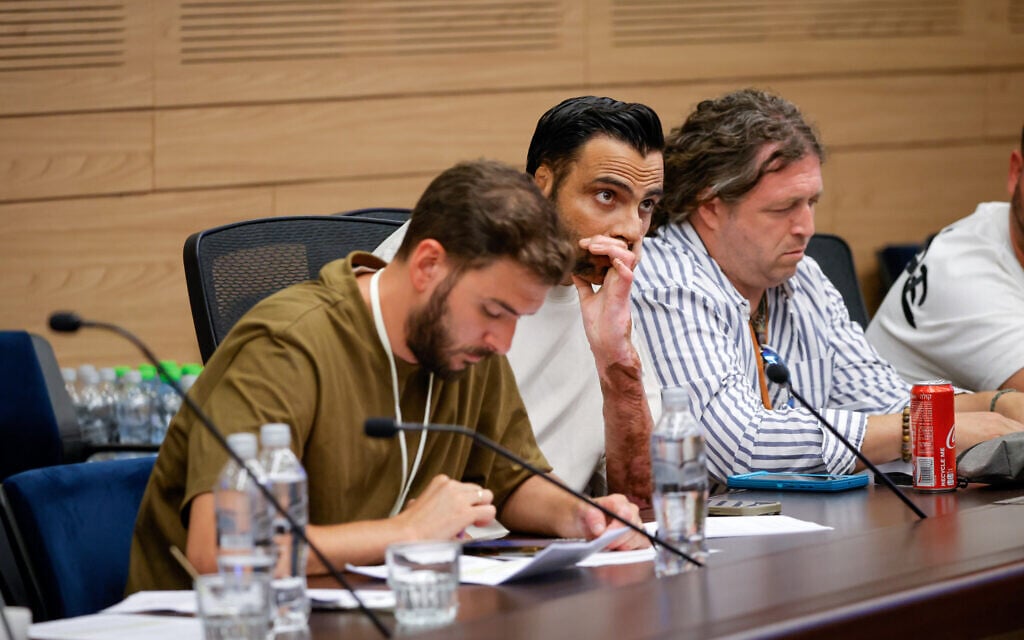
Itzik Saidyan, an IDF veteran who self-immolated outside the Defense Ministry’s Rehabilitation Department for wounded soldiers in 2021, told a Knesset committee on Sunday that the nation must give the highest priority to those who serve on the front lines.
His speech to the Knesset House Committee came as it debated the highly controversial proposed Basic Law declaring Torah study a foundational value of the State of Israel. The bill, which is intended to shield draft evaders from sanctions and prosecution, passed its first reading in the Knesset plenum last week, despite sharp objections from legal authorities.
“With all due respect to the value of Torah and military service, the correction that is most needed here is to give supreme value to those who went into battle, those who sacrificed their lives, who were willing to die,” Saidyan said in a passionate speech to the committee. “There are people who, in practice, are perhaps 10 percent [of the population] according to the data, who go into battle. They lost friends right before their eyes. They collected bodies. They sacrificed everything – everything – not in theory, in the line of fire.”
The combat veteran continued: “And you bring the Torah here, there’s no problem… but the first thing, the very first priority is the fighters, the ones who go into battle… those who were in the line of fire, who were injured… who lost part of their body and soul… who feel that the state has forgotten them,” Saidyan said. “They need to feel every day when they wake up in the morning that the state appreciates and recognizes them.”
Some 80,000 ultra-Orthodox men aged between 18 and 24 are currently believed to be eligible for military service, but have not enlisted. The proposed Basic Law would ensure that they do not face consequences for refusing to enlist, despite a persistent IDF manpower shortage.
Get The Times of Israel's Daily Edition
by email and never miss our top stories
By signing up, you agree to the terms
Absent a constitution, Basic Laws in Israel have the highest legal status in the country.
חובת צפייה – איציק סעידיאן זועק, לוחם גולני והלום קרב, זועק מדם ליבו בחוק יסוד לימוד תורה – ״התיקון היחיד שצריך לעשות זה לקבוע כערך עליון את מי שיצא לקרב, את שהקריב את החיים שלו והיה מוכן למות!״ pic.twitter.com/8ZArZwes5I
— דפנה ליאל (@DaphnaLiel) July 5, 2026
Saidyan’s 2021 self-immolation attracted national attention to the plight of IDF veterans traumatized by events that happened during their military service. At the time, Saidyan spoke about his years-long struggle to receive the care he sought for PTSD, which he said stemmed from his service in the military.
The Defense Ministry warned last week that the Rehabilitation Department could “collapse” under the weight of the growing number of casualties, urging the government to immediately implement the recommendations recently made by a public committee.
The ministry said approximately 26,200 wounded IDF soldiers and security personnel have sought treatment through its Rehabilitation Department since the war began on October 7, 2023, and that the total number of wounded from all of Israel’s wars under the department’s care is expected to surpass 90,000 in 2026, a more than 40% increase within three years.
The Finance Ministry also raised objections to the proposed Torah study Basic Law on Sunday, saying that it would have a serious impact on the Israeli economy.
According to Channel 13, the way the bill is worded means that the exact impact it will have on the state budget if it passes is not yet clear, but it nevertheless poses “tangible dangers” to the economy, and could result in taxes going up by as much as 16%.
Separately on Sunday, the Knesset Constitution, Law, and Justice Committee met to discuss a pair of controversial bills to curtail the power of the attorney general. The bills would split the attorney general’s role into two positions and make it significantly harder to indict senior officials, including the prime minister.
However, as the coalition is seeking to pass the legislation before the Knesset enters its summer recess later this month, committee chair Simcha Rothman is hoping to pass a revised version of the bill that would only weaken the attorney general’s powers without splitting the role into two.
Appearing before the committee on Sunday, Deputy Attorney General Gil Limon claimed that the revised version of the bill has proven once and for all that the government seeks to turn the attorney general position into a “private attorney for the government.”
“Throughout the debates, we argued that the bill is not intended to divide, but abolish, the institution of the attorney general,” Limon said. “The bill before us removes the mask. After this law passes, the attorney general will become a private attorney for the government, and they will not be able to fulfill the role as it exists today.”
If the bill passes, Limon warned, it will serve to “normalize systematic violations of the law.”
According to Limon, the bill in its current form will allow the government to simply ignore any rulings or legal opinions it disagrees with.
“The government will be the entity authorized to determine the law for itself,” he said, stressing that the impact of this would be far-reaching, from coalition finances to election laws and police independence.
“In all those cases in which there is concern for the basic principles of democracy, the voice of the attorney general will be silenced,” Limon warned.
The two items of legislation in question passed their first readings in the Knesset a month ago before being returned to the committee for further deliberation.
Even if the bills are not passed into law before parliament disbands, by approving them in a first reading, the coalition will be able to vote in the next Knesset to apply “continuity” to them if it wins the election, allowing lawmakers to resume legislative work without starting from scratch.
Currently, the attorney general serves as the government’s chief legal adviser, represents the government in legal proceedings, mostly in the High Court, and heads the prosecution service, with ultimate power to file criminal indictments against senior public officials, including cabinet ministers and the prime minister.
The original version of the legislation would divide those powers between an attorney general, who would remain responsible for legal advice to the government and state representation in court, and a prosecutor general, who would assume responsibility for criminal investigations and prosecutions. However, the bill would effectively remove all power from the slimmed-down attorney general position in the role of chief legal adviser to the government, including by making their rulings nonbinding.
With the clock ticking on the Knesset session and the post-election future of the current coalition unclear, Rothman is now seeking to section off portions of the legislation and attempt to pass them this week.
View original source — Times of Israel ↗
Related stories

TechRadar
TechnologyJul 5, 2026 · 1 min
NYT Strands hints and answers for Monday, July 6 (game #855)
TechRadar
ABC News
TechnologyJul 5, 2026 · 1 min
From Call of Duty to Dreamtime: These designers are lighting up video games
ABC News

TechRadar
TechnologyJul 5, 2026 · 1 min
NYT Connections hints and answers for Monday, July 6 (game #1121)
TechRadar

TechRadar
TechnologyJul 5, 2026 · 1 min
Quordle hints and answers for Monday, July 6 (game #1624)
TechRadar