CNA
At 22, she took charge of The Park Hotels. Decades later, she is still shaping its future
Priya Paul talks about her late father, Surrendra Paul, the way you’d hope a daughter might, decades on – warmly, easily. “He was great fun,” she said. “He was always very involved with us, despite all his busyness. He didn’t have ups and downs – he was quite balanced in the way he saw the world, through both good and bad times.” His motto was simple: Work hard, play hard. Don’t take yourself too seriously, he told his children, unless the situation really called for it. It’s a line Priya still lives by.
From the time she was about 10, she had wanted to join the family business – the century-old Apeejay Surrendra Group, then run by her father, the chairman, and his brother, Jit Paul, with interests spanning tea, shipping and hotels. It was a decision her parents never pushed her towards. “We were always encouraged to pursue our own paths,” Priya said, “whether that meant joining the family business or forging a different career.” She studied economics at Wellesley College, graduated in 1988, then returned home, eager to work alongside her father.
At the time, the family’s hotel business comprised three properties under The Park brand. Priya was 22 and already working as marketing manager of one of them, The Park New Delhi, when tragedy struck. In April 1990, while visiting tea estates in Upper Assam, Surrendra was killed in an attack blamed on militants.
In the difficult weeks that followed, her uncle asked her mother, Shirin Paul, to take on the chairmanship of the wider group. Her sister, Priti, who had just graduated, was asked to lead the shipping division. Priya, who already knew the hotels best, was given the entire hotel portfolio. “I simply had to step up and deal with the crisis, both personally and from a business point of view. There was a vacuum that had to be filled.”
By Priya’s own account, those first years were mostly about catching up fast. “At 22, I was not only learning how to work and build a business, but also learning an entirely new industry, as I had no background in hospitality,” she said. When her workload tripled to three properties, she leaned most on the people around her. “I knew I needed to surround myself with people who had deep hospitality expertise,” she said.
Over the following years, she found time for executive programmes at Harvard Business School and INSEAD, fitting them in around the work of actually running the hotels. She’s candid, too, about where the real resistance came from in those early years. “Being a woman was rarely the biggest challenge,” she said. “I faced more resistance because of my age. Many people questioned whether someone so young could make major decisions.”
Somewhere in those years, Priya arrived at “Leadership through Differentiation” – the idea that every Park hotel should look and feel like nothing else in the group. It’s a principle that now seems obvious, in an India that’s long since caught up to the design-led, boutique hotel. Priya still treats the idea as unfinished business – an “ongoing search for the right creative voice” in every city the brand enters, so no two Park hotels repeat themselves, even as all of them might feel recognisably hers.
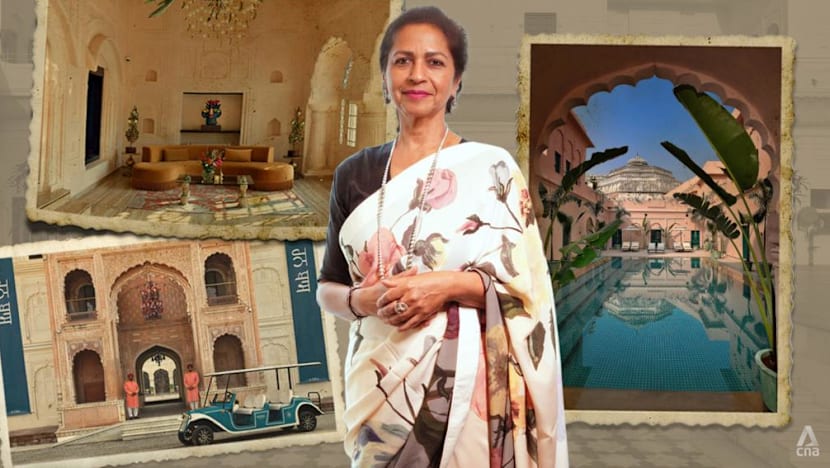
That search led, eventually, to Ran Baas, The Palace in Patiala, Punjab, which opened last year. The bid for the palace went in towards the end of one of the COVID-19 waves, when only a couple of people on her team had seen the building in person. “It was only when I visited much later that I realised the true scale of it, which was far greater than anything the drawings had suggested,” Priya said. What convinced her was a feeling, more than a plan. “There are some buildings where, despite the practical challenges, you can immediately sense the possibility. Ran Baas had that quality. It had scale, history, atmosphere and a certain emotional pull.”
She kept coming back to one question: How would the Maharajas of Patiala have approached this today? “In their time, they drew on the best influences from around the world, so we wanted to honour that same spirit – not by creating a museum, but by creating a living palace hotel.”
There’s another reason Punjab itself matters to her, beyond the building. The Apeejay Surrendra Group was founded in Jalandhar, a short drive from Patiala, in 1910 – yet the company had never built a hotel in the state until now. Ran Baas gave her “the opportunity to explore Punjab more deeply – its culture, history, identity and extraordinary sense of pride,” she said.
She brought in conservation architect Abha Narain Lambah, who had studied the site as a student and worked on its earlier government-led conservation. Priya also made a point of staffing the project with people who had a genuine claim to the place, down to the uniform designer and graphic design team. “The hotel has resonated strongly with people from Punjab and with the wider Punjabi diaspora, and it has become a source of real pride,” Priya said. “That has been one of the most rewarding aspects of the project.”
Ran Baas did not happen in isolation. Months earlier, the group had quietly opened The Lotus Palace Chettinad, a restored Chettinad mansion in Tamil Nadu – a different region, an entirely different architectural language, shaped by a merchant family’s travels across Europe and Asia. Priya curated the art collection herself.
Ran Baas and the Lotus Palace are one-of-a-kind projects, but like every hotel in the Park portfolio, each is built to outlast the person who made it. Which raises the obvious question: Who comes after Priya Paul?
Succession is the one subject she won’t get ahead of. The family still runs on a constitution drawn up in 2000, with each sibling holding a division and sitting on each other’s boards – Priya on the shipping board, her brother Karan on the hotel board. They still eat together often, much as her father once did with his uncles. The next generation, she said simply, is still in college. “It’s also entirely possible they will choose to build something of their own, as times have changed.”
It is the same instinct Priya relied on all those years ago – a trust once given to her, and one she now extends to them: Let people find their own way into the work. It is not so far, in the end, from her father’s old motto: Work hard, play hard. Don’t take yourself too seriously.
Source: CNA/bt
Related stories

The Punch
WorldJul 6, 2026 · 1 min
Court halts Lagos takeover of widow’s estate
The Punch
The Punch
WorldJul 6, 2026 · 1 min
Nigeria tops Africa again with 89 EU Erasmus scholarships
The Punch
The Punch
WorldJul 6, 2026 · 1 min
48 students feature in Ogun school poetry anthology
The Punch
The Punch
WorldJul 6, 2026 · 1 min
2027: Lanlehin, Adedoja lead Oyo APC reconciliation
The Punch