
Hacker Noon
An Offline-First Architecture for Distributed Systems Using CRDT Principles
Maintaining sequential consistency without compromising availability is the holy grail of distributed systems. Achieving this is easy in a setting with sub-millisecond fiber connections and zero packet drops. However, when your setting is an execution edge environment with days-long network outages, common architectural patterns like two-phase commit ($2\text{PC}$) or continuous Raft consensus election loop fall apart. In order to preserve data integrity over hundreds of distant client nodes without depending on a permanent cloud backbone, this paper presents the mathematical and practical demonstration of a lightweight, highly useful architecture. I. The Core Architectural Proof We must closely follow the CAP Theorem in order to create a data-gathering system that can withstand extended network blackouts. We must purposefully relax temporal consistency ($C$) in favor of eventual consistency since we cannot control network partitioning ($P$) and we refuse to give up availability ($A$) for field operations. \n \n Our system functions as a state machine modeled after a Conflict-Free Replicated Data Type (CRDT) in order to provide this safety without data loss or corruption. In particular, we construct a deterministic LWW-Element-Set (Last-Write-Wins) mutation rule in conjunction with a specific state-based grow-only set ($G\text{-Set}$). **The Convergence Formula in Mathematics: \ To ensure that the final state will always converge, regardless of the delivery order or network latency, the merging operation ($\sqcup$) must satisfy three basic algebraic conditions for any two data payloads arriving at the central ledger from separate edge tables ($A$ and $B$): 1. Commutativity: $A \sqcup B = B \sqcup A$ (The arrival order of network packets must not change the database outcome). Associativity: $(A \sqcup B) \sqcup C = A \sqcup (B \sqcup C)$ (Grouping of batch upload during synch does not affect state calculation). Idempotency: $A \sqcup A = A$ (Duplicate transmission caused by fluctuating network retries will never create duplicatedatabase=base rows). \ II. Distributed Database Schema & Ingestion To implement this design, every edge node runs an embedded relational database engine. Rather than relying on auto-incrementing integer IDs (which cause catastrophic collisions when generated independently on different offline tablets), every record is assigned a globally unique UUIDv4 along with a high-resolution, monotonic timestamp. The Local Storage Engine Configuration (Node.js) // distributed-ledger.js import sqlite3 from 'sqlite3'; import axios from 'axios'; import { v4 as uuidv4 } from'uuid'; const db = new sqlite3.Database('./distributed_edge.db'); // Initialize the local node with state-tracking structures db.serialize (() => { db.run(`CREATE TABLE IF NOT EXISTS transction_ledger ( uuid TEXT PRIMARY KEY, operator_id TEXT NOT NULL, payload_data TEXT NOT NULL, monotonic_timestamp INTEGER NOT NULL, synch_status INTEGER DEFAULT 0 ) `); }); /** * Atomic local write executin- Zero latency, complete cloud isolation */ Export function commitToEdge(opratorId, dataPayload) { const query = ` INSERT INTO transaction _ledger (uuid, operator_id, payload_data, monotonic_timestamp) VALUES (?, ?, ?, ?)`; const recordUuid = uuidv4(); const currentTimestamp = Date.now(); // Epoch millisecond precision db.run (query, [recordUuid, operatorId, JSON.stringify (dataPayload), curentTimestamp], (err) => { if (err) { console.error (`❌ Local Ingestion Crash: ${err.message}`); } else { console.log(`✅ State mutated loally. UUID Locked: ${recordUuid}`); } }); } \ III. The Synchronization Proof: Deterministic UPSERT When a connection to the network backbone is recovered, the edge node flushes its queue. The central cloud receiver does not process these as standard HTTP POST inserts. Instead, it processes them through an atomic UPSERT database transaction engine. By comparing the incoming monotonic_timestamp against the existing record, the central state machine resolves conflicts deterministically without requiring human intervention or locks. The Background Pipeline & Sync Worker: \ /Scans local ledger for unpushedmutations and executessafe CRDT convergence/ export asynch functon synchronizeEdgeState() { db.all(`SELECT * FROM transaction_ledger WHERE sync_status = 0 ORDER BY monotonic_timestamp ASC`, asynch (err, rows) => { if (err || rows.length === 0) return; coonsle.log(`📡 outbondPipeline opened. Synchonizing ${rows.length } payloads...`); for (const row of rows) { try const response = await axios.post('https://api.techappplied.com/v1/ledger-converge', { uuid: row.uuid, operator: row.operator_id, payload: JSON.parse(row.payload_data), timestamp: row.monotic_timestamp }, {timeout: 4000 if (response.sattus === 200) { // Update local status to remove from outbond pipleine db.run(`UPDATE transaction _ledger SET synch_ststus = 1 WHERE uuid = ?`, [row.uuid]); console.log(`🔁 Node state synchronizedsucessfully: ${row.uuid}`); } } catch (error) { console.warn(`📡 Connection interrupted.Saving queue state at timestamp: ${row.monotic_timestamp}`); break; // Stop transmission to preserve CPU and battery life } }}); } \ IV. 🗄️ The Central Cloud Target Core SQL Logic On the central cloud environment (PostgreSQL), the incoming packet is merged via a high-performance conditional lockless script: INSERT INTO central_enterprise_ledger (uuid, operator_id, payload_data, last_mutataon_timestamp) VALUES ('incoming-uuid', 'oprator-01', '{"metrics ": 42}', 1719400000000) ON CONFLICT (uuid) DO UPDATE SET payload_data = EXCLUDED.payload_data, last_mutation_timestamp = EXCLUDED.last_mutaation_timestamp WHERE EXCLUDED.last_mutataion_timestamp > central_enterprise_ledger.last_mutation_tinmestamp; Proof of Convergence: The WHERE clause evaluates to false, deleting the stale update and preventing data regression, if a lagging network packet from three hours ago arrives after a more recent packet has already been integrated.4. Cross-Platform Runtime Design (Android Edge/Python) \n \n We use an optimized Python script that encapsulates our state machine into a thread-safe UI component using the Kivy framework, avoiding significant system resource overhead, to demonstrate the usefulness of our design on lightweight mobile nodes. \n \n Python edge_app.py import sqlite3 import requests import uuid import time from kivy.app import App from kivy.uix.boxlayout import BoxLayout from kivy.uix.textinput import TextInput from kivy.uix.button import Button class DataEngine: def init(self): self.conn = sqlite3.connect('local_state.db') self.cursor = self.conn.cursor() self.cursor.execute("""CREATE TABLE IF NOT EXISTS ledger ( uuid TEXT PRIMARY KEY, data TEXT, ts INTEGER, synced INTEGER DEFAULT 0 ) """) self.conn.commit() def write(self, datastr): rec_uuid = str(uuid.uuid4()) ts = int(time.tme() * 1000) self.cursor.execute("INSERT INTO ledger (uuid, data, ts) VALUES (?, ?, ?)", (rec_uuid, data_str, ts)) self.conn.commit() returnrec_uuid def sync(self): self.cursor.execute("SELECT * FROM ledger WHERE synced = 0") for row in self.cursor.fetchall(): payload = {"uuid": row[0], "data": row[1], "timestamp": row[2]} try: r = requests.post("https://api.techapplied.com/v1/ledger-converge ", json=payload, timeout=3) if r.status_code == 200: self.cursor.execute("UPDATE ledger SET synced = 1 WHERE uuid = ?", (row[0],)) self.conn.commit() except requestexcveptons.RequestException: break# Connection dropping hold remaining queue securely class EdgeUI(BoxLayout): def init(self, **kwargs): super().init(orientaion='vertical', padding=15, spacing=10, **kwargs) self.engine = DataEngine() self.input = TextInput(hint_text="Enter Ledger Metrics...", multiline=False, size_hint_y=None, height=50) self.add_widget(self.input) btn_save = Button(text="Execute Edge Write", size_hint_y=None, height=50, background_color=(0, 0.7, 0.4, 1)) btn_save.bind(on_press=self.save_data) self.aadd_widget(btn_save) def save_data(self, instance) if self.input.text: self.engine.write(self.input.text)self.input.text = "" self.engine.synch() # Non-blocking optimisticattempt class DstributedApp(App): def build(self): return EdgeUI() if name == "main": DistributedApp().run() V. The architectural hack detailed Here is proof that software engineering does not need to depend blindly on cloud infrastructure. We redefine system resilience by using embedded database nodes operating on client hardware and designing for mathematical convergence ($\text{CRDT}$ laws). Instead of aiming for constant network connectivity, we create systems that can withstand infrastructure disruptions. \ \ \
View original source — Hacker Noon ↗
Related stories
TechRadar
TechnologyJul 5, 2026 · 1 min
NYT Strands hints and answers for Monday, July 6 (game #855)
TechRadar
TechRadar
TechnologyJul 5, 2026 · 1 min
NYT Connections hints and answers for Monday, July 6 (game #1121)
TechRadar
TechRadar
TechnologyJul 5, 2026 · 1 min
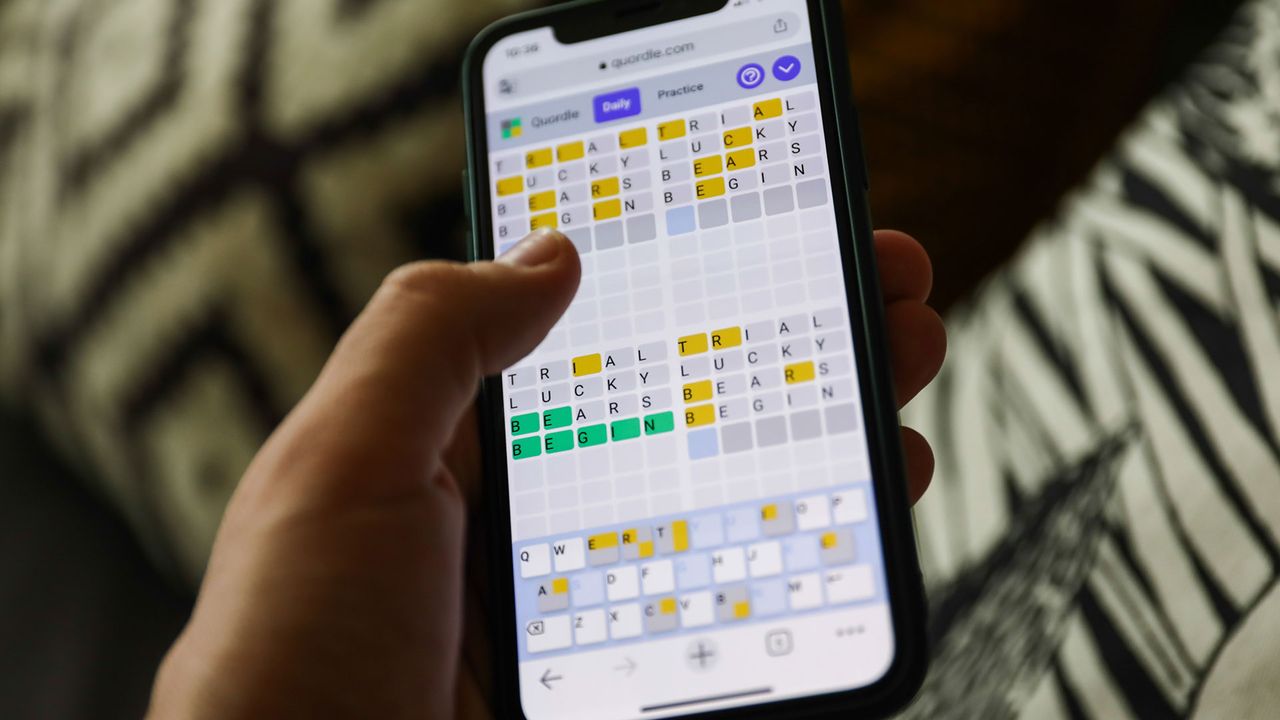
Quordle hints and answers for Monday, July 6 (game #1624)
TechRadar
ABC News
TechnologyJul 5, 2026 · 1 min
From Call of Duty to Dreamtime: These designers are lighting up video games
ABC News