Indian Express
One night at CJP protest: Crash course in politics & an ex-mall worker’s dream
Around 3 am Saturday, at Jantar Mantar in the heart of Delhi, Vikas Kumar opens his small bag and pulls out a crumpled A4 sheet announcing his political party. The 20-year-old, wearing a white kurta with a blue scarf around his shoulder, stands with folded hands. The sheet carries his picture which, he says, is enhanced with AI. He runs his finger down it: “Apna Bharat Sena Party-ABS Party”, it reads.
For the past 15 days, Kumar, from Hajipur in Bihar, has been part of the Cockroach Janta Party (CJP) protest demanding the resignation of Union Education Minister Dharmendra Pradhan over the NEET exam paper leak. Now, he is preparing to start his own political party.
Kumar is one among several volunteers — from artists to workers — for whom the protest site has also become a “political classroom” of sorts.
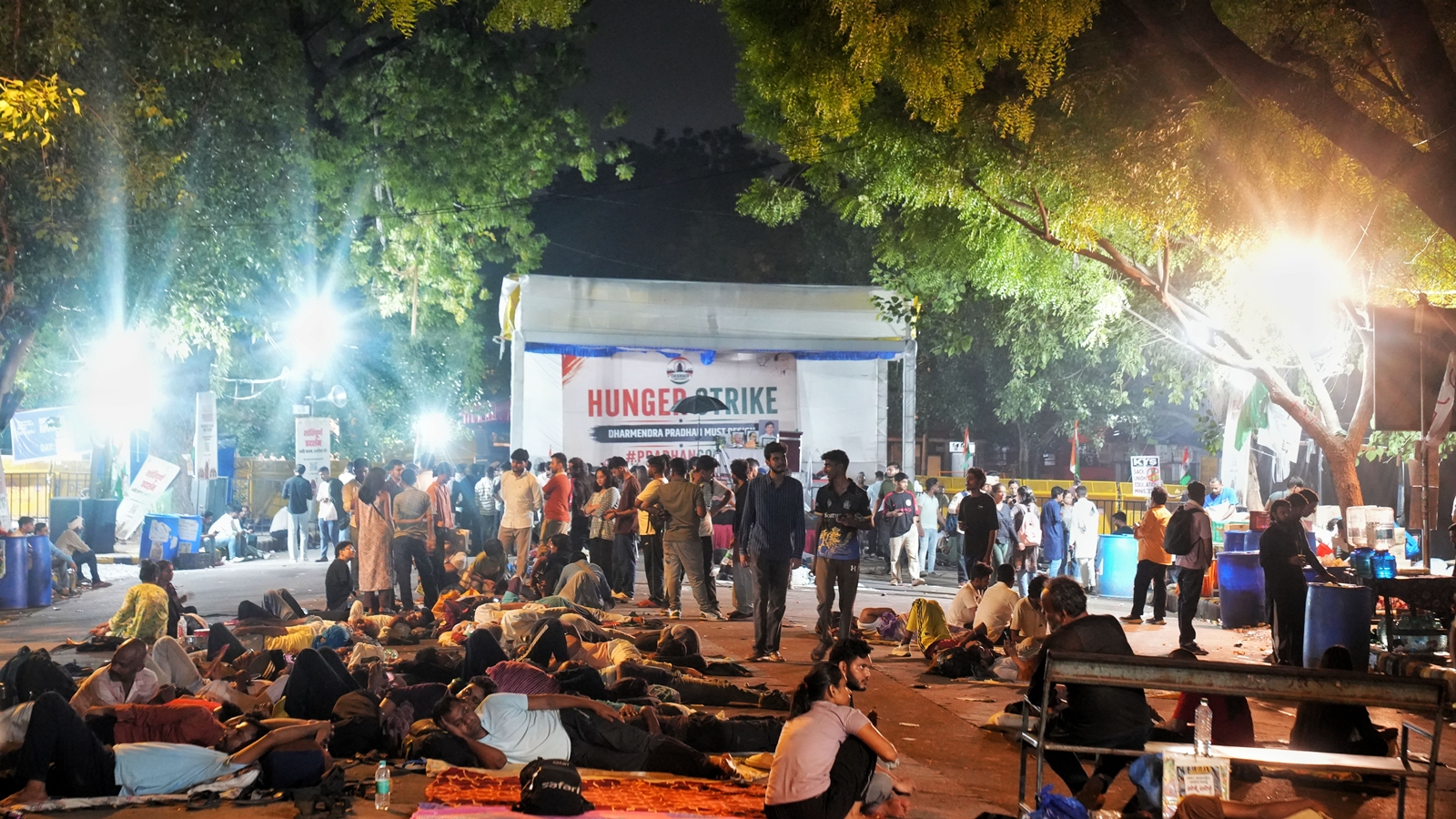
On the stage, activist Sonam Wangchuk, who is on a hunger strike, and CJP founder Abhijeet Dipke, sleep with a table fan for relief. Others lie on thick black sheets on the floor. A few fan their neighbours with plastic fans, while many sit in circles, exchanging ideas with strangers about everything under the moon.
Kumar, for his part, is busy learning. “Just like people pay money to take courses in digital marketing and computers, I’m doing a course in politics here. I get food and a place to sleep. It’s been 15 days since I started the ‘course’. Once it’s over, I’ll become a politician. Already 17 people have joined my party here,” he says.
After completing a polytechnic course at Ambala in Haryana, Kumar says he moved to Noida for a job at a hardware firm and has since switched jobs across Delhi-NCR. On June 19, he left his “supervisor job” at a mall in Gurgaon to join the protest.
“My family’s financial condition is not good, so I had to start earning. I know the value of education and how important it is to reach higher. Rich fathers can hand over established businesses to their children, while middle and lower-class parents struggle to even give an education. When I become a politician, I won’t become rich, but I’ll have the power to raise the voice of these people,” he says.
Story continues below this ad
“Here, I’m meeting people who have studied arts. They have ideologies and different views, and they are patient in their approach. They think deeply. I’m watching and learning. I take decisions impulsively,” he says, before playing a 3-minute-20-second AI-generated video of his “party’s roadshow” in Bihar, adding that his friends in his village are more excited than he is.
The protest, which started after Dipke arrived in Delhi from the US, has crossed the fortnight mark. So far, prominent figures who have visited the venue to extend support include author Arundhati Roy, CPM leaders Brinda Karat and John Brittas, Swaraj India founder Yogendra Yadav and AAP leader Sanjay Singh.
The fight will continue, say volunteers, even as the silence of the night is broken by chatter, chalk scraping on canvases, songs and slogans demanding the Minister’s resignation.
At the first stall near the stage, Zahid, who says he travelled two days from Baramulla in Kashmir to reach the site, is joined by two friends from Sopore and Srinagar. The 32-year-old wears a white T-shirt printed with the image of a cockroach and has a card hanging from his left wrist that reads “Volunteer Marshal”. Past midnight, he is still serving food and water to supporters on site, along with others.
Story continues below this ad
Zahid says he could not make it to Delhi for the June 6 CJP protest but managed to reach the site after the extended agitation started at Jantar Mantar on June 20. “I came across the party’s social media page on May 15 and felt it was right, after reading the demands,” he says.
Struggling to adapt to the Capital’s weather, the construction contractor says it was unbearable at first, but the nightly discussions have kept him going. “Sometimes they call me over there, sometimes over here, as if I’ve known them for a long time,” he says, adding that his worried family calls him several times a day.
Having rented a room for Rs 1,800 a day in Lajpat Nagar, he says he only goes there at 7 in the morning to freshen up and sleep a little before returning, stressing how much he wants to “learn from the field”.
Asked about the protests he took part in Kashmir, Zahid laughs. “It is safe to protest in Delhi, at least I feel it is,” he says.
Story continues below this ad
“In Kashmir, even when we protest on the road, police stand right opposite us. There, we would be able to protest for half-an-hour or an hour at most. After that, there would be stone-pelting, pellet guns, tear gas… It’s different here. Here, people are listening, they’re letting us speak, everyone notices what’s happening,” he says.
As the clock marks 3.30 am amid rising humidity, a few people leave while others settle in, putting mosquito nets in place, as police personnel occasionally walk through the crowd.
For Vinod (28), a fine arts student at Delhi University and a member of the collective Progressive Artists’ League, his three nights at the protest site have taught him “a lot” about things he “just knew but never discussed”.
“CJP must have a different perspective, but we are seeing how this opens a larger platform under an umbrella issue. A movement has now made young people, students and older generations, who genuinely care about the education system, slowly start pouring in,” he says.
Story continues below this ad
“These are common people, and through them we are getting to meet and speak with people who have different things to say.”
As dawn breaks, there is a stir as the site begins to wake up, slowly readying for another day of protest — with slogans and people sitting in circles.
View original source — Indian Express ↗
Related stories

The Punch
PoliticsJul 6, 2026 · 1 min
2027 candidates: Saturday deadline puts parties under pressure
The Punch
The Punch
PoliticsJul 6, 2026 · 1 min
Senate meets Tuesday as fake agency budget row deepens
The Punch

The Hindu
PoliticsJul 6, 2026 · 1 min
West Asia War LIVE: Huge crowds expected at former Iran leader Khamenei's funeral procession
The Hindu

The Guardian
PoliticsJul 6, 2026 · 1 min
Sara Duterte: why is the Philippines vice-president facing an impeachment trial?
The Guardian