VnExpress
University selection shifts beyond degrees in AI era
As artificial intelligence (AI) reshapes education and the workplace, many families are placing greater emphasis on universities that help students develop critical thinking, adaptability, and practical skills alongside academic knowledge.
With Vietnam's national high school graduation exam results now released, many students and parents are entering the university admissions period.
For Thu Ha, a parent in Hanoi, choosing a university is no longer simply about prestige or rankings. Instead, she is looking for an environment where her daughter can build the skills needed to succeed in a rapidly changing job market.
The changing priorities reflect broader trends in higher education.
As AI becomes increasingly capable of performing technical and analytical tasks, employers are placing greater value on qualities such as communication, problem-solving, critical thinking, and adaptability.
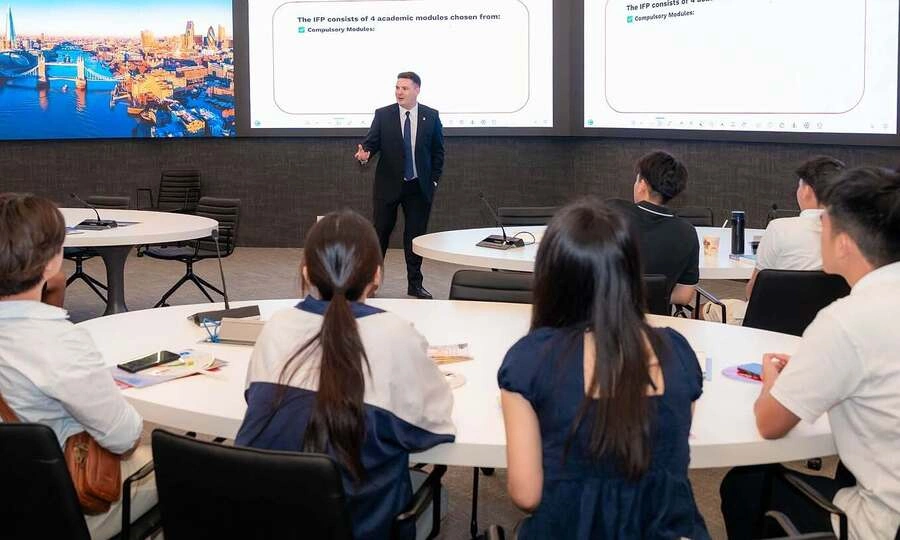
Students and parents consult with lecturers and experts during the Experience Day. Photo courtesy of the university
According to Van Le, a British University Vietnam (BUV) MBA alumna and human resources professional, many employers now evaluate candidates using the ASK framework: attitude, skills, and knowledge. Within this framework, attitude and skills are often the factors that clearly distinguish young candidates from one another.
"Technical knowledge can always be taught. Developing a growth mindset, adaptability, and a proactive attitude is much more difficult, and these qualities often determine how quickly young professionals advance in their careers," she said.
The shift has prompted many families to consider not only what students study, but also how universities prepare them for employment and lifelong learning.
BUV's learning ecosystem is built around its Triple Quality Framework. Photo courtesy of the university
In the age of AI, the value of a university education is no longer defined by any single metric. Rather, it comes from a combination of academic quality, technological capability, real-world experience, industry engagement, and international exposure.
At British University Vietnam, this approach is reflected in its Triple Quality Framework, which aligns standards from Vietnam's Ministry of Education and Training, the U.K.'s Quality Assurance Agency (QAA), and the QS Stars rating system.
The university has also introduced an AI Assessment Scale (AIAS), which provides guidance on the appropriate use of AI in learning and assessment while encouraging students to develop independent thinking and critical evaluation skills.
Beyond academic study, students participate in the university's Personal and Social Growth (PSG) program, which focuses on communication, leadership, teamwork, and problem-solving.
Learning is also supported through partnerships with more than 500 companies, providing internships, industry projects, and networking opportunities. The university also collaborates with more than 70 overseas institutions on student exchange and study programs.
Students regularly visit leading companies to gain first-hand industry experience. Photo courtesy of BUV
According to BUV, all graduates either secure employment or continue their studies within three months of graduation.
Van, whose daughter recently received the university's British Ambassador Scholarship, said the learning environment influenced the family's decision.
"What convinced us was not only the British degree but also the confidence that our daughter would grow in an environment that encourages independence and critical thinking and prepares students for their future careers," she said.
The university has also introduced the Graduation Star Scholarship for students achieving high results in Vietnam's national high school graduation examination.
For parents like Ha and Van, choosing a university is no longer about meeting an entry requirement or comparing rankings. As AI continues to reshape education and employment, many families are increasingly evaluating universities not only by their academic reputation, but also by the opportunities they provide for practical experience, personal development, and career readiness.
Learn more about the Graduation Star Scholarship here.
View original source — VnExpress ↗
Related stories

Euronews
TechnologyJul 6, 2026 · 1 min
At least eight killed in massive overnight Russian attack on Kyiv
Euronews

Indian Express
TechnologyJul 6, 2026 · 1 min
Sri Ganganagar gangrape case: Police say viral video from UP, not Rajasthan; outrage mounts
Indian Express

The New York Times
TechnologyJul 6, 2026 · 1 min
Deadly Russian Strikes Rock Kyiv on Eve of NATO Summit
The New York Times

CNA
TechnologyJul 6, 2026 · 1 min
Singer Harry Styles thanks One Direction bandmates on final day of Wembley Stadium concert
CNA