Indian Express
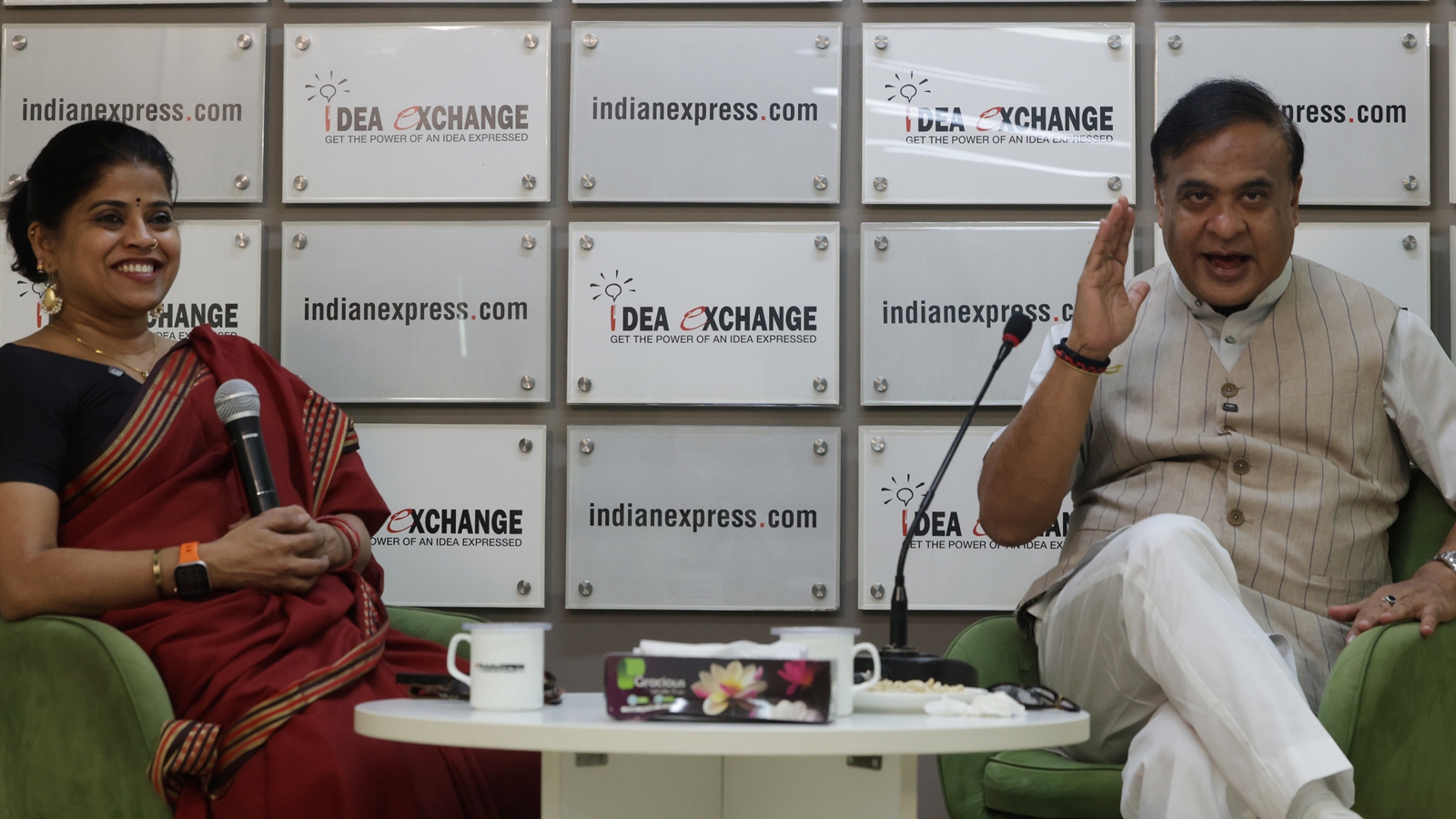
Himanta Biswa Sarma at Idea Exchange
Assam Chief Minister Himanta Biswa Sarma on Assam’s shift from insurgency to peace and development, politics of polarisation, citizenship debates and evolving challenges in Manipur and Bangladesh. The conversation was moderated by Liz Mathew, Deputy Editor, The Indian Express.
Liz Mathew: You’ve had resounding victories in Assam. What do you think is your biggest achievement in Assam and what is it that you plan to focus on in the next five years?
I think restoring peace and confidence among the people of Assam is the biggest achievement of the NDA government. Earlier, there was a huge trust deficit between the people of Assam and power in Delhi. Secondly, within the state, there was mistrust between various ethnic communities. Third, insurgency played a devastating role right from the ’60s. Gradually, it shaped us; it took us in a completely different direction around 1985-86. If you go to Assam now, the new generation doesn’t speak of insurgency anymore. Instead of lots of complaints against Delhi, now there is a complete feeling of oneness. And within Assam, our differences among the ethnic communities have been resolved to a large extent. Today Assam is one of the most peaceful states in the country. People have become aspirational. Even in our wildest dreams, we did not think that there would be a year where there would be no agitation, no bandh, no picketing, no bombs, no firing. Earlier, people were happy if you gave them something. Now we can be like any other advanced state of the country, dream of a medical college, a good road, 24 hours of electricity, industry and employment. So the biggest challenge for me will be: we have created an aspirational generation. Aspirations are bigger than our resources. So that will be our challenge.
On Expanding BJP’s Fold| ‘It is my duty to bring anyone in Congress, with some merit, or in CPM or in CPI, to the rightist fold and make them ideologi-cally more inclined towards us… I want Hinduism and rightist ideology to flourish’
Liz Mathew: Your critics say that you are one of the most effective figures in using polarisation in politics. Is this an image that is thrust upon you or is it a political strategy?
Assam needed a polarising figure. Because we were about to be a minority; we were about to lose our temples, our monasteries. My last five or 10-year journey was needed for Assam to restore confidence among the Assamese people, who were frustrated. People saw that we did not have a future and soon would become a minority, and gradually we will either be rooted or thrown out.We have resisted many aggressions. However, in the last 70 years, gradually, we became a minority. We lost 13 to 14 districts. We lost areas in kilometres. So Assam, at that point of time, needed a polarising figure. In fact, people had become very frustrated because there wasn’t one. So, when required, I served that purpose. Now, people feel that we are safe. Although nothing has changed numerically, people feel that we now have a government that will take care of us and not just one community. Now, we can create a government, or we can throw out a government. Earlier, people thought that they did not have power because they were fragmented. When you talk of Assam, you should talk of the pain of the Assamese people, irrespective of Hindus and Muslims. The problem is that in Delhi, people are so set with the typical Hindu-Muslim narrative. People have no time to think about an ethnic community that has been thrown from the mainstream to the gallery. So a polarising figure like me was needed.
Liz Mathew: Can we expect a moderate Himanta Sarma in the future?
In my state now, polarisation is not required because I have controlled that means. Now nobody can put a finger on Assamese people. Now nobody has the guts to encroach the land of the temple, or pick up a girl without her consent. Now people have been streamlined. People have become law-abiding. Once everybody abides by the law, then I do not have to talk every day. But if I see we are losing the space, I will speak again.
Story continues below this ad
Liz Mathew: You’re known as one of the BJP’s most combative leaders, yet PM Modi has frequently cited your governance as a model. How do you balance these two aspects?
As CM, I have the responsibility for health, education, for bringing development to every corner of my state. I have tried to restore the glory of Assamese people in Assam, that doesn’t mean I have to discriminate against somebody. In Assam, compared to all other states of India, most Muslims go for medical education, for engineering, compete for civil services. They get service on merit. So we have also created equality. Once you start abiding by the law, everybody is equal. I say, ‘stop Madrasa, come to medical’? Out of 1700 medical seats in Assam, every year 350 Muslim boys and girls join our medical education. So, roughly 25 per cent seats on merit go to Muslims because we have created equality. You will not be appeased, but you will not be discriminated against either. So, that is why the Assam model, when we have given 1,60,000 government jobs, is huge. Everything is based on a system of meritocracy. As long as you do not overpower us, we are equal.
Assam Chief Minister Himanta Biswa Sarma in conversation with Liz Mathew, Deputy Editor, The Indian Express.
Vikas Pathak: There has been concern about illegal immigration in Assam. But it took the Sangh Parivar 20–25 years to make an impact as it focused on illegal Muslim immigration while Assam’s concern was all illegal immigration. The CAA (Citizenship Amendment Act) led to protests.How have the Assamese reconciled with the BJP in the last six–seven years?
That is a question of insecurity. When we started the agitation, it was against foreign nationals. At that time, religion was discounted because, from a religious point of view, we were not insecure. We were insecure only in linguistic terms or that we were losing land, etc. As days went by, people realised that we were losing even on the religious front. As a society develops, when they came 25 years back, 30 years back, they came as 5,000. But as multiplication started, they became one lakh. So now they are not only threatening your land and culture, but they are threatening your religion also. So that became an added concern. When I see that my religion is at stake, then I do not go for language. Then there is a tendency to unite.
On manipur’s violent conflict | ‘In Manipur, the conflict between the communities, Kuki and Meiteis, now Kuki and Nagas, will never be resolved by outside interference. The dispute is not related to law and order. It is related to the big trust deficit’
Story continues below this ad
I think that is what happened during the Assam Agitation in 1979. Nowhere in Assam was Hinduism at the receiving end. That is why we treated every legal migrant equally. But gradually we realised that we were losing on the religious front also. When that happens, you become more empathetic to somebody who has come to Assam because of persecution. Not for economic advantage but because they cannot stay there. I do not say everybody subscribes to my notion or the BJP’s. Many still feel every foreigner is the same. But people like me believe you cannot put everybody on the same pedestal. You have to safeguard those who came because of persecution. I think, gradually, more people are aligning with our view because religion is also now at stake.
Vikas Pathak: You have seen the Congress from the inside. Why do you think it is in terminal decline?
Congress has tilted to the Left. In India, the ideology of the Left has never become the ideology of the majority. I think Congress party’s biggest problem is that as they have shifted more towards the Left, ideologically they will be stronger, but numerically they will be weaker. Which is why it is never accepted by the vast majority of the people. So when a Congress leader now speaks to the people, he looks like an alien. The more Rahul Gandhi takes Congress to the Left, the more he will lose support from the centrists and rightists.
Jatin Anand: It’s been 12 years since you joined the BJP, and you’ve seen many leaders switch. Do you see these shifts as political pragmatism or is there room for ideology still?
Story continues below this ad
BJP is an ideologically inclined party. We want to expand the rightist footprint in the country. So it is my duty to bring anybody who is in Congress, with some merit, or in CPM or in CPI, to the rightist fold and make them ideologically more inclined towards us. I want that everybody should be in the BJP in India. Irrespective of anything. I want Hinduism to flourish. I want rightist ideology to flourish. Now the problem is staying. Because if you have come for power, you will not stay. In this party, you cannot carry the culture of the other party.
Assam Chief Minister Himanta Biswa Sarma in conversation with Liz Mathew, Deputy Editor, The Indian Express.
Srirupa Goswami: In Assam, infiltration is one of the key issues. But why was there no SIR in Assam?
SIR will come; there was a technical problem. SIR and NRC (National Register of Citizens) are complementary, not in conflict. Our NRC has not been fully published. If somebody’s name is deleted in SIR but there in NRC, that contradiction will arise. We are in the process of publishing the NRC data, followed by the SIR. I met the Chief Election Commissioner Gyanesh Kumar, requesting for SIR. But he says that we cannot do it because the NRC has not been published. In all other Indian states, there is no NRC. That is why before the election, we could not do SIR. But we have done something called SR (Special Revision). In Assam, we deleted 12 lakh names. These include those who died, whose names were duplicated and who’ve been declared as foreigners by the tribunal.
P Vaidyanathan Iyer: Now that the new government is in place in Bangladesh, do you think that political rhetoric can come down and become more conducive for talks?
Story continues below this ad
I think political rhetoric can be withdrawn or discontinued in the next two minutes, but the question is of practical reality, which follows political statements. So, if there is a substantial change within Bangladesh, and if Hindus in Bangladesh are feeling secure, I don’t think that there is anything which will stop India from entering into a good relationship with Bangladesh. If that is ensured, then we are the closest neighbours.
On Centre’s Non-Interference | ‘The central leadership does not interfere with the affairs of a state, as long as it is going smoothly. But jab mai raaste se bhatak jaun (if I go off-track), then there will be control, there will be instruction, there will be interference’
Sandeep Singh: You spoke about restoring peace and tranquillity in Assam. Why do you think that peace has not been restored in Manipur?
I think in Manipur, the conflict between the communities, Kuki and Meiteis, now Kuki and Nagas, is very strong, and it will never be resolved by outside interference. The dispute is not something which is related to law and order. The dispute is related to the big trust deficit. We can restore law and order. But we cannot make two brothers sit and settle their dispute. That we can only encourage; we cannot force. If you see their agenda, there is no memorandum before the Government of India. That means there is nothing with the Indian government. The people in Delhi, people in the rest of India, are not realising that situation. A lot of process is going on; inter-community dialogue has been initiated.
Neerja Chowdhary: As the CM of Assam, you have walked in tandem with the Centre yet you have managed to carve out an autonomous political persona. What is your secret?
Story continues below this ad
The central leadership does not interfere with the affairs of a state, as long as it is going smoothly. But jab mai raaste se bhatak jaun (when I go off-track), then there will be control, there will be instruction, there will be interference. If you are managing it nicely, you are not bringing problems to Delhi.
Asad Rehman: In 2024, the Gauhati High Court had ordered the Assam government to pay Rs 30 lakh in compensation to six families whose homes were illegally bulldozed in Nagaon. Doesn’t bulldozer justice go against natural justice?
The problem is that we don’t have any other equipment other than bulldozers when you have to perform evictions. In Assam, an accused will be tried in the eyes of the law through a legal process. But when one becomes an accused, they come under greater scrutiny. If their house was built illegally, then what is the problem with demolishing it? If I follow the 16-point judgement of the Supreme Court, then I can demolish it. What is the problem?
Asad Rehman: What if that person is later acquitted?
But the house was illegal, right? We made a mistake in Nagaon, so we gave the compensation. However, one wrong by the government does not mean that it was wrong everywhere else.
Story continues below this ad
Vandita Mishra: You’ve said polarisation was needed in Assam and you became an agent of it. Does that mean it can simply be switched off? Is it really that easy, especially in the age of social media? Also, the distinction between illegal Muslim immigrants and Muslims has largely disappeared. How will you address this?
I meant that the dominance of Assam should be by the people of Assam. The people being the Assamese people, including the Muslims who have been in Assam. Forget dominance; we were being pushed into a corner. At one point, we just asked to be allowed to live there. From there we fought. Today we are strong and stable, but that doesn’t mean we have done something wrong to the other camp; we just said follow the law. When they follow the law, it “switches off.” There is no guilt on our side because we gave them everything. We asked valid questions: why do you take our temples, our land, our girls? They said they won’t do it anymore, and that was the end of it.
The distinction between illegal Muslim immigrants and Muslims will last forever. It cannot end. Sometimes religion plays a bigger role, but that is temporary; the differentiation will always remain. You will see fewer marriages between them and interpersonal communication hasn’t necessarily improved. They may say they are united to oppose the BJP, but relations between them cannot improve. Our indigenous Assamese Muslims know that if they (immigrants) grow, we will lose our culture. The main resentment in Assam comes from this.
Rangnath Singh (Jansatta): Regarding the Ram Mandir controversy, do you think the image of the VHP, RSS and BJP has been hurt among the supporters and there may be a fallout in the UP elections?
Story continues below this ad
I don’t think so. The Congress, which never went to Ram Mandir, is now raising slogans for it. The Samajwadi Party is talking about it. Even those who didn’t accept Ram’s existence and refused formal invitations to the inauguration are now raising the issue. If there is a scam, action will be taken against the culprits. But you shouldn’t run a campaign to defame the temple or the Sangh.
Apurva Vishwanath: In the past 10 years, Assam has built detention centres that could become a model for the rest of the country. How much has the state government spent on these facilities and how many people are currently being held in them?
I haven’t found out about that, but the concept of the detention camp was a bit wrong. We never read the law. The Illegal Immigration (Deportation) Act was an act from 1950 and was made by Jawaharlal Nehru. Recently, the Supreme Court has said that the Act is valid. So, instead of putting people in detention camps, you can evict them from India. Now the process has smoothened. There might be 10 or 12 people.
Apurva Vishwanath: You’re saying that in Assam there will only be 10 –12 people in detention camps?
It will be below 100, I can say. I can say it is below 50 also because whatever happens now, I agree to evict them from the country. Right now a judgment from a Constitutional Bench has come, which says that your Act of 1950 is valid. It empowers the District Commissioner (DC) to evict a foreigner if he is prima facie satisfied. He doesn’t have to push him to a tribunal. So we mistakenly created tribunals. We never studied that Act. So, detention camps are gradually becoming irrelevant. Why should I feed them?
Apurva Vishwanath: If the tribunal decides they are not foreigners?
Where will he fight the case from? He is gone. From there, he cannot fight a case. If he files a case from the country where he has been sent, that is a different matter. So now the detention camp has become like a transit camp.
View original source — Indian Express ↗
Related stories
Indian Express
WorldJul 6, 2026 · 1 min
Mumbai Rains Today LIVE Updates
Indian Express

Euronews
WorldJul 6, 2026 · 1 min
Common mosquito, Asian tiger mosquito: Germany faces mosquito plague
Euronews

RNZ
WorldJul 6, 2026 · 1 min
Strongman Samoa aims to create new pathways for local talent
RNZ

RNZ
WorldJul 6, 2026 · 1 min
Australia and Fiji sign landmark security and peace treaties
RNZ