Indian Express
From Rs 100 a day on petrol to Rs 20 a charge: Why Delhi is turning to EV scooters
The TVS showroom in Laxmi Nagar, in East Delhi, is quiet on a Friday morning. Rows of blue, red, and yellow motorcycles gleam beneath showroom lights. Sales executives wait behind their desks, looking up whenever someone slows outside the glass entrance. “Most days, we barely get around 15 visitors,” one salesman says. “There are long stretches when there’s hardly anyone in the showroom.”
The stillness ends at the branch manager’s desk. Pawan Suryavanshi spends much of the day answering his phone. Since last week, the 32-year-old says, it has rung 70 to 80 times a day, each call from someone asking about an electric scooter.
How much subsidy is available on the TVS iQube? When will it be released? How far does it go on a single charge?
Watching him work, it would be easy to mistake the calls for sales. They are not.
His showroom doesn’t sell electric scooters. “We don’t even sell our electric scooters from this branch. There is a separate branch nearby for that,” Suryavanshi says. “But my phone number was given on some website, so I get 70 to 80 calls a day asking about electric scooters.”
Even the customers who do walk in are often looking for something the showroom doesn’t have. “Out of 15 people who come in every day, around 10 are asking for electric models,” he says.
The conversations are playing out at dealerships across Delhi, Suryavanshi says. “When I talk to other managers, I clearly see growing excitement around electric two-wheelers.”
Story continues below this ad
That interest has accelerated since the Delhi government announced a new electric vehicle policy this week. The policy offers incentives to buyers, expands charging and recycling infrastructure and, most significantly, will prohibit the registration of new petrol and CNG two-wheelers in the capital beginning April 1, 2028. If the government’s new EV policy has accelerated interest in EV two-wheelers, showroom employees say the shift in consumer sentiment had begun months earlier. One reason, they say, comes down to simple arithmetic.
At Bajaj Auto’s petrol two-wheeler showroom in West Delhi’s Ramesh Nagar, salesman Ravi spends his day trying to convince customers that an internal combustion engine (ICE) vehicle is still worth buying. Increasingly, he finds himself listening to customers explain why they are leaning the other way. “They’ve done the math before they walk into the showroom,” Ravi says.
At an electricity tariff of around Rs 5 a unit, a full charge for an electric scooter costs roughly Rs 20 and can last about 100 km, he explains. Even assuming a customer rides that distance every day, the monthly charging cost works out to about Rs 600, or roughly Rs 1.1 lakh over three years. By comparison, someone spending Rs 100 a day on petrol would spend nearly Rs 3,000 a month and around Rs 1.1 lakh over the same period. For many buyers in Delhi, the economics become even more favourable because of the city’s concessional electricity tariff for EV charging. “They know EV users pay around Rs 4.5 per unit, compared to the normal tariff of Rs 6 to Rs 7 depending on consumption,” Ravi says. “That’s another factor people bring up.”
Cost, however, is only part of the story. Both Ravi and Suryavanshi say customers have also become increasingly wary of petrol vehicles in recent months.
Story continues below this ad
The conflict in West Asia, which pushed up fuel prices, has prompted many prospective buyers to reconsider the long-term cost of owning a petrol two-wheeler, they say. At the same time, customers have raised concerns over the government’s increased ethanol blending in petrol. “There have been complaints of damage to the internal combustion engine and a drop in mileage. Because of this, there is a lot of negativity around petrol recently,” Suryavanshi says.
For dealers, the real impact of Delhi’s new EV policy is expected to play out in the coming weeks, as customers begin arriving to take advantage of the incentives on offer.
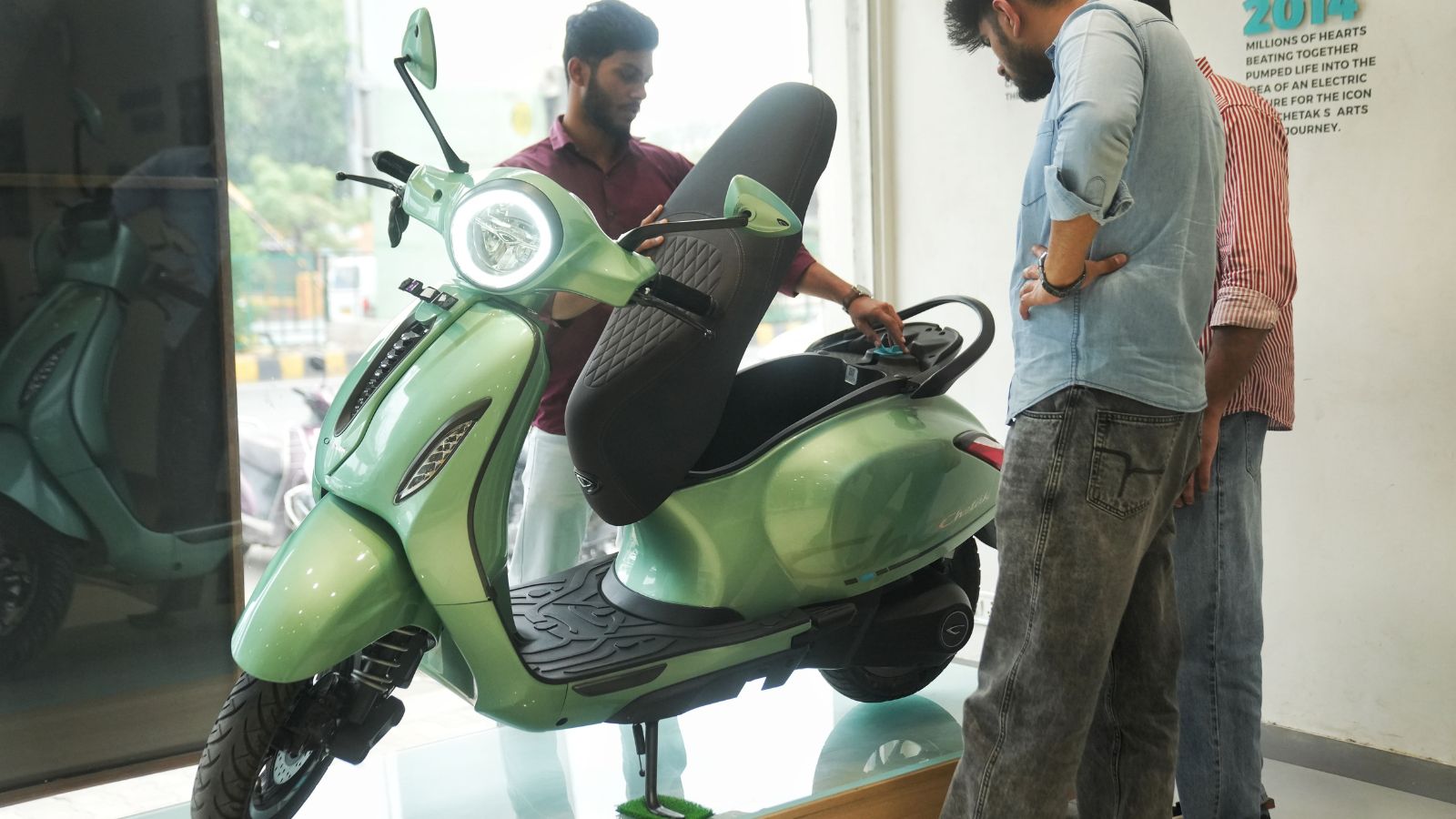
At Bajaj Auto’s Chetak showroom in Ramesh Nagar, 27-year-old software professional Anubhav Yadav is among the first.
“I had been thinking about buying an electric scooter since the start of 2026, but someone told me a new policy was coming and I would be able to buy it much cheaper, so I waited,” Yadav says. The difference between Bajaj’s adjoining petrol and electric showrooms hints at how manufacturers are positioning themselves for the transition. Climb a flight of stairs and the petrol showroom is crowded with around 15 motorcycles and scooters packed beneath a low ceiling. On the ground floor of the adjacent building, the Chetak showroom feels almost gallery-like – bright, spacious and uncluttered. Just three pastel-coloured electric scooters occupy the floor, each given ample room to stand out.
Story continues below this ad
Yadav circles one of the display models, but his questions are less about the scooter itself than the government’s incentives.
“What exactly are the benefits I’ll get if I buy a Chetak now?” he asks the salesman.
The salesman walks him through the numbers.
For Yadav, charging the scooter is not a concern. He lives in Rajouri Garden and has a stilt parking space where he can plug it in overnight. That, experts say, puts him in a relatively privileged position.
For many Delhi residents, particularly those in unauthorised colonies, charging remains a key obstacle. Without dedicated parking or formal electricity connections, many rely on shared sockets, temporary connections or extension wires.
Story continues below this ad
A recent study by EV charging startup Kazam and the Alliance for an Energy Efficient Economy (AEEE) found that only 55% of prospective EV buyers nationwide have access to formal charging infrastructure.
“Vehicle owners who charge through informal routes end up paying considerably more per charge than the cost of the electricity itself,” says Moushumi Mohanty, head of electric mobility at the Centre for Science and Environment. If the electric two-wheeler mandate is to succeed, she says, legal electricity access must be treated as part of the EV rollout, not a separate housing issue.
View original source — Indian Express ↗
Related stories

The Punch
WorldJul 6, 2026 · 1 min
Bandits kill nine farmers in Kaduna, kidnap many
The Punch

Japan Times
WorldJul 6, 2026 · 1 min
At the foot of Mount Olympus, a return to ancient Greek heritage
Japan Times

Indian Express
WorldJul 6, 2026 · 1 min
Allies seek to expand their footprint, BJP chief tells them not to make claim on specific seats
Indian Express

Philippine Daily Inquirer
WorldJul 6, 2026 · 1 min
Go hopeful more banks will scrap transfer fees
Philippine Daily Inquirer