Indian Express
Colaba sees decade’s wettest July day as heavy rain continues to batter city
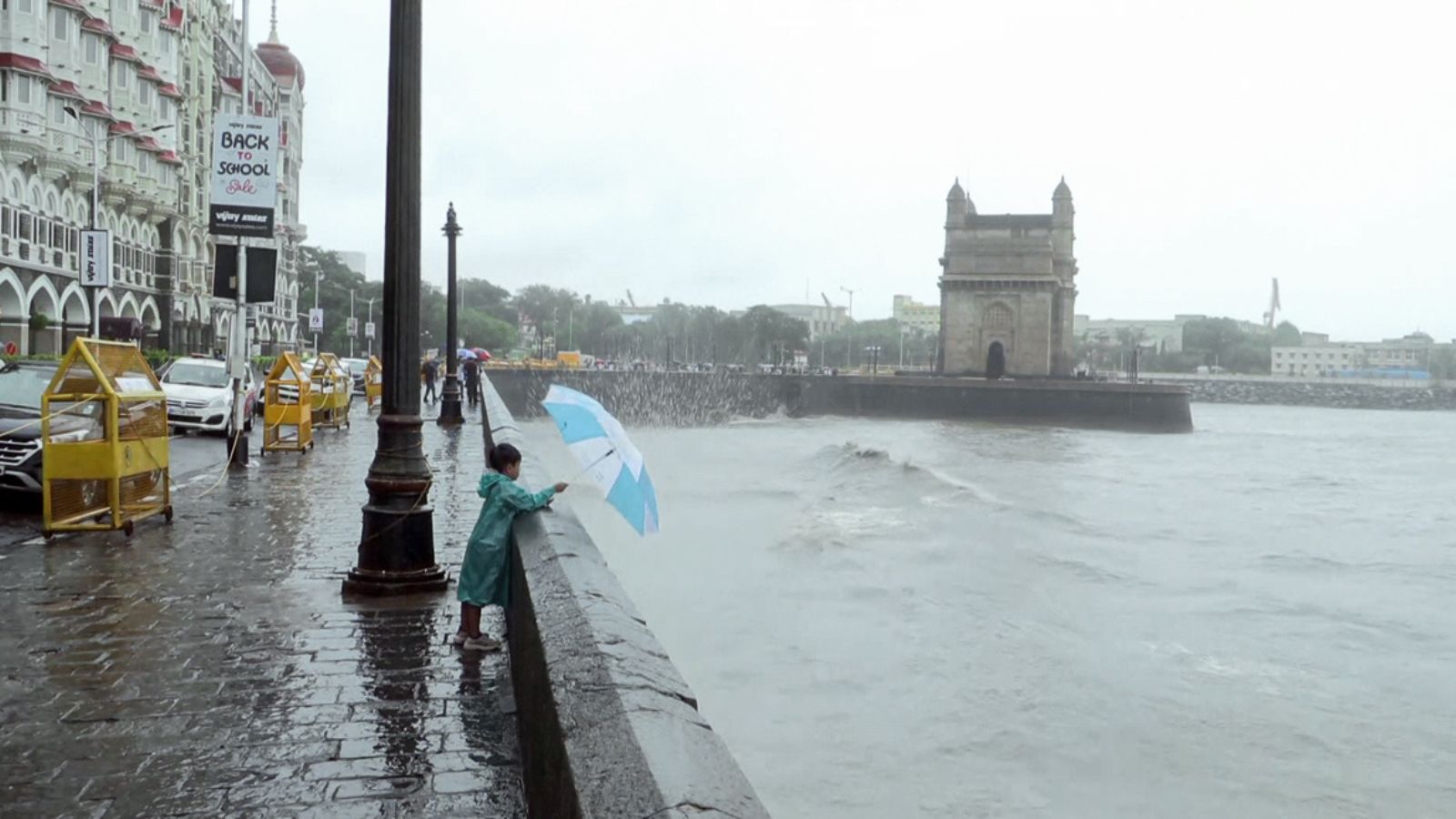
As Mumbai reeled under a red alert for two consecutive days, the Colaba observatory of the India Meteorological Department (IMD) witnessed its wettest July day in a decade, as intense spells of rain coupled with gusty winds continued throughout the weekend.
The wind speed recorded on Sunday was also more than three times the normal level, leading to more than 150 tree-collapse incidents across Mumbai.
The IMD, in its five-day forecast issued on Sunday afternoon, announced an orange alert for Mumbai on Monday (July 6), indicating heavy rainfall to continue. Following this, a yellow alert has been issued for Wednesday.
Alongside Mumbai, an orange alert has also been issued for the Thane and Palghar districts for Monday, while the Raigad district has been kept under a red alert till Wednesday.
Keeping in mind the rainfall situation, the Brihanmumbai Municipal Corporation (BMC) has announced a holiday for all private and government schools, colleges and universities on Monday. The Thane and Navi Mumbai administrations have also announced a school and college holiday on Monday.
Speaking with the Indian Express, an IMD official said that the rains will continue to batter Mumbai till the middle of next week, as a low-pressure area has developed over Maharashtra.
IMD’s data show the Colaba observatory recorded 265.6 mm of rainfall in the 24 hours ending at 8.30 am on Sunday. Before this, the Colaba observatory had recorded the wettest day in the month on July 1, 2022, when 227.8 mm was recorded in this observatory within a 24-hour span. In comparison, the highest July 24-hour rainfall was 161.4 mm on July 9, 2024, and 86.6 mm on July 23, 2025.
Story continues below this ad
Meanwhile, the Santacruz observatory recorded 227.7 mm during the same 24-hour period, making it the second-highest 24-hour July rainfall at the station in the last five years. The highest 24-hour rainfall in the past five years was recorded at Santacruz on July 8, 2024, when the observatory recorded 267.9 mm.
Furthermore, the BMC’s automated weather system shows that Mumbai’s eastern suburbs recorded 217 mm of rainfall, followed by 194 mm recorded at the island city, while 186 mm was recorded at the western suburbs.
The downpour, which came during two consecutive days of red alert, has also pushed the city to the brink of achieving its average rainfall for the entire month of July within just the first five days.
The persistent spell of rain since July 1 has rapidly narrowed the gap to the city’s monthly rainfall average. Between July 1 and July 5, Colaba received 695.4 mm, accounting for nearly 94% of its normal July rainfall of 734.1 mm. Santacruz recorded 739.2 mm, or about 86% of its July normal of 855.7 mm.
Story continues below this ad
With the IMD issuing an orange alert for Monday and forecasting another round of heavy showers, weather officials said Mumbai is likely to cross its average rainfall for the entire month within the next two to three days. Rainfall intensity is, however, expected to gradually reduce from July 8, when only moderate rain has been forecast.
Rain continued through Sunday as well. In the 12 hours ending 8.30 pm, Colaba recorded 49 mm of rainfall, while Santacruz received 66 mm.
Heavy rainfall was not confined to Mumbai alone, with several parts of the Mumbai Metropolitan Region (MMR) also experiencing intense showers. In the 24 hours ending 8.30 pm on Sunday, Navi Mumbai recorded 210.76 mm of rainfall, Thane received 184.66 mm, Vasai logged 179 mm, while Palghar topped the region with 273 mm.
Alongside heavy rain, Mumbai also recorded gusty winds throughout the day ranging between 72.4 km/h and 77 km/h – which was more than three times its normal range.
Story continues below this ad
Usually, the average wind speed ranges between 20-30 km/h during monsoon.
Lake levels go up
In a significant boost to Mumbai’s water reserves, the average water stock in all the seven lakes have jumped by 4 percentage points in the last 24-hours. According to the BMC’s data, Mumbai’s water stock on Sunday stood at 13.19 per cent or 1.9 lakh million litres against its total capacity of 14.47 lakh million litres. In contrast, the water stock in the lakes stood at 54.27 per cent on July 5, 2025.
BMC’s data shows that in the last 24 hours, the highest rainfall was recorded in the catchment areas of Tulsi lake at 321 mm, followed by 275 mm of rainfall recorded at the catchment area of Vihar Lake, 92 mm at Tansa Lake, 87 mm at Bhatsa, 86 mm at middle Vaitarna, 82 mm at Modak Sagar and 59 mm at Upper Vaitarna.
View original source — Indian Express ↗
Related stories

AllAfrica
TechnologyJul 6, 2026 · 1 min
Mali: Mali Rebels Target Army Bases, Prison in Fresh Attacks
AllAfrica
The Guardian
TechnologyJul 6, 2026 · 1 min
Meta bosses grilled over decision to cut ‘censorship’ that has potentially unleashed more antisemitic content
The Guardian

TechCrunch
TechnologyJul 6, 2026 · 1 min
This humanoid robotics company is going public, but its CEO isn’t promising a robot in your home anytime soon
TechCrunch

The Guardian
TechnologyJul 6, 2026 · 1 min
John Lewis dishwasher leak forced buyers into hotels for eight months
The Guardian