Indian Express
Top 20 UPSC Current Affairs Pointers of the past week | June 29 to July 5, 2026
Every Monday, we bring you UPSC Current Affairs Pointers—a concise, exam-focused guide to help you stay ahead in your Prelims and Mains preparation.
(FYI: The data provided in these reports can be used to substantiate your Mains answer and create a broad understanding of the topic.)
— A total of 747 foreign nationals were arrested in India in 2025 in narcotics cases, with the highest numbers from Nepal (203), Nigeria (143), and Myanmar (97), according to the Narcotics Control Bureau’s (NCB) Annual Report 2025.
— India also saw a significant rise in narcotics-related enforcement in 2025, with the number of people arrested in anti-drug operations increasing sharply.
— Encrypted messaging platforms such as Telegram, WhatsApp and Signal have become major channels for drug trafficking worldwide, including in India. Of these three, Telegram has emerged as a key platform for drug-related advertising.
— The report by the apex drug law enforcement agency also flagged a trafficking corridor from Myanmar into India’s Northeast as a major security concern, warning that the drug trade in the region is linked to arms smuggling and financing of terror groups.
Story continues below this ad
— The report flagged two emerging threats that require urgent attention: the spread of nitazenes, a class of synthetic opioids said to be 500 times more potent than heroin, and the increasing link between drug trafficking and organised violence across transit economies.
Defence
India’s first Integrated Battle Groups (IBG)
— The Army is set to establish and operationalise its first Integrated Battle Groups (IBG) by next month.
— The Indian Express has learnt that a self-contained, agile, brigade-sized fighting unit will be carved out of the Panagarh-based XVII Corps — the mountain strike corps (MSC) facing China — for swift deployment in mountainous areas.
— Each IBG, comprising over 5,000 troops, will have battalions of infantry, artillery regiments, Corps of Electronics and Mechanical Engineers, Combat Engineers, Army Service Corps and a field hospital.
Story continues below this ad
— The IBGs will be especially crucial in mountainous terrains, as their agile nature allows rapid deployment, eliminating the wait for the entire corps to mobilise.
— The creation of the IBGs is part of a larger restructuring plan of the Army, which includes the creation of Bhairav battalions, Rudra brigades, Divyastra batteries and Shaktibaan units.
‘VIJAY’ Roadmap
— Assuming charge as the 31st Chief of Army Staff on 1st July, General Dhiraj Seth underlined the need to take forward the modernisation of the Army with “renewed energy and firm resolve to respond effectively to the evolving security environment.”
— Stating that the Indian Army is a combat-ready and battle-hardened force, fully prepared and capable of meeting every challenge in the operational domain, he listed his focus areas in the acronym ‘VIJAY’.
Story continues below this ad
‘V’ stands for Vigilance along borders and against emerging threats.
‘I’ stands for Innovation and Transformation through innovation in both doctrine and technological solutions
‘J’ stands for Jointness and Integration
‘A’ stands for Atmanirbharta and, with indigenous capabilities and technologies developed within the country
‘Y’ stands for Yodha First, adding that from the Agniveer to the senior-most veteran, each army personnel is a yodha (fighter).
Polity
Story continues below this ad
Delhi EV policy 2.0
— The Electric Vehicle (EV) Policy approved by the Delhi government on June 29 has dropped the proposal to extend incentives to strong hybrid vehicles, and has instead focused entirely on promoting pure EVs.
— The policy, which goes into effect from July 1, also mandates that only electric two-wheelers will be registered in Delhi from April 1, 2028, effectively phasing out petrol-run bikes in Delhi.
— The policy aims to achieve a minimum 30% electrification of Delhi’s vehicle fleet by March 31, 2030, when the policy runs out.
— No petrol motorcycles and scooters can be registered in Delhi after March 31, 2028. The registration of new CNG auto-rickshaws will stop at the end of this year. Beginning April 2028, therefore, every new two- and three-wheeler sold in Delhi will have to be an electric vehicle (EV).
Story continues below this ad
— The new policy expands the incentives and scrappage benefits to encourage a rapid transition to EVs. The government has proposed a cash incentive of up to Rs 30,000 for buying an electric two-wheeler in the first year of the new policy, and Rs 20,000 and Rs 10,000 for purchases made in the second and third years, respectively.
The EV policy cleared by the Delhi Cabinet cited the latest report of the Commission for Air Quality Management (CAQM), ‘Identification of the Causes for Worsening AQI in Delhi-NCR’, which notes that two-wheelers constitute nearly 67% of Delhi’s vehicle stock, making their rapid electrification critical for reducing emissions.
A draft report by the nonprofit The Energy and Resources Institute (TERI) in 2021 also identified vehicles as the single largest contributor to Delhi’s PM2.5 pollution through much of the pollution season.
Haryana and Rajasthan sign MoU on water sharing
— Haryana and Rajasthan have signed a memorandum of understanding (MoU) on 29th June to operationalise water-sharing as per the long-delayed 1994 Upper Yamuna River Board Agreement.
— Under the MoU, Haryana will supply 580 million cubic metres of water from the Yamuna canal to Rajasthan through three underground pipelines from July to October every year.
Story continues below this ad
— The 1994 agreement allocated Yamuna waters as follows: Haryana: 40.6 per cent, Uttar Pradesh: 35.1 per cent, Rajasthan: 10.4 per cent, Delhi: 6.3 per cent, and Himachal Pradesh: 1.7 per cent.
FCRA 2.0 portal
— In a move aimed at strengthening the “government’s capacity to monitor foreign donations in real time”, Union Home Minister Amit Shah launched the Foreign Contribution (Regulation) (FCRA) 2.0 portal on 30th June.
— Shah said the revamped FCRA system would simplify compliance procedures for registered organisations and strengthen the government’s capacity to monitor foreign donations in real time.
— The portal has been designed as a fully digital, end-to-end platform covering applications, renewals, annual returns and other regulatory services.
Story continues below this ad
— It is also integrated with several government and institutional databases, including PAN, Aadhaar, OCI, NGO Darpan, and the ICAI’s UDIN system.
— The FCRA was enacted during the Emergency in 1976 amid apprehensions that foreign powers were interfering in India’s affairs by pumping money into the country through independent organisations.
— The law sought to regulate foreign donations to individuals and associations so that they functioned “in a manner consistent with the values of a sovereign democratic republic”.
— Recently, the government has revamped the FCRA Rules which seek to restrict the activities of NGOs that receive foreign funding.
— As per the amendments, FCRA registration would no longer operate as a general permission to receive foreign contributions. Organisations must now identify specific activities from the newly prescribed, more prescriptive schedules for religious, cultural, economic, educational and social purposes, and also specify States or Union Territories where foreign contributions are planned to be utilised.
— Organisations receiving foreign contributions in instalments under prior permission route are now required to demonstrate utilisation of 75% of previously received foreign funds before subsequent instalments are released, supported by Chartered Accountant’s certification and on-field regulatory verification.
The Union Home Minister also launched the electronic Overseas Citizen of India (e-OCI) card, saying it will bring “great convenience” to more than 50 lakh OCI cardholders. Introduced in August 2005, the OCI scheme provides for registration of all Persons of Indian Origin (PIOs) who were citizens of India on January 26, 1950, or thereafter, or were eligible to become citizens of India on the said date.
VB-G RAM G
— The Viksit Bharat-Guarantee for Rozgar and Ajeevika Mission (Gramin) (VB-G RAM G) Act, 2025, came into effect on 1st July, replacing the two-decade-old Mahatma Gandhi National Rural Employment Guarantee Act (MGNREGA), 2005. The Centre has also notified wage rates for unskilled manual workers under the VB-G RAM G.
— Section 10 of the VB-G RAM G Act empowers the Centre to specify wage rates for unskilled manual work provided under the Scheme. As per the Act, the Central government can notify different wage rates for different areas. As per the government notification, daily wages have been fixed between Rs 300 and Rs 409 across states, with a special rate of Rs 450 in certain gram panchayats in Sikkim.
— The Act also mandates that the wage rate notified under the VB G RAM G law shall not be less than the prevailing wage rate as notified under Section 6 of the Mahatma Gandhi National Rural Employment Guarantee Act, 2005.
— The VB-G RAM G Act increases the number of working days from 100 to 125. It provides for a 60-day pause in the scheme during the peak agricultural sowing and harvesting seasons to ensure the availability of farm labour.
— Unlike the MGNREG Scheme (MGNREGS), which the Centre primarily funded, the VB-G RAM G Act provides for funding between the Centre and the state, with 40% of the funding burden on states.
Dark patterns in Insurance
— Regulator Insurance Regulatory and Development Authority of India (IRDAI) is now seemingly tightening regulations surrounding “dark patterns” across many of these digital insurance marketplaces to boost consumer trust.
— “Dark patterns” refer to practices and deliberate mechanisms hidden in websites intended to manipulate users into sharing data or making choices they otherwise won’t usually make by pressuring or misleading them.
— Some examples include forcing users to provide personal information to view product offerings on websites, deliberately making it difficult for users to cancel subscriptions, and spam calling to push products.
— The regulator has partnered with the statutory body, the Institute of Public Auditors of India to monitor dark patterns across the industry over a period of 9 months.
International Cooperation
Prime Minister Narendra Modi and his Japanese counterpart Sanae Takaichi positioned economic and energy security as the defining pillars of the next phase of bilateral ties between the two countries. (Express Photo by Renuka Puri)
India-Japan relationship
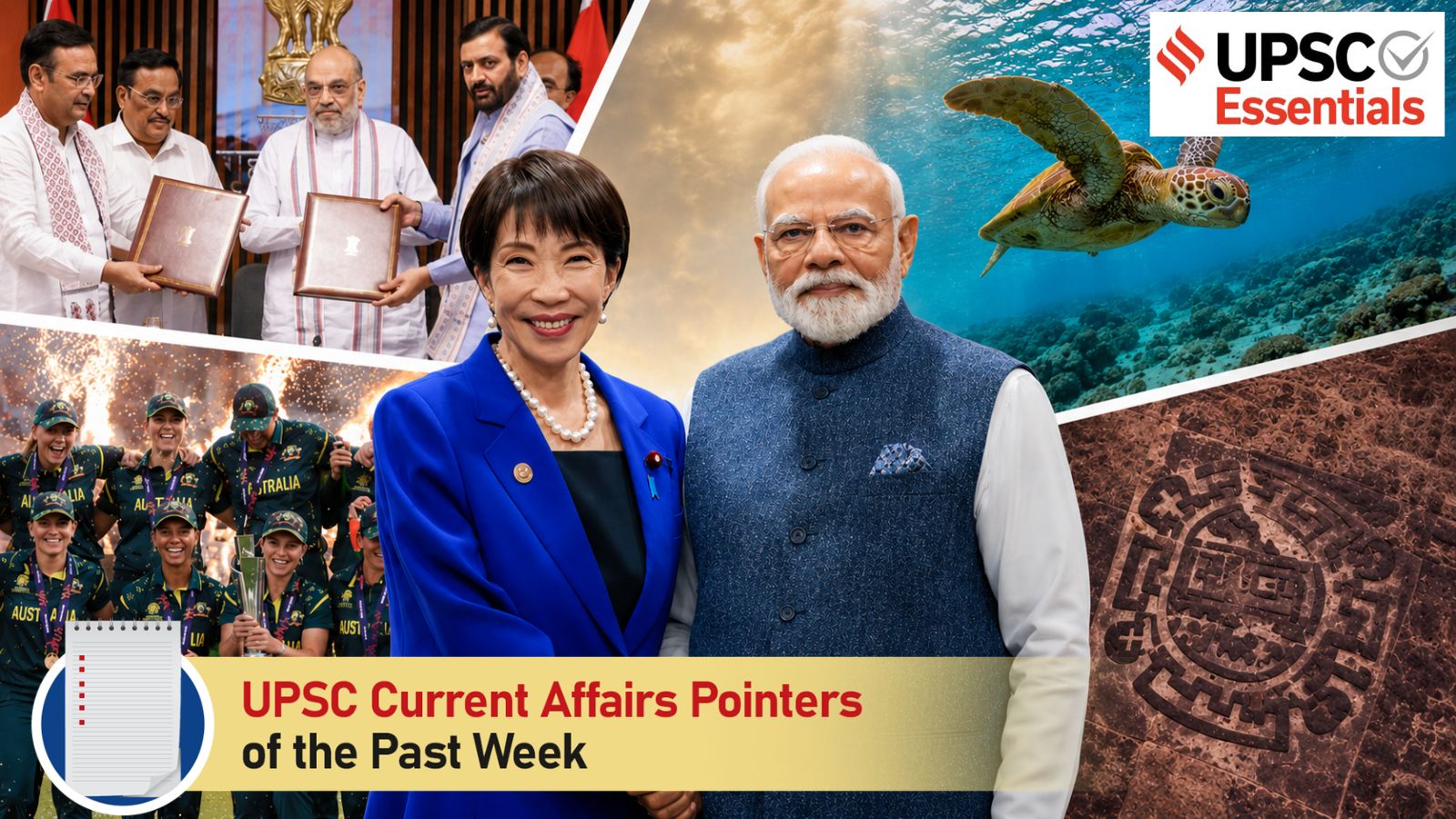
— Japanese Prime Minister Sanae Takaichi visited India from July 1 to 3. She participated in the 16th edition of the India-Japan Annual Summit, a mechanism established in 2006 under which the prime ministers of the two countries meet annually, each alternating as host.
— The bilateral trade reached $27.5 billion in 2025-26, with Japanese investment in India going up to $3.2 billion between April and December 2025.
— Japan is among India’s largest investors, backing major infrastructure projects including a high-speed rail corridor between Mumbai and Ahmedabad.
— Japan is the only country with which India has a dedicated institutional mechanism for the development of the North-East – the India-Japan Act East Forum. India and Japan are partnering on connectivity and development in Northeast India, including projects in infrastructure, urban renewal, energy, agriculture, tourism and skills.
— The North-East fits into Japan’s vision of a free and open Indo-Pacific as a bridge connecting South Asia with Southeast Asia.
— Japan participates in several bilateral exercises with India, including JAIMEX, Dharma Guardian, Veer Guardian, and bilateral Coast Guard Drills, as well as in multilateral exercises such as MALABAR and MILAN.
Major outcomes of the 16th India-Japan Annual Summit:
(i) India-Japan Joint Declaration on Economic Security to promote project-based collaboration in semiconductors, critical minerals, ICT, including AI, clean energy and pharmaceuticals, while enhancing joint resilience in strategic sectors.
(ii) Joint announcement to celebrate 2027 as the India-Japan Year of Shared Horizons, commemorating the 75th anniversary of diplomatic relations through a series of events.
(iii) MoU for the India-Japan Cooperative Biogas for Growth (CBG) Initiative to support the establishment of 1,000 biogas and organic fertilizer plants across India through dairy cooperatives.
(iv) MoUs were signed for batteries; pharmaceuticals and medical devices; geology and mineral exploration; and collaboration across the full AI technology stack, including foundation models.
EU Carbon tax
— The Centre is working on a scheme to absorb 90% of the compliance cost borne by micro, small, and medium enterprises (MSMEs) to help soften the disproportionate impact of the Carbon Border Adjustment Mechanism (CBAM) compliance burden imposed by the European Union.
— India’s efforts to secure a concession for its small industries in negotiations with developed countries have not worked, and the industry has been seeking assistance to meet the steep annual compliance costs due to the imposition of the EU’s carbon tax since January 1, 2026.
— According to the World Bank, “a carbon tax directly sets a price on carbon by defining a tax rate on greenhouse gas emissions or – more commonly – on the carbon content of fossil fuels”. It is a type of carbon pricing, and the other type of carbon pricing is the emissions trading system (ETS). The CBAM is a form of carbon pricing system.
— The CBAM or Carbon Tax was first introduced by the European Union in 2021. It taxes certain products coming in from other countries based on their carbon emissions footprint in their production process.
— For instance, if the imported steel were produced through a process that entailed higher emissions than the emissions standards for that product in Europe, it would be taxed.
— CBAM allows industries in Europe to remain competitive while continuing to maintain high environmental standards.
— It prevents these industries from relocating their production to countries where production might be cheap owing to less strict emission norms, a situation described as carbon leakage. In the process, it hopes to contribute to reducing global emissions.
Prime Minister Narendra Modi and Seychelles President Patrick Herminie (Photo/X@narendramodi)
PM Modi state visit to Seychelles
— Prime Minister Narendra Modi undertook a state visit to Seychelles from June 27-29 to participate as the Guest of Honour in the Golden Jubilee celebrations of their National Day.
— Following the official talks, both leaders released a joint commemorative logo marking 50 years of the establishment of diplomatic relations between the two countries.
Outcomes of the visit:
• India also gifted one Fast Patrol Vessel to the Government of Seychelles.
• Extradition treaty aimed at strengthening cross-border crime cooperation
• An agreement on cooperation in the peaceful uses of outer space
• An agreement to advance UPI-based digital payments in Seychelles
• Umbrella line of credit agreement with the Export-Import Bank of India
• An agreement for preliminary preparations for a new Seychelles National Hospital.
• Seychelles announced that it is joining the Coalition for Disaster Resilient Infrastructure (CDRI).
— Diplomatic ties were established with Seychelles in 1976. Earlier this year, Modi also described Seychelles as a key part of India’s maritime policy — Vision MAHASAGAR (Mutual and Holistic Advancement for Security and Growth Across Regions).
— Seychelles conferred the title of “Guardian of the Blue Horizon”—the Republic of Seychelles’ highest honour for international dignitaries—upon Prime Minister Narendra Modi.
— This distinction represents the highest honour that the Republic of Seychelles confers upon international dignitaries.
The island republic of Seychelles is located in the western Indian Ocean. Seychelles is situated between 4° and 11° S latitude and 46° and 56° E longitude. The major islands are about 1,000 miles east of Kenya and roughly 700 miles northeast of Madagascar. Victoria, the capital, is on Mahé Island. Situated close to Africa, the Middle East, and Asia, Seychelles serves as a vital counterweight against expanding influence of China in the Indian Ocean.
It operates under a presidential system of government. Dr. Patrick Herminie is the current President of the country.
Environment
The seizures suggest traffickers overwhelmingly rely on passenger trains rather than railway cargo systems. All 654 animals recovered during the six-year period were found concealed in passengers’ luggage.
India’s protected turtles
— Police in Madhya Pradesh are preparing their first coordinated crackdown on wildlife trafficking through the state’s railway network.
— This is done after an analysis of six years of seizure data uncovered organised interstate networks smuggling protected freshwater turtles from northern India’s river systems to markets in Southeast Asia and the Middle East, The Indian Express has learnt.
— “Freshwater turtles are the species we encounter most frequently in trafficking cases,” a senior wildlife official said.
— The Indian softshell and Indian flapshell turtle — both listed under Schedule I of the Wildlife Protection Act, 1972, in the same protection category as tigers and elephants — inhabit the river systems of the Gangetic basin.
— “Indian roofed turtles and star tortoises are primarily sought for the illegal pet trade,” officials familiar with the investigations said.
— “Species such as the Batagur turtle, which is critically endangered and survives in very limited stretches, including the Chambal river system, are particularly vulnerable as they are trafficked to exotic pet markets in Southeast Asia,” a senior forest officer said.
18th anniversary of tiger reintroductions at the Sariska Tiger Reserve
— The Centre released two new assessments to mark the 18th anniversary of tiger reintroductions at the Sariska Tiger Reserve in Alwar. Nestled in the lap of the Aravalli ranges, the tiger reserve had previously lost all its tigers.
— The first is a roadmap to manage tigers in the years ahead while the second dictates the lessons learnt from 12 re-introduction initiatives in the country. It has been argued that national parks and reserves with low tigers should be in focus beyond simply counting tiger numbers.
— India’s tiger population has risen steadily. From 1,411 in 2006, there are now 3,682 tigers in 2022 across 58 tiger reserves, spread across 85,000 square kilometers (sq km).
— Of the 58 tiger reserves, 10-12 tiger reserves alone account for about 36 per cent of the population. Importantly, there are 12 tiger reserves with less than three tigers inside.
— Three of these reserves– Kawal, Kamlang and Dampa– have zero tigers. As the density of tigers increases, they disperse to buffer areas, territorial divisions and mixed-use land.
— The Sariska reintroduction episode is considered as the first successful scientific tiger reintroduction to be carried out in the world, with previous attempts having failed in Russia.
— Sariska’s success was replicated in Panna which had faced a similar wipeout of tigers in the mid to late 2000s. Since Panna’s reintroduction project in 2009, ten such translocations have been carried out with mixed success and some outright failures.
Hasdeo Arand forest
— In Chhattisgarh’s Hasdeo-Arand forests, the Environment Ministry has accorded environmental clearance for mining in the Kente extension integrated coal block, with a projected production capacity of 9 million tonnes of coal per annum.
— This is the third major coalfield that has been granted clearance in the Hasdeo forests. Parsa and Parsa East Kente Basan (PEKB) open cast mines are already operational in the forests — once earmarked as a no-go zone for mining to protect forests and wildlife.
— The Hasdeo-Arand forests are considered Central India’s green lungs. They are home to around 640 plant species and nine schedule-1 wildlife species, which are accorded the highest legal protection. About 40-50 elephants are known to use the forests overlapping with the coal field area. Also, the forest is a catchment for Hasdeo river which joins the Mahanadi.
— The forest spans the Korba, Surguja and Surajpur districts in Chhattisgarh. It is also a catchment for the Hasdeo River and Bango Dam, and a dispersal corridor for tigers.
Science & Technology
NASA’s Swift Boost mission
— NASA has successfully launched a first-of-its-kind rescue mission, Swift Boost mission, aimed at extending the life of one of its longest-serving space observatories.
— The mission sent a privately built spacecraft into orbit to rendezvous with the ageing Neil Gehrels Swift Observatory, which is gradually losing altitude and faces eventual destruction as atmospheric drag pulls it back toward Earth.— The mission also marked the final flight of Northrop Grumman’s Pegasus XL rocket, bringing an end to a launch vehicle that has served the space industry for more than three decades.
— Launched in November 2004, the Swift Observatory was designed to study gamma-ray bursts and other high-energy cosmic events. More than 20 years later, the telescope continues to deliver valuable scientific observations.
— However, increased solar activity has intensified atmospheric drag in low Earth orbit, causing Swift’s orbit to gradually decay. Unlike many newer spacecraft, Swift was not designed with propulsion systems capable of raising its own orbit, leaving it vulnerable to eventual re-entry.
— Over the coming weeks, LINK will gradually approach Swift while observing the spacecraft to determine the safest location for capture.
— The servicing spacecraft is equipped with three robotic arms that will secure the observatory before using ion thrusters to slowly raise both spacecraft back to a more stable orbit over several months.
BMS ‘hack’
— The government has directed Apple and Google to take down at least three apps over reports of them being misused to remotely switch off some e-rickshaws amid cybersecurity concerns and passenger safety risks.
— The apps that have been directed to be blocked include BAT-BMS, Lossigy, and Epoch Li-ion. At least a couple of them are of Chinese origin.
— A battery management system (BMS) essentially tracks the state of a battery, with the primary aim of eliminating variations in performance of individual battery cells to allow them to work uniformly inside a battery pack.
— This system is incorporated in an electric vehicle (EV) powered by a large-capacity lithium-ion battery and plays a key role in extending the battery’s service life and ensuring its safe use.
— The BAT-BMS app was originally developed by China’s Shenzhen Grenergy Technology as a legitimate battery management tool for Bluetooth-enabled lithium-ion batteries. The idea of having a Bluetooth connection point is to enable vehicles with these batteries to connect to the device remotely through an app and monitor the parameters of the battery on a real-time basis.
— The primary concern, however, lies with the security configuration of some BMSs used in low-cost EVs. The apps in question could connect to the BMS within a limited range and be used to cut battery power, bringing the vehicle to a sudden halt.
Places in News
(Just FYI: The location of the place is important, considering that UPSC has asked several questions about places that were in the news, such as Aleppo and Kirkuk, in the 2018 UPSC Prelims. The best way to remember them is to plot them on a world map.)
Petroglyphs in Konkon
— The Maharashtra government is making technology meet archaeology by using Artificial Intelligence (AI) to scientifically analyse, classify and interpret the origin and cultural etymology of thousands of prehistoric petroglyphs scattered across the Konkan region.
— Petroglyphs are stone carvings of animal figures or humanoids, found in the lateral plateau regions across Ratnagiri and Sindhudurg districts of coastal Maharashtra.
— The carvings mainly comprise figurines, including turtles, elephants, peacock and rhinoceros. These were discovered throughout a series of expeditions and excavations carried out between 2017 and 2023.
— According to archaeologists and experts, the origin of these carvings ranges between 20,000 BC and 10,000 BC and is older than the Harappan civilization whose earliest phase dates back to 7,000 BC-5,000 BC. The carvings have an average size of 50 square metres by 20 square metres.
Do You Know?
India’s first Petroglyph Conservation Park will open at Sindhu Ghat in Leh. The foundation stone was laid in April this year by L-G Vinai Kumar Saxena. The Petroglyph Park aims to serve as a dedicated conservation space for centuries-old rock carvings (petroglyphs) that are increasingly under threat due to unregulated tourism, rapid infrastructure development, and a lack of awareness.
Vizhinjam Port
— Adani Ports and SEZ (APSEZ) Ltd is moving to sell 49% of its stake in Kerala’s Vizhinjam port to Switzerland-based container shipping behemoth MSC Group for around $1.4 billion (more than Rs 13,000 crore).
— The Kerala government has stated that Adani’s decision to sell the 49% stake constitutes a change in ownership under the agreement’s terms and, thus, requires government permission.
— Vizhinjam is India’s first deep-water container transshipment port and is expected to handle domestic and regional cargo at a lower cost rather than routing it through Sri Lanka, according to its website.
— The project is being developed as a public-private partnership between the Kerala government and Adani Vizhinjam Port Pvt Ltd (AVPPL) — the port’s operating company and concessionaire — under the Design, Build, Finance, Operate and Transfer (DBFOT) model.
— According to the concession agreement, Adani must retain 51% share in the port during the construction period and the first year of commercial operations. Beyond the first year, it has to maintain a minimum share of 26%.
— According to the Adani group, the Vizhinjam port is now in its second year of operations, allowing it to dilute up to 74% of its stake.
— The agreement doesn’t prohibit a stake sale, as laid out above. But it does say that Adani shall not undertake or permit any change in ownership, except with the prior approval of the authority — that is, the government.
Awards
2026 Commonwealth Short Story Prize
— Trinidadian writer Jamir Nazir, 61, who wrote ‘The Serpent in the Grove’, has been named the 2026 overall winner of the £5,000 (₹6,23,500) award.
— Since 2012, Granta has been publishing the winners of the Prize — awarded in partnership with the Commonwealth Foundation — for five geographies: Africa, Asia, Canada and Europe, the Caribbean, and the Pacific.
Winners
Asia region: Sharon Aruparayil (India) for Mehendi Nights
Africa: Lisa-Anne Julien (South Africa) for Me and Ma’am
Canada and Europe: John Edward DeMicoli (Malta) for The Bastion’s Shadow. DeMicoli is the first Maltese writer ever to win the regional prize.
Caribbean region: Jamir Nazir (Trinidad and Tobago) for The Serpent in the Grove.
Pacific region: Holly Ann Miller (New Zealand) for Second Skin
Sports
Australia’s Ellyse Perry celebrates with teammates after winning the ICC Women’s T20 World Cup 2026 (Reuters Photo)
Women’s T20 World Cup
— Australia was crowned champion of this year’s T20 World Cup, clinching their seventh title; with this, they bagged the biggest cash prize in women’s cricket history.
— The tournament had a record prize pool on offer after the International Cricket Council (ICC) increased the total prize money for the 2026 edition to $8.76 million (approximately Rs 73.1 crore), the highest ever for a Women’s T20 World Cup.
— The final was held between Australia and England. Australia won the match with seven wickets.
Brief Scores: England 150/4 in 20 overs (Nat Sciver-Brunt 58 not out) lost to Australia 153/3 in 17.1 overs (Beth Mooney 64, Phoebe Litchfield 48) by seven wickets.
Test Your Knowledge
(Note: The best way to remember facts for UPSC and other competitive exams is to recall them through MCQs. Try to solve the following questions on your own.)
(1) Consider the following statements: (UPSC CSE 2019)
1. Some species of turtles are herbivores.
2. Some species of fish are herbivores.
3. Some species of marine mammals are herbivores.
4. Some species of snakes are viviparous.
Which of the statements given above are correct?
(a) 1 and 3 only
(b) 2, 3 and 4 only
(c) 2 and 4 only
(d) 1, 2, 3 and 4
(2) Consider the following statements about the Carbon Border Adjustment Mechanism (CBAM):
1. Form of carbon pricing
2. First introduced by India
3. The UK’s carbon tax will come into effect from 2027.
How many of the statements mentioned above is/are correct?
(a) Only one
(b) Only two
(c) All three
(d) None
Prelims Answer Key
1. (d) 2. (b)
For your suggestions and feedback, write to [email protected]
Subscribe to our UPSC newsletter. Stay updated with the latest UPSC articles by joining our Telegram channel – IndianExpress UPSC Hub, and follow us on Instagram and X.
🚨 Click Here to read the UPSC Essentials magazine for June 2026. Share your views and suggestions in the comment box or at [email protected]🚨
View original source — Indian Express ↗
Related stories

Indian Express
TechnologyJul 6, 2026 · 1 min
Sony’s PlayStation game discs will still be available after 2028, but there’s a catch
Indian Express

AllAfrica
TechnologyJul 6, 2026 · 1 min
Nigeria: Ekiti Governor Visits Rescued Victims, Condemns Politicising Insecurity
AllAfrica
South China Morning Post
TechnologyJul 6, 2026 · 1 min
China’s EV deliveries remain stuck in downward spiral, exacerbating industry worries
South China Morning Post

The Guardian
TechnologyJul 6, 2026 · 1 min
‘It’s smoke and mirrors’: hope turns to fear in Scottish village chosen for AI datacentre
The Guardian