Indian Express
Knowledge Nugget: How direct seeded rice could be the future of rice farming
With sustainable agriculture, water conservation, and climate-resilient farming practices becoming crucial in the backdrop of climate change, Direct Seeded Rice (DSR) has been seen as a key way to make rice cultivation more efficient and climate-resilient. Here’s your UPSC Current Affairs knowledge nugget for today on direct seeding of rice.
In an El Niño year, direct seeded rice is gaining traction among farmers. In this context, let’s know what direct seeding of rice is, how it works, and what its benefits and drawbacks are.
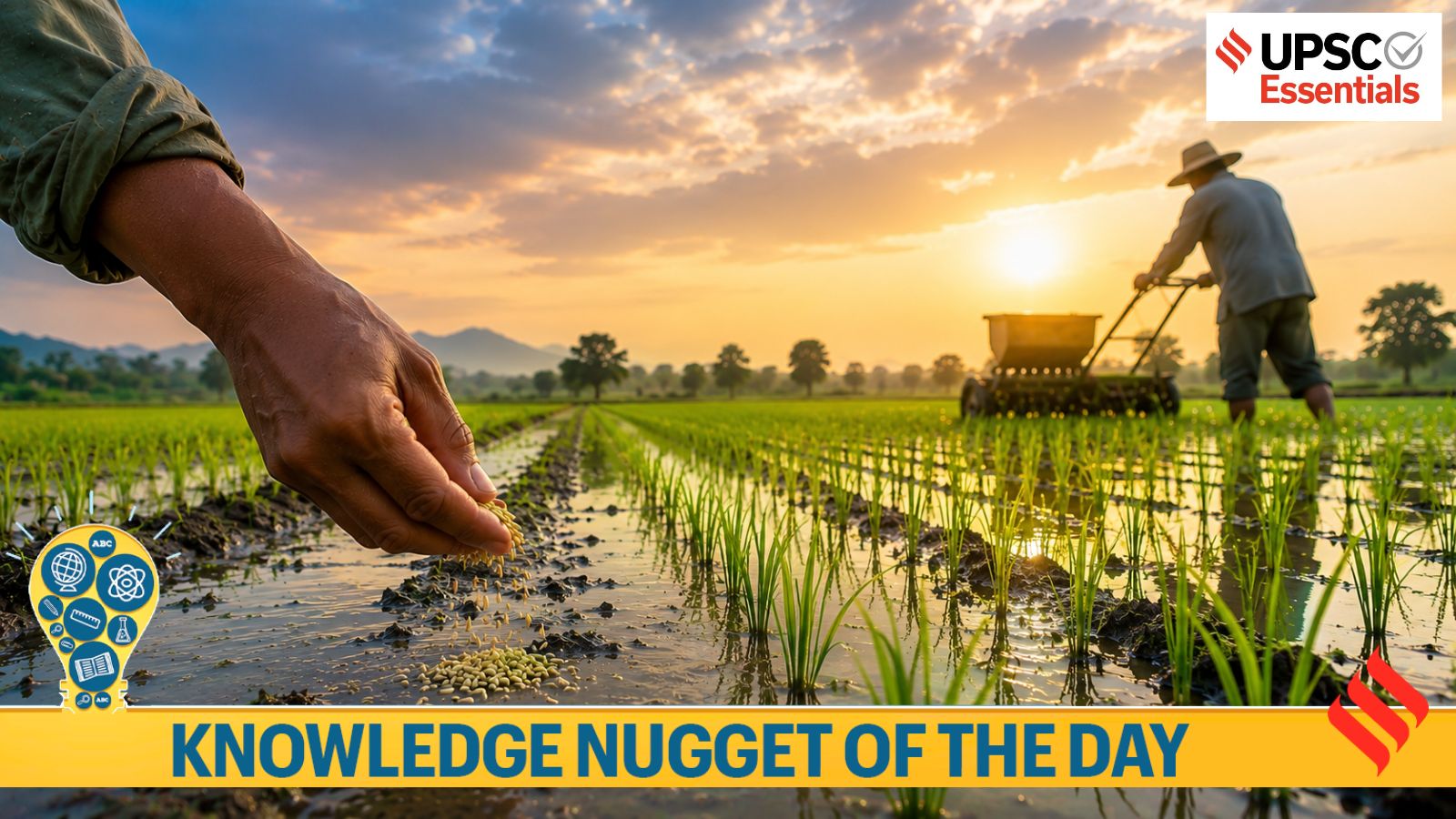
1. Direct Seeding of Rice refers to the practice of sowing rice seeds directly onto the main field without using a nursery to transplant seedlings. It is also known as the ‘tar-wattar’ technique.
2. Direct seeding can be accomplished by sowing pre-germinated seed into wet soil (wet seeding via broadcast or drum seeder) or by planting dry seed (dry seeding by broadcast and seed-cum-fertilizer drill) on prepared ground.
How does DSR work?
3. Traditionally, paddy farmers create nurseries where seeds are first planted. After 25–35 days, the immature plants are plucked and transplanted in the flooded main field. While this practice is labour and water expensive, it is known to increase yields and improve crop health.
4. DSR, as the name suggests, requires no nursery preparation or transplantation. Paddy seeds are directly sown, roughly 20-30 days prior to when they would have been transplanted. The field is irrigated and laser leveled prior to the seeding process which is carried out using a seed drill or lucky seeder. Seed treatment is crucial, with seeds soaked in a fungicide solution for eight hours, then dried for half a day before sowing.
5. The first round of irrigation is carried out 21 days after sowing, followed by 14-17 more rounds at 7-10 day intervals, depending on soil type and the quality of the monsoon. The final irrigation takes place 10 days before harvest. The traditional method requires 25-27 irrigations in total.
Story continues below this ad
What are the benefits of DSR?
6. Direct seeding of rice provides several benefits such as:
(i) It can reduce water use by 15% to 20% (the traditional puddling method requires 3,600 to 4,125 litres of water to grow a single kilo of rice).
(ii) DSR requires less labour.
(iii) It matures 7 to 10 days faster, giving farmers more time to manage paddy straw.
(iv) It offers low production cost
Story continues below this ad
(v) DSR provides better soil physical conditions for following crops and less methane emission.
What are the challenges associated with DSR?
7. Weeds are the biggest significant impediment to the success of DSR. Weeds are more problematic in DSR than in puddled transplanting because sprouting weeds compete with simultaneously emerging DSR seedlings.
8. While direct planting can help to reduce methane emissions, aerobic soil conditions can also increase nitrous oxide emissions. Nitrous oxide generation increases with redox potential.
9. Micronutrient deficiencies are a prominent cause of concern in DSR such lack of iron content of the soil can severely impact yields and lead to major financial losses for farmers.
Story continues below this ad
India's rice production surge: food security and sustainability
Top producer Water cost Where it grows Fortification push
World's largest producer
India overtakes China in 2024-25
India surpassed China to become the world's largest rice producer in 2024-25, cementing its dominance in both global output and global trade of the crop.
28%
Share of global rice production, 2024-25
40%
Share of global rice trade
#1
Rank, having overtaken China
The water cost
A thirsty crop straining groundwater
Rice is water-intensive, and this heavy draw has caused over-exploitation of groundwater across many rice-growing regions of the country.
3,000-4,000L
Water needed to produce 1 kg of rice
2009
Punjab and Haryana pass Subsoil Water Act
●
Delayed sowing rule
The law bars sowing paddy before May 10 and transplanting before June 10, shifting irrigation burden from groundwater to monsoon rain.
▲
Narrow sowing window
The delay leaves little time before the next crop, pushing farmers toward burning stubble to clear fields quickly.
⚠
Air quality fallout
Stubble burning has become a major seasonal cause of degrading air quality across northern India.
Where it grows
Rice belts follow India's river basins
Rice needs hot, humid conditions, plentiful water and alluvial soil — so river flood plains across India form its most productive rice regions.
▲
Brahmaputra basin, north-east
Records the highest intensity of rice cultivation in the north-eastern region.
▲
Ganga and Mahanadi basins, east
Highest cultivation intensity spans Bihar, Chhattisgarh, Jharkhand, Madhya Pradesh, Odisha, Uttar Pradesh and West Bengal.
▲
Godavari, Krishna, Cauvery deltas, south
Telangana leads all states in rice production, alongside Andhra Pradesh, Tamil Nadu and Kerala.
▲
Punjab and Haryana, north
Key northern rice-producing states; in Himachal Pradesh and Jammu & Kashmir, low winter temperatures restrict the season to May-July through September-December.
Fortification push
Fighting anaemia through the ration plate
To tackle anaemia and other nutritional deficiencies, the government piloted rice fortified with iron, folic acid and vitamin B12 between 2019 and 2022, before the Union Cabinet approved it in 2022.
81.35 Cr
People covered under NFSA
65%+
Share of foodgrains allocation that is rice
40.6 MT
Rice allocated for 2025-26
What is the status of Rice production in India?
10. In January 2026, the Union Agriculture Minister Shivraj Singh Chouhan said that with the production of around 150 million metric tonnes of rice, India has surpassed China which produces 145.28 million tonnes to become the world’s largest rice producer in 2024-25.
11. Rice crop requires hot and humid conditions, abundant water availability, and alluvial soil (soil formed by the deposition of silt brought by rivers). River flood plains are among the most rice productive regions.
12. A temperature range of 20-37.5 degree celcius is required for its optimum growth. It is grown both during the kharif (southwest monsoon) and rabi (winter-spring) seasons. Moreover, it is cultivated across a wide geography.
BEYOND THE NUGGET: What is India’s Designer Rice?
1. Scientists at CSIR – National Institute for Interdisciplinary Science and Technology (NIIST) in Thiruvananthapuram, Kerala, have developed a “designer rice”. During the technology transfer ceremony held on 18th February, 2026, titled “CSIR-NIIST Tech Connect: From Lab to Market”, the rice was officially released.
Story continues below this ad
2. The scientists have applied food-processing technology rather than genetic modification to bring this designer rice. It is a “fundamental re-architecture of our most basic staple”.
3. Dr C. Anandharamakrishnan, Director, CSIR-NIIST and the visionary behind the project, noted, “To understand this, imagine a building. If traditional rice is a house made mostly of ‘sugar bricks’ (starch), the CSIR-NIIST team took that house apart. They removed a significant portion of the starch and replaced it with ‘protein beams’.”
4. The team took broken rice ground them into flour, and blended them with protein and micronutrients like iron, folic acid, and Vitamin B12. They then “reformed” this mixture into grains that look, feel, and taste exactly like the rice we know.
5. Benefits of the Designer rice
* Low GI: According to the scientists, designer rice benefits as it has a low glycemic index(GI) which is below 55. “It releases energy slowly, preventing the sugar spikes that plague diabetics.”
Story continues below this ad
* Protein powerhouse: While normal rice has about 6–8 per cent protein, this version boasts over 20 per cent.
* Fortified defense: It bridges the gap for anaemia by embedding iron, folic acid, and Vitamin B12 directly into the grain’s structure.
Post Read Question
With reference to the direct seeding of rice, consider the following statements:
1. It is a method of sowing rice seeds directly into the main field, without raising a nursery for transplanting seedlings.
2. It is done only through sowing dry seed.
3. It helps in substantial savings of irrigation water.
Which of the statements given above is/are correct?
(a) 1 only
(b) 2 and 3 only
(c) 3 only
(d) 1 and 3 only
Answer key
(d)
Story continues below this ad
(Sources: Why direct seeding of rice (DSR) is yet to pick up in Punjab, In El Niño year, direct seeded rice finds traction with farmers)
🚨 Click Here to read the UPSC Essentials magazine for June 2026. Share your views and suggestions in the comment box or at [email protected]🚨
Subscribe to our UPSC newsletter. Stay updated with the latest UPSC articles by joining our Telegram channel – Indian Express UPSC Hub, and follow us on Instagram and X
View original source — Indian Express ↗
Related stories

Euronews
TechnologyJul 6, 2026 · 1 min
South Korea to funnel AI chip tax windfall into public investment, housing and jobs
Euronews

TechSathi
TechnologyJul 6, 2026 · 1 min
OPPO A6s Pro Price in Nepal: Specifications, Features & Availability
TechSathi

Rio Times
TechnologyJul 6, 2026 · 1 min
Bitcoin Holds Above $63,000 as the July Rebound Extends
Rio Times

TechRadar
TechnologyJul 6, 2026 · 1 min
'We’re seeing a clear divide': Many business leaders admit they only have a 'limited understanding' of AI budgets
TechRadar