SBS News
Two major Pacific deals down, Albanese now looks ahead to the Solomon Islands
in brief
Anthony Albanese is on a diplomatic tour of the Pacific.
China confirmed it has tested ballistic missiles in the region as experts warn it looks to expand its influence.
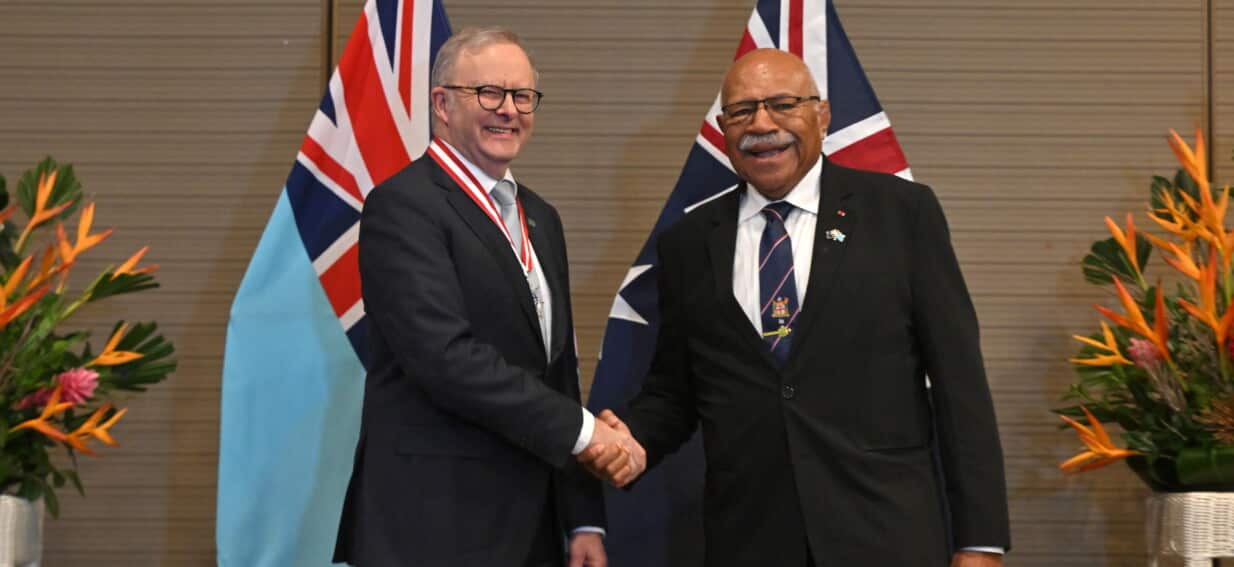
Anthony Albanese is turning his attention to the Solomon Islands after securing Australia a major new defence agreement with Fiji, as he seeks to shore up support against the expansion of Chinese influence in the region.
Albanese and Fijian Prime Minister Sitiveni Rabuka formalised the Ocean of Peace Alliance alongside an updated Vuvale Union partnership during a ceremony in the Fijian capital Suva on Monday.
Albanese hailed the treaties, aimed at strengthening regional security amid intensifying strategic competition in the Pacific, as "one of the most significant endeavours Australia has undertaken with any country".
Fiji is one of Australia's closest Pacific security partners and has one of the region's largest militaries, making the agreement one of Canberra's most noteworthy in the Pacific.
The visit to Suva is part of a days-long diplomatic mission during which Albanese will meet with several regional leaders including Solomon Islands counterpart Matthew Wale for a whistle-stop tour on Tuesday, with the focus on a new comprehensive treaty.
News that makes sense
Your trusted source for staying up-to-date with the world around you. Get free daily news updates and analysis, straight to your inbox.
The leaders last week agreed to start talks on a treaty to "capture the two countries' joint ambition for the relationship".
This latest push from Albanese comes as China confirmed on Monday it successfully tested a submarine-launched ballistic missile carried by a strategic nuclear submarine in international waters in the Pacific Ocean.
What's in the latest agreements?
The agreements with Fiji expand the two nations' long-standing security and development relationship and introduce a mutual defence commitment.
The new Ocean of Peace Alliance commits both countries to consult and respond to security developments that threaten the sovereignty, peace or stability of either nation.
"Each Party recognises that an armed attack on any of the Parties within the Pacific would be dangerous to each other's peace and security as well as the security of the Pacific, and declares that it would act to meet the common danger, in accordance with its domestic processes," the deal reads.
Australia will support the partnership with more than $1 billion in funding over the next decade, targeting transnational crime prevention and investing in education, healthcare, and infrastructure projects in Fiji.
What is Australia's strategy for the Pacific?
Australia works with all 14 Pacific Island nations to varying degrees, and has major security agreements with Papua New Guinea, Fiji, Solomon Islands, Vanuatu, Tuvalu and Nauru.
It also cooperates with other nations in the region, from foreign aid and infrastructure funding to marine surveillance and peacekeeping.
Henry Ivarature, a Pacific fellow with the Australia Pacific Security College at the Australian National University, told SBS News Australia has been "very successful" in securing security agreements with Pacific nations.
"I think Australia has learned to listen to Pacific leaders and accommodate their concerns," he said.
Australia has spent billions of dollars in development funding for its neighbours, in what Ivarature described as "great deals" for Pacific Island nations.
"The challenge is sustaining these relationships and strengthening them in the long term against the growing influence of China," he explained.
"Not engaging leaves the door open to other players to enter."
China has previously criticised Australia's growing network of regional security agreements, arguing they are intended to limit Beijing's influence, although Fijian leaders have indicated the new treaty is not directed at any particular country.
Last week, Australia signed a $500 million security deal with Vanuatu, which will allow Australia to be consulted on any third party involvement in Vanuatu's critical infrastructure.
What about other global powers?
The agreement also comes amid growing competition between Australia, China and other powers for influence across the Pacific.
Paul Dibb, an expert on Australia's defence policy, told SBS News that competition in the Pacific is intensifying as China seeks to be the "dominant power" in the region.
"China has consistently tried very hard but hasn't achieved the same sorts of defence pacts as Australia," he said.
"China does, however, have a win in the Solomon Islands, where it does have a foothold."
The China-Solomon Islands security agreement, signed in 2022, allows Beijing to deploy police and military personnel, including armed forces, to Solomon Islands to maintain social order and protect Chinese personnel and projects.
The pact also permits Chinese naval vessels to dock and replenish in the country.
China also cooperates with a handful of other Pacific nations with various programs, including police training and infrastructure funding.
Dibb said this limited but "worrying" Chinese influence in the Pacific is cause for concern for several global powers.
"I think we can expect our Japanese friends to be seriously worried; the Chinese are already making it very difficult for the Japanese Navy in the East and South China seas, which adjoin China," he said.
The United Kingdom, the United States, New Zealand, and France all have agreements and deals with Pacific nations and are "likely on edge", Dibb added.
What's next for Anthony Albanese?
Albanese will meet Papua New Guinea Prime Minister James Marape and Tonga's Prime Minister Lord Fakafānua in Brisbane at the final State of Origin rugby league game on Wednesday.
Albanese and Marape are expected to mark the start of the Pukpuk Treaty between Australia and PNG and finalise agreements covering grassroots rugby league funding.
Albanese will finish his regional tour in Melbourne, where he is due to meet Indian Prime Minister Narendra Modi.
The two leaders are expected to sign agreements expanding defence and security cooperation while finalising arrangements to facilitate Australian uranium exports to India in support of its growing nuclear energy program.
Additional reporting by the Australian Associated Press
For the latest from SBS News, download our app and subscribe to our newsletter.
View original source — SBS News ↗
Related stories

The Punch
WorldJul 6, 2026 · 1 min
INEC partners NGO to boost voter registration awareness in Ondo
The Punch
The Punch
WorldJul 6, 2026 · 1 min
VIDEO: I was the olodo, now I feed them all, Portable recounts family, education struggles
The Punch
The Punch
WorldJul 6, 2026 · 1 min
Masquerade kills 24-year-old in Oyo, suspect arrested
The Punch
The Punch
WorldJul 6, 2026 · 1 min
Video of ‘fake’ agency DG confronting Gbajabiamila resurfaces
The Punch