Times of Israel
Gruff and unpolished, Gadi Eisenkot is becoming the face of the anti-Netanyahu movement
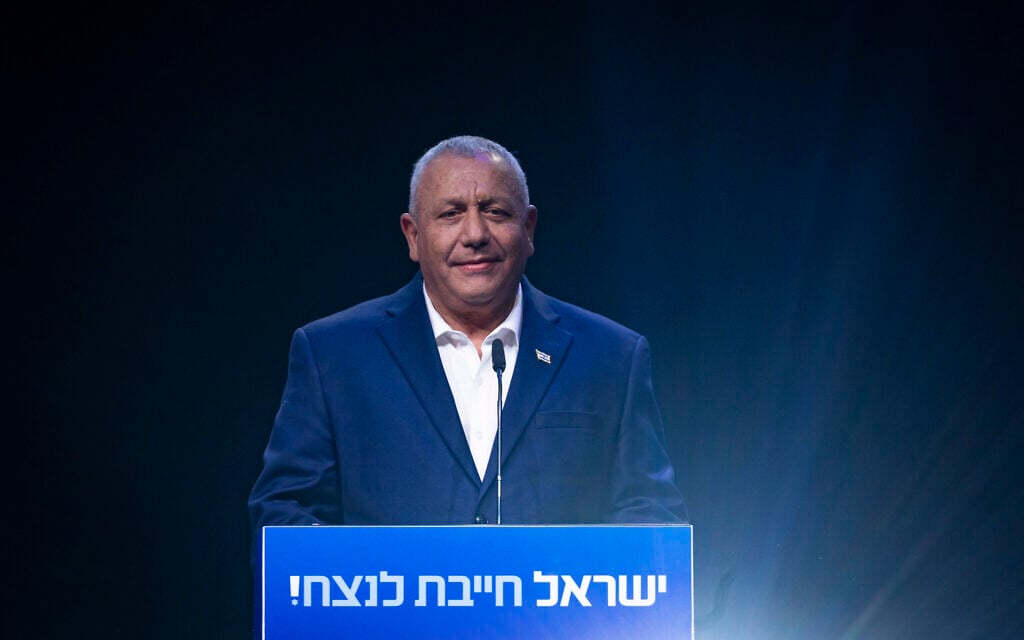
When Gadi Eisenkot took the podium at his new party’s official launch event last week, his message came through not just in what he said, but how he said it.
Eisenkot is the latest in a long line of contenders aiming to depose Prime Minister Benjamin Netanyahu, who has led Israel nearly uninterrupted since 2009. But unlike with some of those other challengers, the contrast between the premier and his opponent was apparent from the start.
Netanyahu is the consummate orator, most at home in the spotlight. He’s (almost) always clad in suit and tie. He knows when to crescendo his voice and when to pause for effect. He knows how to get the audience to clap. He knows when to joke, when to exhort, when to warn. He has no problem mentioning his brother’s death in battle to make a point. Sometimes he brings props.
Not so Eisenkot. When the former IDF chief of staff walked onstage, he seemed like… a former IDF chief of staff. He didn’t so much as wave to the crowd that had assembled to hear him. And when he launched into his speech, it was mostly in monotone, with few rises and falls, and with the gruff candidate looking directly at the crowd, unassumingly, in a suit with an open collar. He famously lost his son and two nephews in battle following the Hamas-led October 7, 2023, attack — but didn’t directly mention them once. He also didn’t mention Netanyahu by name.
“We will open a new and much better chapter in Israel’s history. We will write it together,” he said. “The leadership is using the term ‘national unity’ as a cynical election campaign. I will do everything to unify the nation.”
Get The Times of Israel's Daily Edition
by email and never miss our top stories
By signing up, you agree to the terms
Eisenkot is pitching a new era in Israeli government, presenting himself as an alternative not just to Netanyahu, but also to Naftali Bennett and Yair Lapid, who join him in opposing the premier. Their platforms are closer to Eisenkot’s, but their image and style — polished, poll-tested, fluent in English, comfortable on camera — are thoroughly a product of the Netanyahu era.
Embodied in Eisenkot’s persona and biography is a wager that his country is ready not just for a different policy, but for a different kind of politician. The question is whether a plainspoken candidate running for prime minister for the first time can make it through a brutal campaign — especially versus a longtime leader with a singular talent for winning elections who’s fighting desperately for his political life.
“Gadi projects everything Netanyahu is not,” Gayil Talshir, a political scientist at Hebrew University in Jerusalem, told The Times of Israel.
“He projects authenticity, he projects a spine,” Talshir added. “People see Gadi as a responsible figure who will work on behalf of the country’s security. He doesn’t sparkle, he doesn’t have the flash, he doesn’t have the rhetorical ability, he doesn’t have Netanyahu’s political shrewdness.”
Netanyahu — along with his surrogates in the media — argues that Eisenkot lacks the gumption necessary to lead Israel at such a critical moment. Some portray him as merely the latest frontman for an out-of-touch elite straining to keep its grasp on power.
But as Eisenkot rises in the polls, a consensus is forming: He’s the guy who will face off with the prime minister at the ballot box in late October.
“Netanyahu already knows who his main rival will be in the elections,” wrote Amit Segal, a Channel 12 political commentator with close ties to the prime minister’s camp. “It’s Netanyahu versus Eisenkot, and Eisenkot versus Netanyahu.”
Netanyahu’s lines of attack
Netanyahu has been experimenting in real time with lines of attack against Eisenkot, and so far, two have emerged: That he’ll be beholden to Arab politicians, and that he’ll be timid in the face of existential threats.
Netanyahu has worked to delegitimize Israel’s Arab political parties for more than a decade, and is using the Arabs as a cudgel against Eisenkot. His social media feed is filled with attack ad after attack ad juxtaposing Eisenkot’s photo next to the face of Ra’am chairman Mansour Abbas, who joined with an anti-Netanyahu coalition in 2021 to briefly unseat the prime minister.
The slogan “Eisenkot has no government without the Arab parties” is becoming a mainstay.
Opposition Leader Yair Lapid (right) and former prime minister Naftali Bennett at a press conference announcing their joint run in the coming elections, in Herzliya, central Israel, April 26, 2026. (Chaim Goldberg/Flash90)
Eisenkot, indeed, has not ruled out working with Arab parties to secure a majority in the Knesset, but the negative campaign also serves Netanyahu’s electoral math: Among the Knesset’s Jewish parties, the pro-Netanyahu bloc consistently trails the anti-Netanyahu parties, but both are shy of a 61-seat majority. The balance is held by Arab parties.
If Netanyahu can convince Israel’s electorate that cooperation of any kind with them is anathema, it could leave his opponents unable to form a coalition in a deadlocked Knesset — and keep him in power in the interim.
“Netanyahu needs a preventative bloc that will ensure that the liberal camp [opposing him] can’t form a government,” Talshir said. “Because that means we go to a transitional government and more elections. In other words, Netanyahu stays prime minister for at least [another] six months, if not a year.”
The other line of attack — that Eisenkot is gun-shy — is riskier for the premier.
It’s true that Eisenkot resigned from Netanyahu’s war cabinet in 2024, reportedly after sending the premier a letter complaining that the conflict that erupted on October 7, 2023, was being “conducted in accordance with tactical objectives, without meaningful moves to achieve the strategic objectives.”
Netanyahu has argued that Eisenkot was agitating to stop the war earlier — a decision that, he says, would have kept Israel from a series of victories against Hezbollah, Iran and other adversaries that left them dramatically weakened (and that caused the fall of Bashar al-Assad in Syria).
Pro-Netanyahu commentators are already echoing that argument. One, Yaakov Bardugo, included Eisenkot among a list of former IDF chiefs of staff and ministers who clashed with the prime minister and, he claimed, agitated to “make peace with Hezbollah” before Israel decimated the terror group’s leadership in 2024.
“Had we listened to [Yoav] Gallant, Gadi Eisenkot, Herzi Halevi, Benny Gantz, we’d be in a completely different place,” Bardugo said on a recent radio show. “Now they’re trying to rewrite history.”
But it’s also true that Netanyahu himself elevated Eisenkot to IDF chief of staff and praised his record at the time. Potentially more problematic for the prime minister, however, is the fact that Israelis don’t feel like Netanyahu won the wars he’s defending, turning the issue into a political minefield.
Hamas remains in power over part of Gaza and most of its population. Hezbollah is still ensconced in Lebanon. And when it comes to Iran, which has been Netanyahu’s focus for decades, more than 90% of Israelis feel the Islamic Republic came out on top after the latest round of fighting.
“It would have been better for him to say, ‘I erred, I set false goals that I wasn’t able to achieve,’” Eisenkot posted on X after Netanyahu claimed victory against Iran last month. “This would have given Netanyahu much more credit and respect from the people, if he had admitted he made empty declarations.”
That doesn’t mean, however, that voters won’t buy Netanyahu’s claims that the wars were resounding successes.
“Netanyahu knows that if you say things enough, people accept them as a given,” Talshir said. “Netanyahu keeps saying: ‘We won, we achieved all of this, Iran is weakened, we achieved 80% of our goals.’”
Rising through the ranks
Like many other leaders in the anti-Netanyahu camp, Eisenkot once worked for the man he’s now trying to unseat. Unlike some others, he hasn’t tried to emulate his former boss.
Much of the difference is biographical: Netanyahu grew up amid Israel’s Ashkenazi elite and spent part of his childhood in the United States; Eisenkot was one of nine children in a family of Moroccan descent, part of a historically marginalized minority, and grew up in the low-income peripheral cities of Tiberias and Eilat.
He rose through the ranks of the IDF’s famed Golani infantry brigade and became chief of staff in 2015, succeeding future political partner Benny Gantz. Helming the army, he gained a reputation for emphasizing organization and planning, something he continued focusing on after his discharge, when he co-wrote a pamphlet in 2019 outlining how Israel needed to approach its national security strategy.
The paper argued that Israel needed to focus on fighting short, defensive wars, combined with a “campaign between the wars” consisting of targeted offensive operations that convinced the enemy that resisting Israel was futile. The approach, he and co-author Gabi Siboni wrote, was based on the ideology of Ze’ev Jabotinsky, whose Revisionist Zionism was a forerunner of Netanyahu’s Likud.
“Peace is possible only once Israel’s enemies have concluded that their efforts are ineffective and serve to increase their own suffering,” Eisenkot and Siboni wrote. “They must be convinced that they can attain much more through dialogue than through violence.”
Eisenkot is also known for pioneering the “Dahiyeh Doctrine,” a military strategy named after Hezbollah’s stronghold in the southern suburbs of Beirut that advocates using overwhelming force against an enemy by destroying civilian infrastructure.
Yet his peace-through-strength hawkishness is tempered by his commitment to fighting within clearly defined legal and ethical boundaries, even if it means defying the political leadership.
The most controversial moment of his tenure as IDF chief came in 2016 when a combat medic, Elor Azaria, killed a Palestinian terrorist who had already been wounded and didn’t pose a threat.
In a politically charged tribunal, the IDF, backed by Eisenkot, tried and convicted Azaria for manslaughter.
“He thought the army has a certain ethos, and as chief of staff, it was up to him to make sure that it lived up to that ethos,” said David Makovsky, a senior fellow at the Washington Institute for Near East Policy, a Washington-based think tank where Eisenkot was based after his military career ended.
“If there’s a violation of those norms, then you act instinctively. And he did,” Makovsky said of Eisenkot. “And that wasn’t always the way other politicians saw it.”
Unlike Eisenkot, Netanyahu came out against Azaria’s prosecution. Acceding to calls from his base and political allies, the prime minister called the moment of the verdict “a hard and painful day” and said the soldier should be pardoned (he was not).
Azaria’s case may resurface in Netanyahu’s campaign, Talshir said, calling it a “card he holds up his sleeve” to sway voters who oppose prosecuting soldiers for abusing terrorists, and the issue is already rearing its head. Recently, the pro-Netanyahu pundit Shimon Riklin contrasted Eisenkot’s determination to prosecute Azaria with his alleged diffidence in the face of Israel’s foes.
“How could you speak of victory when, throughout the entire war, you exhibited softness and defeatism and a desire to stop the war?” Riklin posted on X last week. “If you act the hero when it comes to Elor Azaria on one hand, and on the other hand are constantly afraid of Israel’s enemies, you won’t be able to lead Israel.”
The anti-Bibi and the ‘wannaBibis’
Following the October 7 Hamas attack, Eisenkot, now in the Knesset, initially joined the emergency war cabinet alongside Blue and White chairman Benny Gantz. Two months into the war, he lost his son, Gal Meir Eisenkot, and vowed in his eulogy to “continue the campaign [in Gaza], fighting to strengthen the state you so loved, and especially so that it will be strong, developed and just.” He also lost two nephews in the fighting.
As the war ground on, Eisenkot increasingly broke with Netanyahu, and then with Gantz as well.
In mid-2024, Eisenkot and Gantz both resigned from the war cabinet, decrying the way Netanyahu was prosecuting the conflict. The following year, Eisenkot resigned from Gantz’s flailing centrist party and then from the Knesset. He’s now plotting his comeback from the helm of his own newly founded anti-Netanyahu centrist faction, Yashar, meaning “straight” or “honest.”
The party endorses the tenets that have animated the anti-Netanyahu opposition for years, according to a brief platform on its website. Its first priority is establishing a state commission of inquiry into the failures surrounding the October 7 attack, a subject which earned the largest round of applause in Eisenkot’s campaign speech.
Most Israelis want an empowered, independent inquest into the catastrophe, but Netanyahu has resisted the idea, instead pushing a probe with a mandate and scope determined by the Knesset, which his coalition controls. The party would also institute a two-term limit for the prime minister.
Unsurprisingly for Eisenkot, who focused on formulating long-term strategies as IDF chief and afterward, Yashar proposes creating a new national defense strategy based on pre-formulated plans rather than reactive moves, focused on “fortifying security at the borders.”
Like other centrist parties, Yashar avoids mentioning Palestinian statehood, an idea that the Netanyahu government explicitly opposes and that has become increasingly toxic among the electorate after October 7. But Yashar does, without elaboration, call for “expanding the circle of peace and ensuring a solid Jewish majority,” which would preclude annexing Palestinians into Israel.
In terms of one of Israel’s most intractable and urgent issues, integrating its growing Haredi population into mainstream society, Yashar proposes two initiatives: First, expanding national service for all Israelis, including Arabs and Haredim, the vast majority of whom do not currently enlist, with a particular emphasis on military service. Second, mandating the study of a core curriculum (generally including subjects such as English and math) in all schools, including ultra-Orthodox ones that eschew secular subjects.
Bennett and Lapid’s Together party, which also seeks to unseat Netanyahu, endorses versions of many of those principles too. What separates them from Eisenkot is image and biography.
Like Netanyahu, and unlike Eisenkot, Lapid and Bennett are practiced at politics and aren’t strangers to the world stage. They have deep differences with the sitting prime minister on substance, and similarities when it comes to style — examples of what Economist correspondent Anshel Pfeffer has long called the “WannaBibis.”
Eisenkot — stocky, grizzled, not particularly charismatic — cuts a different figure, and one that may be more appealing to Israeli voters, particularly Netanyahu’s heavily traditional, Mizrahi base, with whom Eisenkot shares his background.
Netanyahu’s Likud Party has mocked Eisenkot’s English, but it’s possible that his heavily accented timbre will resonate with the average Israeli. (And English doesn’t seem to be Eisenkot’s party’s top priority: He spells his name one way on social media, where he is active. In a video he posted on X, the English subtitles spelled it another way.)
“You always felt with him that what you see is what you get,” Makovsky said. “He’s someone who, I think, people feel he’s very authentic.”
Makovsky later described his former colleague as a “teddy bear with a steel spine.”
“He’s not going to be an easy target,” Makovsky added. ”I think people see him as the antithesis of a slick candidate.”
Against that backdrop — and particularly given the loss of Eisenkot’s son — the pro-Netanyahu commentator Avishay Ben Haim posted on X that the premier would do well to avoid attacking Eisenkot directly. Instead, he said, Netanyahu’s campaign should take aim at the structures an Eisenkot government would safeguard — namely, the court system, which Netanyahu’s voters see as imperious, and which his coalition has tried for years to weaken and delegitimize.
“The right campaign for the coalition is positioning Benjamin Netanyahu versus [Supreme Court President] Isaac Amit and the judicial system,” Ben Haim wrote. “It’s impossible to run a negative campaign against a dear man and bereaved father like Eisenkot.”
Heading into a caustic campaign
Eisenkot’s outsider image, however, may also prove to be a pitfall in the bloodsport of Israeli politics. He has admitted to being blindsided by the union of Lapid’s and Bennett’s parties earlier this year, done without his prior consultation.
His party has gained in the polls since then. But the race is only getting more intense, and Eisenkot, leading a party for the first time, will have to fend off all manner of attacks not only from experienced opposition politicians looking to claim the mantle of Netanyahu’s chief adversary, but from Netanyahu himself, the man who has won, or survived, more elections than any Israeli in history.
For now, Eisenkot seems to be sticking to his guns, betting that his approach to politics is the change voters are seeking. That’s apparent when it comes to the one piece of his story that most resonates with Israelis: the immense personal sacrifice he made after the October 7 attack.
Another politician, launching a campaign to lead the country, may have invoked the son who died in its service. Eisenkot chose not to, omitting his son’s name from his speech last week. Instead, while clearly alluding to himself, he framed bereavement — and the commitment to fight on — as a national condition.
“This is the people of Israel that you and I, and so many around us, know so well: on the battlefield, in the hospitals, in the embrace of those who have been wounded forever,” he said. Later, he added, “The pain of the war will never be erased, but I am convinced that we contain the strength to blossom and rebuild.”
View original source — Times of Israel ↗
Related stories

Straits Times
TechnologyJul 6, 2026 · 1 min
Israeli drone strike kills four people in southern Lebanon, Lebanese state media reports
Straits Times

South China Morning Post
TechnologyJul 6, 2026 · 1 min
Beijing opens lithium futures to foreign traders to cement pricing power over US
South China Morning Post

AllAfrica
TechnologyJul 6, 2026 · 1 min
Uganda: Museveni Defends Media Regulation, Opposition Bail Policy
AllAfrica

TechRadar
TechnologyJul 6, 2026 · 1 min
Will Netflix's Little House on the Prairie reboot be worth watching? Here's what time you can find it on the streamer
TechRadar