Philippine Daily Inquirer
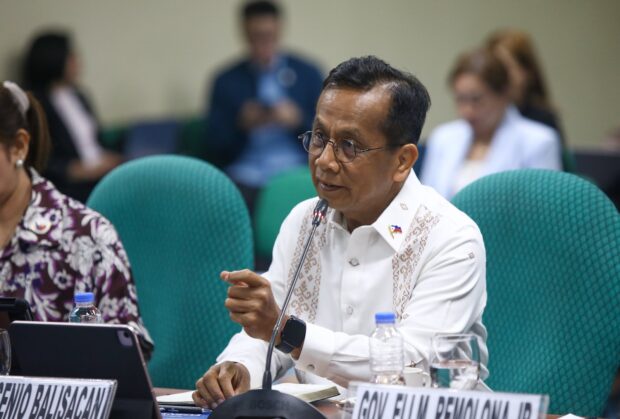
PH needs 3.7% growth in Q2-Q4 to hit target — Balisacan
MANILA, Philippines – The Philippine economy must grow by an average of 3.7 percent in the remaining three quarters of the year to meet the lower end of the government’s revised 3.5- to 4.5-percent growth target for 2026, Economic Planning Secretary Arsenio Balisacan said.
Speaking at a press briefing on Monday, Balisacan said growth from the second to the fourth quarter must average 3.7 percent to achieve the revised target.
To reach the upper end, growth in the remaining quarters would need to average 5.07 percent.
Article continues after this advertisement
“We expect improvements in the second half. The second quarter is still a challenge because that’s the peak of the Middle East conflict,” Balisacan said.
FEATURED STORIES
BUSINESS
BUSINESS
BUSINESS
As it is, the economy grew just 2.8 percent in the first quarter as the fallout from a major graft scandal and the Middle East conflict weighed on growth.
“The numbers coming from the Department of Budget and Management [show] that the fiscal spending continues to have some issues and the capacity of our infrastructure-related agencies to deploy their budgets,” he said.
“But we have been working closely with these agencies. We see that the second half would be a much more improved situation insofar as the infrastructure and government spending is concerned,” he added.
Balisacan’s remarks came as the Philippines moved into the World Bank’s upper middle-income category, ending nearly 40 years as a lower middle-income economy.
Article continues after this advertisement
Asked whether the country could maintain its new status, Balisacan said it is “quite remote” that the Philippines would slip back to its previous income status unless there was a “very bad development in our political economy.”
“I’m optimistic. If there is one thing that we have learned over the last three decades or so, it is that regardless of the political noises, we haven’t really reversed good economic reforms […] The challenges before us are real. So, too, are the opportunities before us,” he said.
Article continues after this advertisement
Poverty reduction
The DBCC last week cut the government’s growth assumptions through 2030, saying rising headwinds had “constrained poverty reduction efforts.”
The latest World Bank assessment projects the Philippines will miss its 2028 poverty target.
Balisacan admitted that the single-digit goal has become challenging.
“Honestly, it’s a big challenge. But I would not completely rule it out yet because it really depends so much on how quickly we can reduce inflation,” Balisacan said.
The DBCC expects inflation to average 6 to 7 percent in 2026, well above the 2- to 4-percent target.
Still, Balisacan said nearing the government’s single-digit poverty target by 2028 would still be “a major milestone” despite slower economic growth in recent quarters.
Your subscription could not be saved. Please try again.
Your subscription has been successful.
“We have designed our intervention programs for the second half of this administration in such a way that it can address the critical pain points of our citizens, particularly on education, health, social protection, and food. Those are the major tensions,” he said. /pai INQ
View original source — Philippine Daily Inquirer ↗
Related stories

CNA
BusinessJul 6, 2026 · 1 min
Hedge funds dumped chip stocks for a fourth week as AI shares sold off
CNA

AllAfrica
BusinessJul 6, 2026 · 1 min
Liberia: Kamara Urges Faster Legal Modernization and Investment Certainty As Liberia Seeks Stronger Mining…
AllAfrica

AllAfrica
BusinessJul 6, 2026 · 1 min
Uganda: Govt Increases Public Service Wage Bill By Shs1.09 Trillion, Tightens HR Management
AllAfrica

The Guardian
BusinessJul 6, 2026 · 1 min
Boost City regulator’s powers to help protect UK consumers from AI, says watchdog
The Guardian