The Guardian
NCAA president expects no changes to trans athlete rules after US supreme court ruling
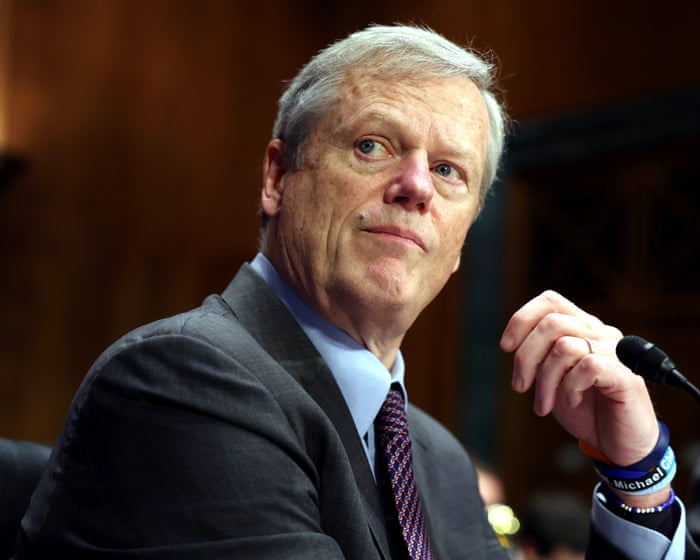
The president of the US’s top administrator of collegiate sports on Sunday said his organization does not anticipate adjusting its rules on transgender athletes after a recent federal supreme court decision allowed states to ban them from participating in school athletics.
In an interview with CBS News’ Face the Nation, Charlie Baker, the NCAA president, alluded to how his organization in late January 2025 had effectively banned transgender athletes from women’s sports by closing off those programs to athletes who were assigned male at birth or were taking testosterone therapy. There are no restrictions for participation in NCAA men’s sports, which Baker referred to on Sunday as “the open network”.
Baker recounted how the NCAA implemented that ban on trans athletes in women’s sports in response to an executive order signed by Donald Trump early in his second term.
“We needed some sort of clarity around what the national standard for this would be – and we adopted and comply with the standard that was put forth by the administration,” Baker, the former Republican governor of Massachusetts, told Ed O’Keefe, a CBS senior political correspondent. “I think what happens at the state level is a different question.”
Baker’s remarks seemingly nodded to how it is expected to have far-reaching consequences for the supreme court to have decided on 30 June to uphold laws in conservative West Virginia and Idaho excluding transgender girls and women from competing in female sports.
Many female sports – including the collegiate, high school and lower levels – are governed by organizations that are not the NCAA. The prohibitions in Idaho and West Virginia furthermore were already replicated in at least 25 other states.
And those states are likely to perceive the US supreme court’s 6-3 decision – from which the liberal justices dissented – as a green-light for their bans, though it remained unclear how it could affect ongoing litigation challenging laws in other places, such as California and Connecticut.
The supreme court majority’s ruling essentially said that banning trans women and girls from competing in female sports does not run afoul of Title IX, a civil rights law prohibiting discrimination in education.
It overturned prior judgments issued by lower courts from two trans students – one in college and the other in high school – who had sued after being barred from competing in West Virginia and Idaho. And the ruling also represented a substantial victory for Trump, who clinched a second term in the Oval Office in the 2024 election by campaigning in part on what he characterized as an issue of “men in women’s sports”.
O’Keefe on Sunday referred to Baker’s having told Congress in 2024 that he was aware of only 10 trans athletes out of more than 500,000 student athletes attending NCAA schools.
The issue received widespread attention among conservative circles in part because of Riley Gaines, a former collegiate swimmer turned anti-trans activist.
Before becoming a prominent rightwing media figure, Gaines tied for fifth place with the trans swimmer Lia Thomas at their sport’s 2022 NCAA championships.
O’Keefe asked Baker to rank where “this issue” fell with respect to “the critical ones facing” the NCAA.
Baker replied: “I can tell you that having talked to people on both sides of this issue – to those who are involved in it, it matters a lot.”
O’Keefe then asked Baker if inclusivity is an NCAA priority – and if its policy makes the organization inclusive enough.
“Yeah, I do,” Baker said. “I don’t have a problem … with the way that policy currently operates. And frankly, I don’t think many of our schools do either.”
View original source — The Guardian ↗
Related stories

TASS
PoliticsJul 6, 2026 · 1 min
US-Iran talks may be held in Islamabad, final decision pending — newspaper
TASS

TASS
PoliticsJul 6, 2026 · 1 min
Russia-China joint naval drills not aimed against anyone — Kremlin
TASS

TASS
PoliticsJul 6, 2026 · 1 min
Kremlin spokesman comments on Putin-Trump call, Russia-China drills
TASS

TASS
PoliticsJul 6, 2026 · 1 min
Zelensky didn't dare accept bodies of Ukrainian soldiers ahead of NATO summit — expert
TASS