CNA
Singapore and Indonesia 'strategically aligned' to keep Strait of Malacca and Singapore open to all: PM Wong
JAKARTA: Singapore and Indonesia are strategically aligned as countries that have coastlines along the Strait of Malacca and Singapore, said Prime Minister Lawrence Wong on Monday (Jul 6), adding that both nations would do their part to keep the waterway safe, open and accessible to all.
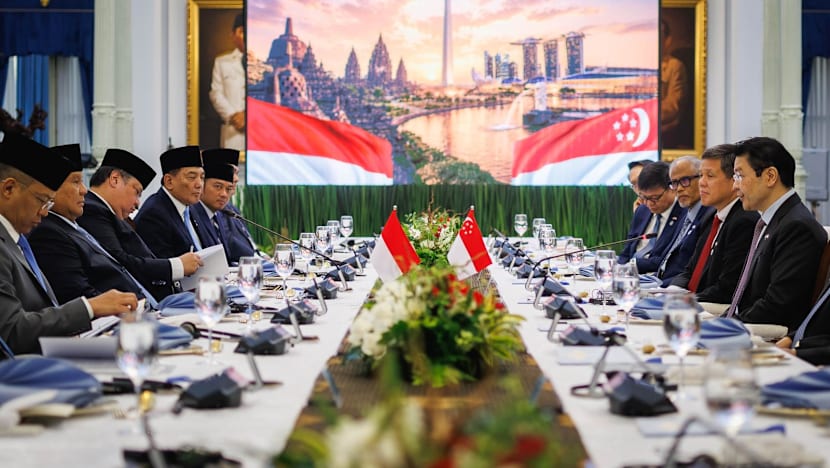
Mr Wong was speaking at a joint press conference with Indonesian President Prabowo Subianto after their second Singapore-Indonesia leaders' retreat at Istana Merdeka in Jakarta.
The Strait of Malacca is a major shipping lane for global trade and energy, bordered primarily by Indonesia, Malaysia and Singapore, and connects the Indian and Pacific Oceans.
The two leaders discussed regional and global developments, agreeing on the importance of ASEAN and ASEAN centrality, Mr Wong said. They also discussed developments in the Middle East and their implications for Singapore, particularly for the Strait of Malacca.
The Middle East conflict had disrupted shipping traffic through the Strait of Hormuz, a critical route for much of Asia's oil and gas supply. Vessels have since resumed passage through the strait after the US and Iran signed a memorandum of understanding in June to pause the conflict.
“We both share interest in upholding navigational rights and freedoms, and keeping sea lines of communication open to all, including the unimpeded rights of transit passage of vessels, in accordance with UNCLOS (United Nations Convention on the Law of the Sea), which is also customary international law,” said Mr Wong.
REAFFIRMING A SHARED POSITION
Mr Prabowo said the two leaders had reaffirmed ASEAN's position that disputes should be resolved peacefully through dialogue and diplomacy, both in the region and beyond.
He noted that Singapore and Indonesia had also reaffirmed their shared position on the Strait of Malacca.
"We must preserve peace and security in the strait, while also protecting it from pollution, accidents and piracy," he said, adding that Singapore and Indonesia would continue coordinating closely with Malaysia and Thailand on the issue as a shared interest among countries surrounding the strait.
"I would also like to assure our friends in Singapore that my position, and Indonesia's position, has remained consistent for decades," Mr Prabowo said.
"I have demonstrated over many years my commitment to ensuring that Singapore and Indonesia remain close partners, working together in friendship and cooperation."
The issue featured prominently at the recent 48th ASEAN Summit in Cebu, which both leaders attended.
Mr Wong had warned then that allowing any party to weaponise and restrict transit through an international waterway like the Strait of Hormuz could set a dangerous precedent threatening sea lanes closer to home, with severe implications for ASEAN countries and the rest of the world.
A joint declaration issued after the summit reaffirmed the importance of navigational rights and freedoms under UNCLOS, including the right of transit passage in straits used for international navigation.
Weeks before the summit, Indonesia’s Finance Minister Purbaya Yudhi Sadewa had floated imposing a levy on ships passing through the Malacca Strait, an idea he said was inspired by Iran's plan to charge vessels transiting the Strait of Hormuz.
He later said he was not serious about the proposal, after Singapore's and Indonesia's foreign ministers stressed the importance of freedom of passage in the strait.
SUPPLY CHAIN RESILIENCE
Singapore and Indonesia are also committed to strengthening supply chain resilience to support each other through external shocks, Mr Wong said.
In a joint statement on the matter, Deputy Prime Minister and Minister for Trade and Industry Gan Kim Yong and Indonesia's Coordinating Minister for Economic Affairs Airlangga Hartarto expressed serious concerns over the Middle East situation and its implications for global peace and stability.
The two ministers called for all parties to observe the ceasefire and uphold the right of transit passage for vessels and aircraft in the Strait of Hormuz under UNCLOS. They also reaffirmed their commitment to keeping markets open and connected, and resolved to swiftly ratify relevant ASEAN agreements to strengthen the region's resilience to external economic disruptions.
Related stories

The Punch
PoliticsJul 6, 2026 · 1 min
Kwankwaso mourns ex-Bauchi dep gov’s children killed in road crash
The Punch

TASS
PoliticsJul 6, 2026 · 1 min
Russian Foreign Ministry summons Swedish ambassador
TASS

TASS
PoliticsJul 6, 2026 · 1 min
Russia keeps comprehensively upgrading T-80BVM main battle tank — defense firm
TASS

The Hindu
PoliticsJul 6, 2026 · 1 min
PM Modi arrives in Indonesia to further strengthen India's Act East Policy
The Hindu