The Next Web
Spain’s Sherpa.ai raises $18M for AI that never touches your data
Everyone wants the power of AI. Few want to hand their most sensitive data to a foreign cloud to get it. A Basque startup thinks it has the fix.
Sherpa.ai has raised $18m to build AI that never sees your raw data, tech.eu reported. The Spanish company sells to banks, hospitals and governments, the customers most nervous about where their data goes. Its pitch rides a fast-rising theme: sovereign AI.
Training without sharing
At its heart sits federated learning. Instead of pooling data in one place to train a model, the model travels to the data. Each hospital or bank trains it locally, then shares only the lessons, not the records. Sherpa.ai says its research can cut the data sent between sites by up to 99 per cent.
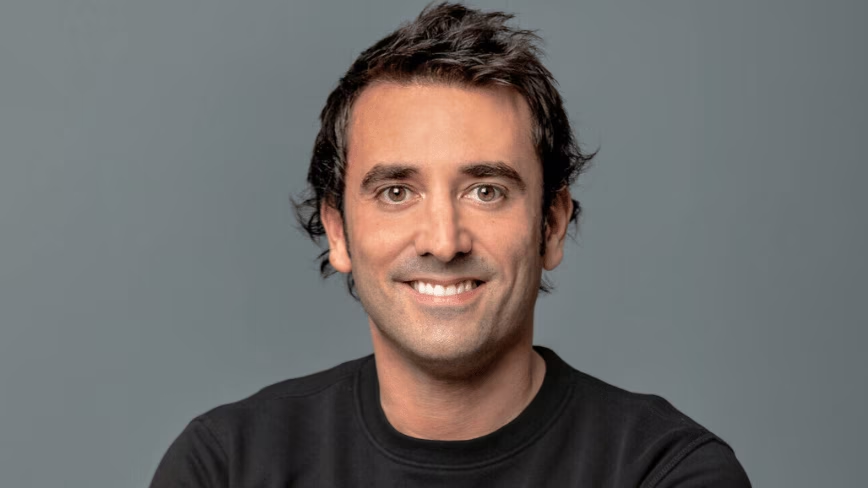
That matters most in regulated corners where privacy rules block ordinary AI projects. The goal, said founder and chief executive Xabi Uribe-Etxebarria, is to let firms “harness the full potential of AI without giving up control, privacy and sovereignty over their data.”
A European pitch, an American backer
The 💜 of EU tech
The latest rumblings from the EU tech scene, a story from our wise ol' founder Boris, and some questionable AI art. It's free, every week, in your inbox. Sign up now!
Forgepoint Capital, a Silicon Valley cyber and AI investor, joined the round. Existing backers Mundi Ventures, Ekarpen, Allegra Holdings and SETT also took part. It is a notably American vote for a company built on the very anxieties driving Europe’s push to keep AI in-house.
The client list points the same way. Sherpa.ai says it has recently signed Spain’s Indra, the banks Caja Laboral and Unicaja, the security group Prosegur, the genomics firm Centogene, and the US National Institutes of Health. A privacy-first European firm selling into a US federal agency is its own kind of proof point.
Substance behind the buzzword
“Sovereign AI” is a crowded label, and federated learning is not new. What gives Sherpa.ai’s version some weight is the research behind it. The company has published peer-reviewed work on training large language models across private datasets. It also worked with the NIH and University College London on using the technique for rare-disease diagnosis.
The raise is modest, and the field is busy. Plenty of firms now promise AI that respects data borders, from national model projects to privacy-focused security startups. But the demand is real, and growing. As governments write ever stricter rules on where data can live, the firm that can train a model without ever touching the data has an easy story to tell.
Sherpa.ai is betting $18m that the story sells.
View original source — The Next Web ↗
Related stories

Lovin Malta
TechnologyJul 6, 2026 · 1 min
Woman Fined And Handed Suspended Jail Term For Threatening Judge
Lovin Malta

ZDNet
TechnologyJul 6, 2026 · 1 min
Want to convince a Windows user to try Linux? Here's how I do it
ZDNet

TechRadar
TechnologyJul 6, 2026 · 1 min
Obsession star Inde Navarrette says she has met with the director of Marvel's new X-Men movie
TechRadar

The Verge
TechnologyJul 6, 2026 · 1 min
Can Partiful keep the party going?
The Verge