Indian Express
Electric 3Ws’ share in EV electricity demand 61%, prioritise charging infra for them: Govt report
4 min readJul 6, 2026 07:38 PM IST
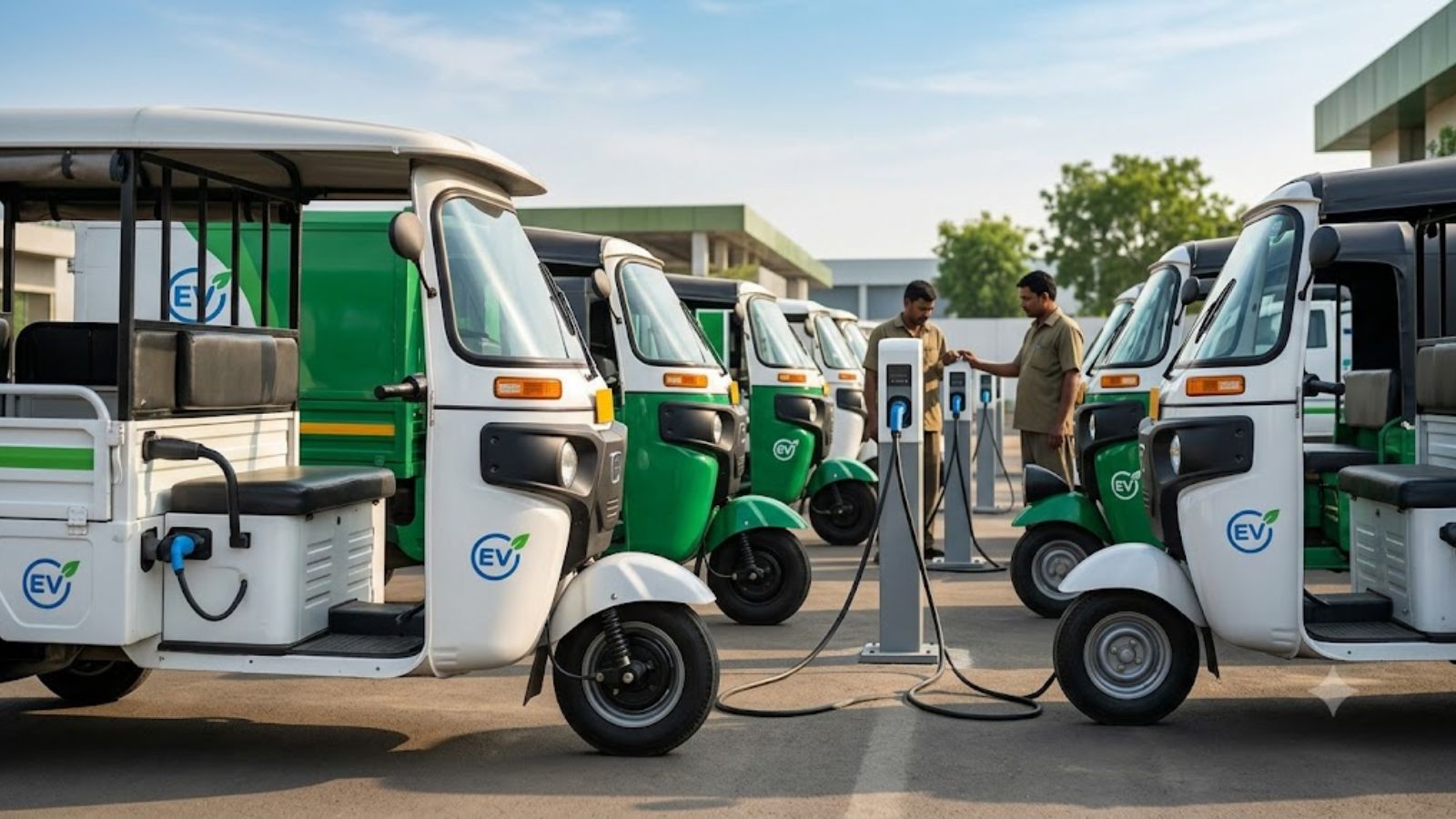
As such, starting April 2028, every new two- and three-wheeler sold in Delhi will have to be electric. (Image generated using AI)
As a government-led push to adopt electric vehicles (EVs) gains momentum, a statistics ministry report has said commercial three-wheeler charging corridors should be prioritised as this category of EVs accounts for the majority of electricity demand.
According to the India EV Electricity Demand Assessment Report, part of the Ministry of Statistics and Programme Implementation’s (MoSPI) report of the Expert Committee on Energy Statistics, electric three-wheelers make up as much as 61% of the annual electricity demand from India’s EV population of 8.97 million vehicles.
“Although 2W vehicles dominate fleet population, their electricity demand remains lower than 3W and HMV (Heavy Motor Vehicles) categories because of lower annual distance and lower per kilometre energy consumption,” the report, released on Monday, said.
As per the report, the annual electricity demand from all the EVs in the country is equal to 20.07 Terawatt-hours per year, or roughly 1.1% of India’s annual electricity generation. While this indicates that “current EV penetration remains manageable for the national power grid”, the NITI Aayog estimates that it may rise to 100 TWh–640 TWh/year by 2030.
“The increasing penetration of electric vehicles (EVs) introduces additional electricity demand on the national grid, making it essential to quantify category-wise energy consumption for future infrastructure planning,” the report said, with the expert committee recommending that the government’ s commitments warrant systematic estimation and dissemination of electricity consumption by EVs in India.
The MoSPI report comes days after the Delhi government said no petrol motorcycles and scooters will be registered after March 31, 2028, while the registration of new CNG auto-rickshaws will stop in 2026-27. As such, starting April 2028, every new two- and three-wheeler sold in Delhi will have to be electric. This sweeping policy is a first in India and aims to make the country’s capital pollution-free by March 2030.
According to the MoSPI report, there are 4.37 million electric two-wheelers in the country and 4.14 million three-wheelers, together making up 95% of all EVs in India. Electric Heavy Motor Vehicles or buses and trucks, meanwhile, only make up 0.4% of all EVs but command an electricity share of almost 22%, with the report noting that “annual energy consumption increases significantly with vehicle size…due to higher payload and long-distance operation”.
Story continues below this ad
Apart from commercial three-wheeler charging corridors, the report also said future infrastructure deployment should prioritise urban fleet charging stations, bus depots and freight charging hubs, and fast-charging infrastructure for heavy-duty transportation. “Residential charging associated with two-wheelers is comparatively manageable because of lower charging power and lower annual electricity consumption,” it added.
The recommendation on EVs is part of a broader attempt by MoSPI to make India’s energy data reporting and collection uniform and aligned with international standards.
Led by Rangan Banerjee, Director of IIT-Delhi, the Expert Committee on Energy Statistics also said the petroleum ministry should conduct regular studies to update data on high-speed diesel sold to retailers and resellers by end-use consuming sectors, estimation of electricity consumption by different sub-sectors under industry by the Central Electricity Authority and distribution companies, and better capturing of off-grid energy consumption in the country.
It also highlighted the absence of data on who uses imported coal, which makes up more than 20% of the domestic demand. The report noted that sectoral data on end-use consumption of non-coking coal – which makes up 75-80% of imported coal and is used by thermal power plants to generate electricity – is not available. As such, the data “fails to provide clear picture of the actual flow/demand of energy across different priority sectors,” the Expert Committee said.
Siddharth Upasani is a Deputy Associate Editor with The Indian Express. He reports primarily on data and the economy, looking for trends and changes in the former which paint a picture of the latter. Before The Indian Express, he worked at Moneycontrol and financial newswire Informist (previously called Cogencis). Outside of work, sports, fantasy football, and graphic novels keep him busy.
... Read More
Tags:
electric vehicles
View original source — Indian Express ↗
Related stories

The Punch
BusinessJul 6, 2026 · 1 min
BREAKING: Tony Elumelu to step down as UBA chair, bank names successor
The Punch

Bloomberg
BusinessJul 6, 2026 · 1 min
BMO Capital Markets' Jennifer Lee on Labor Market, Inflation
Bloomberg

TASS
BusinessJul 6, 2026 · 1 min
New VK-800 aircraft engine to be showcased at Innoprom-2026 exhibition
TASS
Bloomberg
BusinessJul 6, 2026 · 1 min
Ontario, Alberta Pitch Cross-Canada Oil Pipeline to Ease US Reliance
Bloomberg