Indian Express
The Indian Vikings nobody watched
5 min readMumbaiUpdated: Jul 6, 2026 08:15 PM IST
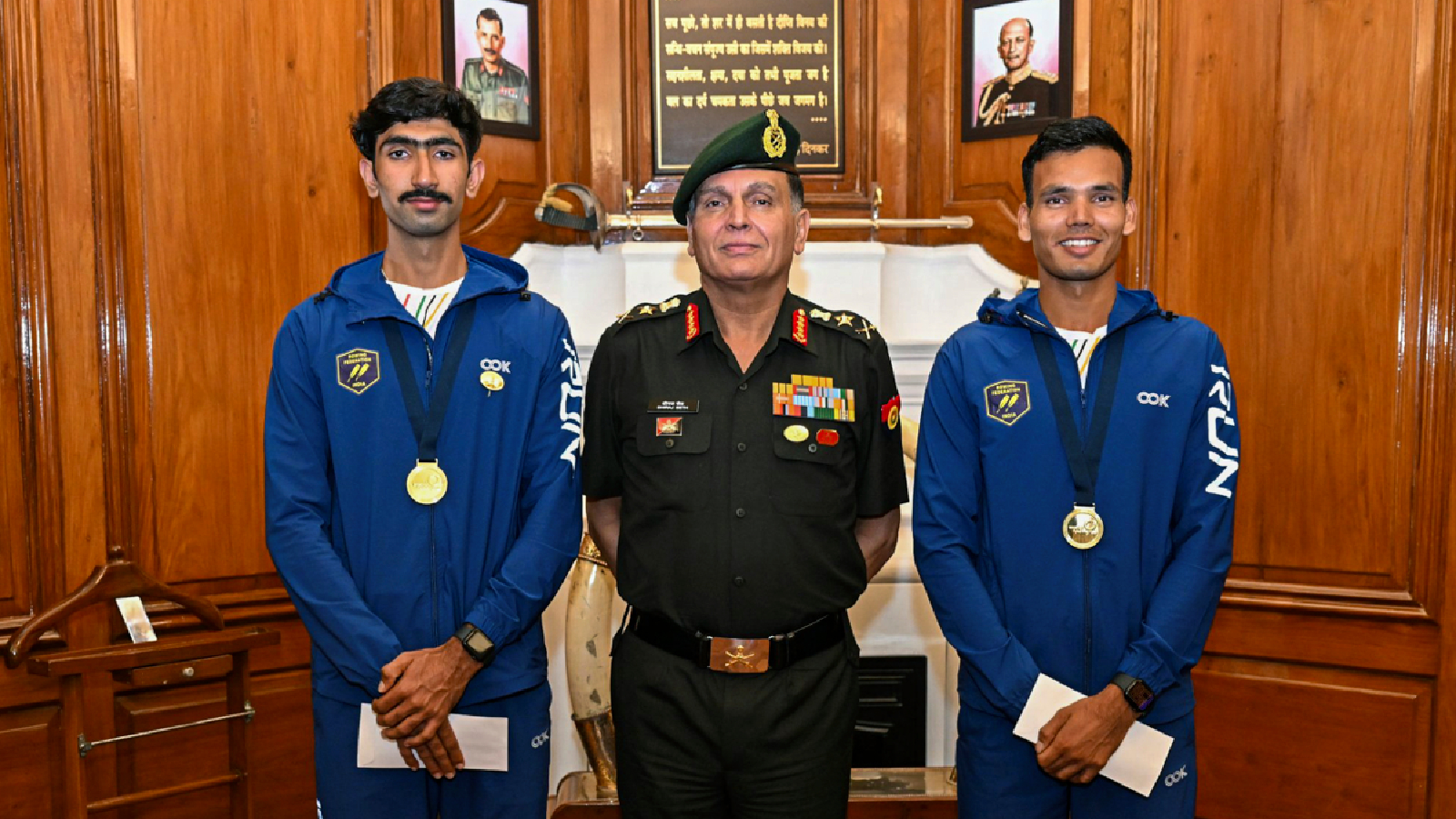
In this image posted on July 2, 2026, Chief of the Army Staff General Dhiraj Seth during a felicitation of Hav Lakshay (left) and Hav Ujjwal Kumar of the Army Rowing Node on their achievement of winning India's first-ever Gold Medal at the World Rowing Cup in the Lightweight Men's Double Sculls (LM2x) event at Lucerne, Switzerland. (@adgpi/X via PTI Photo)
Watching their own sport go viral, care of a Norwegian football celebration, cracked Ujjwal Kumar Singh and his teammate Lakshay up. The Viking Row craze had swept Europe well before Erling Haaland’s men scalped Brazil at the World Cup, and India’s own version of it had already gone into the history books a little more quietly.
“We watched the Viking Row videos, and it was great to see them go viral,” Ujjwal said. “Unfortunately, when we row on water, we are almost collapsing by the end of the race to scream chants!” He laughed at the thought, no synced chants, no battleship backdrop, just two exhausted men crossing a finish line.
That finish line came at the World Rowing Cup 3 in Lucerne this June, where Ujjwal and Lakshay, a lightweight double sculls pair, rowed to gold in 6:26.09, a time that put two boats behind them no Indian crew had ever beaten before: Hong Kong, the dominant force in Asian rowing, and the Netherlands, India’s first European scalp. It sets up a rivalry to watch when the pair reach the Asian Games, where Hong Kong, China and Japan will all show up looking for the rematch.
***
The race itself was a study in patience. India trailed at the first 500 metres, drew level by the 1000-metre mark, where their stroke rate peaked, then traded the lead with Hong Kong through the next 500 before finishing with one of the most composed closing bursts of the regatta, winning the final 500 by over a second.
“We had never beaten Hong Kong who are Asian champs from 2018, 2022 before. Holland are always strong. And we achieved time targets set for us,” Lakshay says.
Ujjwal, a bronze medallist at the last Olympic qualification meet and a four-time national champion, was only recently paired with Lakshay, on the strength of a shared habit: their boat kept hitting its time targets. They have medalled together in every outing since.
***
Rowing at this level doesn’t end in a roar. It ends closer to nausea. “Sometimes you get a vomiting feeling. So Nutrition Ma’am advised on carbs, proteins to deal with it. I never liked fast food or mithai, but I happened to tell her I drink tea twice. Now, chai is not allowed,” says Ujjwal, speaking from the Indian Army’s rowing base in Pune.
Story continues below this ad
Lightweight sculls come with a hard ceiling, 68 kilograms, for the Stroke, the rower who sets the rhythm for the boat and keeps the oar, or chappu, in position. Lakshay rows Bow and holds the balance. “It’s a challenge to maintain body weight but still generate power,” says Ujjwal, 181 centimetres tall to Lakshay’s 188.
Lakshay is the more technically polished of the two, capable of holding 32 stroke pulls a minute on the ergometer, the hardest setting there is, and doing it routinely. His approach to opponents is simple. Stick to training, reputations be damned.
***
Ujjwal had never rowed before he joined the Army, following his brothers into the services. He’s from Atarchedi village in Aonla, Bareilly, a stretch of country that’s quietly become a rowing nursery, the physique, the early diet, the instinctive comfort around water from swimming the Ramganga as kids, all of it produces rowers without anyone planning for it to.
Story continues below this ad
“We are small farmers, struggle is obvious. But toughest days have been when family keeps away health updates of my old mother from me when she’s ill,” Ujjwal says.
That’s the cost nobody puts on the results sheet, next to a personal best of 6:23 on the water and 6:29 on the erg, a devotion that runs quieter than any of the numbers.
Lakshay’s route in was gentler, an uncle who enrolled him at the Chhotu Ram rowing academy in Lakhnoura, Ambala, and a technical gift that showed early.
***
Neither of them was the rowing story Indian sports fans actually watched this month. That belonged to Norway, whose fans, and even its armed forces, marked a World Cup quarter-final with Viking Rows staged on battleships, F-35s, and whatever else with a gun barrel was lying around. These Indian Vikings had none of the theatre. They just had two men beating opponents no Indian boat ever had, sounding the bugle for the Asian Games on the back of a World Cup gold nobody outside the sport noticed.
© The Indian Express Pvt Ltd
Shivani Naik is a senior sports journalist and Assistant Editor at The Indian Express. She is widely considered one of the leading voices in Indian Olympic sports journalism, particularly known for her deep expertise in badminton, wrestling, and basketball.
Professional Profile
Role: Assistant Editor and Columnist at The Indian Express.
Specialization: While she covers a variety of sports, she is the primary authority on badminton for the publication. She also writes extensively about tennis, track and field, wrestling, and gymnastics.
Writing Style: Her work is characterized by "technical storytelling"—breaking down the biomechanics, tactics, and psychological grit of athletes. She often provides "long reads" that explore the personal journeys of athletes beyond the podium.
Key Topics & Recent Coverage (Late 2025)
Shivani Naik’s recent articles (as of December 2025) focus on the evolving landscape of Indian sports as athletes prepare for the 2026 Asian Games and beyond:
Indian Badminton's "Hulks": She has recently written about a new generation of Indian shuttlers characterized by power and physicality, such as Ayush Shetty and Sathish Karunakaran, marking a shift from the traditionally finesse-based Indian style.
PV Sindhu’s Resurgence: A significant portion of her late-2025 work tracks PV Sindhu’s tactical shifts under new coaching, focusing on her "sparkle" and technical tweaks to break out of career slumps.
The "Group of Death": In December 2025, she provided detailed tactical previews for Satwiksairaj Rankireddy and Chirag Shetty’s campaign in the BWF World Tour Finals.
Tactical Deep Dives: She frequently explores technical trends, such as the rise of "backhand deception" in modern badminton and the importance of court drift management in international arenas.
Legacy and History: She often revisits the careers of legends like Saina Nehwal and Syed Modi, providing historical context to current Indian successes.
Notable Recent Articles
BWF World Tour Finals: Satwik-Chirag have it all to do to get through proverbial Group of Death. (Dec 2025)
The age of Hulks in Indian badminton is here. (Dec 2025)
Treadmill, Yoganidra and building endurance: The themes that defined the resurgence of Gayatri and Treesa. (Dec 2025)
Ayush Shetty beats Kodai Naraoka: Will 20-year-old be the headline act in 2026? (Nov 2025)
Modern Cinderella tale – featuring An Se-young and a shoe that fits snugly. (Nov 2025)
Other Sports Interests
Beyond the court, Shivani is a passionate follower of South African cricket, sometimes writing emotional columns about her irrational support for the Proteas, which started because of love for Graeme Smith's dour and doughty Test playing style despite being a left-hander, and sustained over curiosity over their heartbreaking habit of losing ICC knockouts.
You can follow her detailed analysis and columns on her official Indian Express profile page. ... Read More
Tags:
Rowing
View original source — Indian Express ↗
Related stories

ESPN
SportsJul 6, 2026 · 1 min
Ex-UK player Kriisa indicted on $2.2M fraud scam
ESPN

ESPN
SportsJul 6, 2026 · 1 min
FIFA reject Belgium request; Balogun can play
ESPN

ESPN
SportsJul 6, 2026 · 1 min
Keys falls; Paolini wins with 'idol' Federer watch...
ESPN
ESPN
SportsJul 6, 2026 · 1 min
Bellingham, Yamal, Messi unveil updated Trionda fo...
ESPN