The Guardian
Uefa has put European football on war footing with Fifa over Balogun decision | Matt Hughes
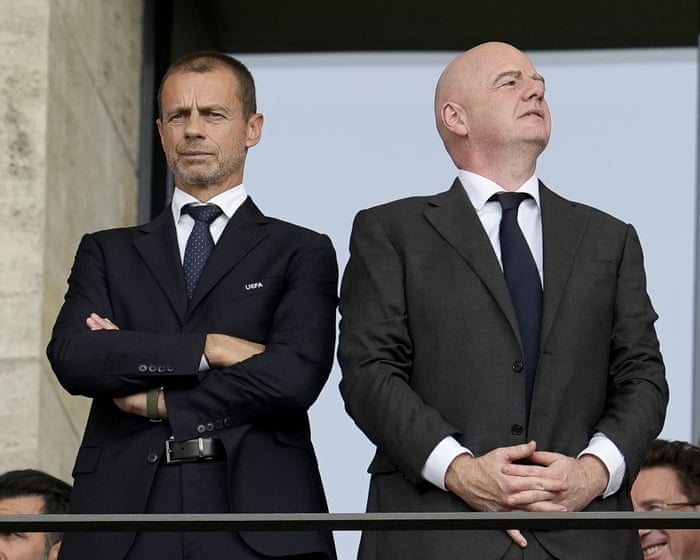
Perhaps the only globally renowned figure who has been more conspicuous by his absence at this World Cup than Donald Trump is the Uefa president, Aleksander Ceferin, although both men have more than made up for their silence over the last 24 hours.
By endorsing a statement in which Uefa accused Fifa of crossing “a red line” in making the “incomprehensible and unjustifiable” decision to lift the USA striker Folarin Balogun’s suspension for Monday’s last-16 tie with Belgium, Ceferin has effectively put European football on a war footing with the world governing body, a dramatic move that could have major implications for the future of the sport.
Much like Trump, and indeed, Gianni Infantino, Ceferin is a hands-on president and avid consumer of football media, so will have known exactly what his organisation was doing. The latter pair have been at loggerheads ever since Infantino proposed the creation of an expanded Club World Cup in 2018, which finally came to pass in the US last year, with much of the current tension between Fifa and Uefa based on the former’s desire to expand the Club World Cup from 32 to 48 teams for the next tournament in 2029.
With Uefa making almost €5bn (£4.27bn) from the Champions League each year, a figure set to rise by about 20% from next year based on media rights and commercial packages sold to date, Fifa wants a piece of the club action, given the vast majority of its four-year revenues of $14bn (£10.5bn) comes from the World Cup.
The most recent public sign of enmity between Uefa and Fifa came in Paraguay in May 2025, when European delegates, including Ceferin and the Football Association chair, Debbie Hewitt, walked out of Fifa Congress in protest at the late arrival of Infantino, who had been attending a summit in the Middle East with world leaders including Trump and Saudi Arabia’s crown prince, Mohammed bin Salman. Since that symbolic show of defiance there had been something of a truce, however, which insiders have attributed to the fact both Infantino and Ceferin will be seeking re-election next year, and have agreed to keep infighting to a minimum.
While Uefa has attempted to score some political points on the back of Fifa’s unpopular running of this World Cup – announcing low ticket prices for Euro 2028, making clear they will not introduce hydration breaks and appointing the Somali referee Omar Artan to take charge of the Uefa Super Cup after he was prevented from officiating at the World Cup by the US Department of Homeland Security – the detente has just about held. But the fragile peace was shattered by Fifa’s unprecedented decision to lift Balogun’s ban in the middle of the tournament, which Uefa said undermined “the integrity of the game” and “the credibility of the competition”.
While much of this dispute is personal and political, there is also genuine disbelief at Uefa’s headquarters in Nyon at how the Fifa administration appears to be run. For all the many criticisms of Uefa, it is an intensely process-driven, bureaucratic organisation, while in using article 27 of its disciplinary code as a get-out to clear Balogun and Cristiano Ronaldo last year, Fifa gives the impression of making policy on the hoof.
After issuing their condemnatory statement on Monday morning, Uefa officials were locked in crisis talks for much of the day, with another indication of the ill-feeling towards Fifa shown in the fact that so few have travelled to the World Cup. Despite sharing a tendency to globe-trot and their mutual self interest, Ceferin and Infantino are rarely seen in the same place at the same time. Following last year’s controversy in Paraguay, Ceferin did not attend this year’s Fifa Congress in Vancouver, while Infantino made his brief appearance at the AGM of the lobby group European Football Clubs (EFC) in Rome last year when Ceferin was absent.
Having expressed their outrage, Uefa’s next steps on the Balogun matter are unclear, and will in part depend on the outcome of Belgium’s appeal against Fifa’s decision. Sources at the Royal Belgian Football Association (RBFA) have told the Guardian they are not expecting another U-turn, and as a result are exploring other legal options, including taking Fifa to the court of arbitration for sport (Cas) in Lausanne after the tournament.
Uefa could lend its support for a Belgian legal action, which given its expertise in Swiss law would probably prove beneficial, as well as potentially making life difficult for Fifa in other ways.
While most of Europe’s biggest clubs, and as a result much of the EFC, are in favour of expanding the Club World Cup for self-interested financial reasons, Ceferin remains personally opposed due to concerns that a 48-team competition would further entrench the dominance of the elite, as well as posing a threat to the pre-eminence of the Champions League. With Fifa preparing to open negotiations with the six continental confederations, domestic leagues and player unions next year over the shape of the global calendar after 2030, there are a number of crucial areas on which Uefa could make life awkward for them.
Determining the date of the 2034 World Cup in Saudi Arabia is looming large, and a Uefa-led protest involving the European national associations, domestic leagues and player unions would at least give them some leverage in negotiating with Fifa. Although with Trump and Prince Mohammed seemingly in Fifa’s corner, it may not be a fair fight.
View original source — The Guardian ↗
Related stories

ESPN
SportsJul 6, 2026 · 1 min
Ex-UK player Kriisa indicted on $2.2M fraud scam
ESPN

ESPN
SportsJul 6, 2026 · 1 min
FIFA reject Belgium request; Balogun can play
ESPN

ESPN
SportsJul 6, 2026 · 1 min
Keys falls; Paolini wins with 'idol' Federer watch...
ESPN
ESPN
SportsJul 6, 2026 · 1 min
Bellingham, Yamal, Messi unveil updated Trionda fo...
ESPN