CNA
Why the next US-China battleground lies beneath the sea
BEIJING: After chips, trade and 5G, the next front in US-China strategic competition is emerging beneath the sea: undersea cables.
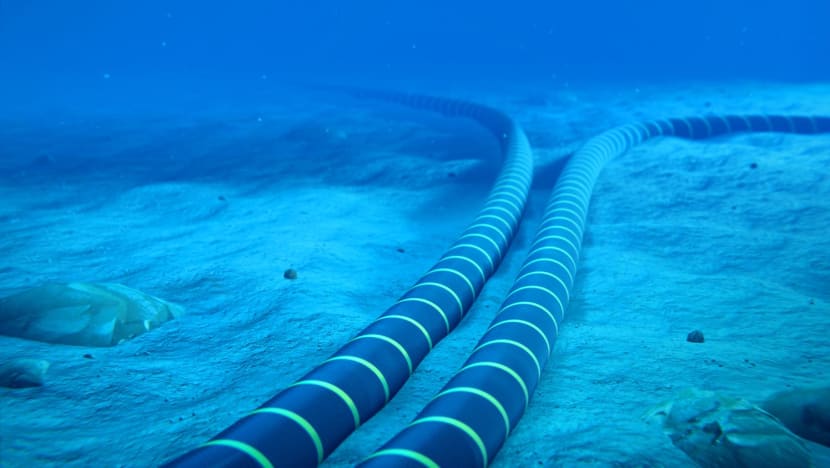
Stretching across ocean floors, these fibre-optic lines transmit multiple terabits of data per second between continents - carrying about 98 per cent of the world’s data traffic.
Once regarded as neutral telecommunications infrastructure, they are now “indispensable strategic” assets at the heart of the US-China contest for digital dominance, said Bart Hogeveen, senior fellow and Europe director at the Australian Strategic Policy Institute (ASPI).
And “their importance is also growing” - as the rapid rise of AI, cloud computing and global finance fuels the demand for faster, safer, and more reliable movement of data.
“Whoever controls critical infrastructure can exercise significant influence over how it's used, by whom, on what terms and at what cost,” Hogeveen said, adding that “concerns about foreign influence and strategic dependence have been becoming much more acute”.
Recent developments also point to how quickly the subsea cable sector is being drawn into that rivalry.
In June, Washington tightened oversight of submarine cable infrastructure, while Beijing has continued expanding its global cable footprint through Digital Silk Road-linked projects.
At the same time, recent cable damage incidents around Taiwan and in the Baltic Sea, along with new initiatives to strengthen the protection of critical seabed infrastructure, have pushed what was once a little-known industry into the spotlight.
THE RACE TO LAY MORE UNDERSEA CABLES
Often described as the “backbone of the global internet”, these cables carry about 98 per cent of the world's data traffic, including email, webpages and video calls.
As more critical data flows through them, cables have become increasingly tied to economic competitiveness, national security and technological leadership.
The surge in demand accelerated especially after the COVID-19 pandemic, analysts said.
“So many people needed to be online, driving up the need for stable internet connectivity,” said Erin Murphy, Asia managing director at US-based global advisory firm Redpoint Advisors, who had also previously served as Indo-Pacific director at the US International Development Finance Corporation.
“Additionally, the AI revolution, and eventually quantum computing, is driving the need for more subsea cables,” Murphy said, adding that competition over undersea infrastructure is also expected to intensify.
The growing strategic importance of these networks has also heightened security concerns.
Speaking at the Shangri-La Dialogue (SLD) in Singapore back in late May, Australian Deputy Prime Minister and Defence Minister Richard Marles described undersea cables as “the arteries of modern civilisation” - warning that “the seabed was becoming a battlefield”, and pointing to a series of attacks on subsea infrastructure over the past year.
Those who can “dominate or control” this critical infrastructure will have an advantage, said Huong Le Thu, deputy director for Asia-Pacific at the International Crisis Group.
The commercial landscape has also evolved dramatically.
What was once led by national telecom operators and companies now counts tech giants like Google, Microsoft, Amazon and Meta among its leading investors and developers, noted Hogeveen from ASPI.
“As economies digitise and AI drives demand for data, these cables have become indispensable,” he said.
GEOPOLITICS: A NEW CABLE COLD WAR?
One of the clearest examples of how geopolitics is reshaping the subsea cable field is SeaMeWe-6, a planned 21,700km cable system linking Singapore and France through Southeast Asia, the Middle East and Europe.
The project was initially expected to be built by China's HMN Tech, formerly Huawei Marine Networks, before the contract was awarded to US-based SubCom following a US lobbying campaign, Reuters reported in 2023.
For analysts, the episode illustrated how geopolitical considerations increasingly shape cable projects. What was once a commercial contest over price and technology has become increasingly influenced by diplomacy, national security concerns and strategic competition.
That shift is also being increasingly reflected in government policy.
In June, the US Federal Communications Commission moved to tighten oversight of submarine cable infrastructure by imposing stricter licensing requirements for owners and operators of cable landing stations and related equipment as part of broader national security measures.
The proposal builds on Washington’s Clean Cable initiative, launched in 2020 during President Donald Trump's first term, which sought to reduce Chinese participation in sensitive cable projects.
Beijing, meanwhile, has continued expanding its presence through HMN Tech, and Digital Silk Road-linked projects - participating in cable developments across Asia, Africa, the Middle East and Latin America as part of China’s broader push to strengthen digital infrastructure and connectivity overseas.
A report released last year by the China Academy of Information and Communications Technology said HMN Tech had delivered more than 100,000 kilometres of submarine cable systems, with operations spanning more than 70 countries and regions.
At the heart of the competition is a convergence of technology and geopolitics, said Jason Hsu, senior fellow at the Hudson Institute.
“Countries now understand that controlling or disrupting data flows can generate significant economic and political leverage without firing a shot,” Hsu, also a former Taiwanese legislator, told CNA.
But this “isn't just a race to lay more cables”, said ASPI’s Hogeveen.
“It’s also a race to meet the demand of the global digital economy and of strategic positioning.”
“The countries and companies that build and operate large parts of the subsea cable network can gain influence over connectivity, standards and resilience,” he added.
“They are also competing to develop the next generation of cable technology - faster, more secure networks with increased capabilities to detect faults, measure oceanic activity and potential interference,” said Hogeveen.
04:12 Min
Murphy from Redpoint Advisors said that the competition echoes earlier contests over China's Belt and Road Initiative and the rollout of 5G networks.
“Economic security is now national security,” Murphy said, adding that US concerns have long centred on Chinese firms such as Huawei and ZTE, as well as other vendors whose hardware and software could be embedded in information and communications systems.
“It could be used as an espionage tool, both for commercial and military purposes,” Murphy said.
“There's also the question of data control and whether China can get access to it through systems they install and what they do with that data,” she added.
The result, analysts said, is a cable network that remains physically global but is becoming increasingly fragmented by geopolitics.
“We're already seeing a bifurcation of the global subsea cable network,” said Hogeveen from ASPI, who noted that “new cable routes are increasingly designed to avoid certain landing points or geopolitically sensitive maritime areas”.
“This reflects a broader fragmentation of the global tech ecosystem,” he said - one driven by competition between “a US-centric technology stack on one side and a China-centric stack on the other”.
VULNERABILITIES AND RISKS
Governments around the world are also racing to ensure cable networks can be monitored, repaired, rerouted and kept running during times of crisis.
“Sabotage, cyber attacks and operational disruption” are immediate security risks which are “real and increasingly visible” as governments pay closer attention to the vulnerability of critical undersea infrastructure, Hogeveen said.
At the same time, concerns have also sharpened following a series of disruptions near geopolitical flashpoints over the past year.
Last February, Taiwanese authorities reportedly investigated a Togolese-flagged, Chinese-crewed ship suspected of damaging a cable near Penghu - and also investigated a Chinese-flagged work barge more than a year later - which was suspected of damaging a cable serving the Matsu Islands.
Finnish authorities seized a freighter on Dec 31, 2025 - after a data cable between Finland and Estonia was damaged in the Gulf of Finland, adding to concerns over possible sabotage in the Baltic Sea.
As military planners and security analysts assess potential blockade or coercion scenarios involving Taiwan, undersea cables have come under increasing scrutiny because of their importance to communications and connectivity.
In Taiwan’s case, disrupting undersea links could “create confusion, undermine public confidence, complicate military coordination, and impose significant economic costs”, said Hudson Institute’s Hsu.
“In a blockade or coercion scenario, cables could become one of the first targets because they offer a relatively low-cost, high-impact means of applying pressure,” Hsu added.
China views Taiwan as its own territory. While Beijing has said that it prefers “peaceful reunification”, it has never renounced the use of force to bring the island under its control.
Huong of the International Crisis Group said Southeast Asian countries also understood the vulnerabilities of undersea cables, having experienced disruptions “intentional or not”.
Some incidents may be accidental, but the broader global pattern is now harder for governments to ignore, said Hsu.
“Whether or not every incident is deliberate, the cumulative effect is to normalise pressure on critical infrastructure below the threshold of armed conflict,” he said.
02:15 Min
That has accelerated efforts to strengthen the protection of seabed infrastructure.
At this year’s SLD, 17 countries launched the Guiding Principles for Underwater Infrastructure Defence Exchanges, or GUIDE, a framework aimed at improving defence cooperation around critical underwater infrastructure. Neither the US nor China was among the participating countries.
Separately, the US, UK and Australia announced on May 30 that they would jointly develop payloads and supporting systems for uncrewed undersea vehicles, with protection of critical seabed infrastructure listed among the missions such technology could support.
For Hsu, the strategic question is no longer simply who can build cable networks, but who can keep them operating under pressure.
“The strategic question today is whether countries can detect interference, repair damaged cables quickly, reroute traffic, and maintain connectivity during a crisis,” he said.
REGIONAL BALANCING ACT
Across Southeast Asia, demand for undersea cables is rising as population growth, industrialisation and digital adoption drive the need for more connectivity.
However, the region “does not have the capacity” to repair undersea cables and instead, relies on external help, said Huong from the International Crisis Group, noting that many repair vessels operating in the region were commercial - with some belonging to China.
“The region, as well as individual countries need to join forces to support building up such capacity,” she added.
When it comes to undersea cable and infrastructure partnerships, many Southeast Asian countries continue to avoid choosing between the US and China where possible, Huong said.
“In the case of cables - it will depend on the supply (and) whether either China or US are willing and able to provide for such a growing demand,” she added.
That aligns with Murphy's assessment that Washington cannot rely on national security arguments alone to win support in Southeast Asia and the wider Global South.
“The national security argument hasn't swayed too many in the Global South but it will be very difficult to compete on price, especially with price conscious countries,” she said.
Murphy added that the US and its allies could instead differentiate themselves by pairing cable projects with capacity-building, jobs training and education programmes, though the dissolution of USAID has made that harder.
Partners like Japan, Australia and European providers could become more important, Huong said.
She noted how Australia had worked with the US and Japan on cable infrastructure in strategically located Palau - underscoring how even small Pacific connectivity projects are now viewed through a wider geopolitical lens.
Cable construction, maintenance and repair are also often multi-country and multi-partner efforts, Huong added.
Yet analysts expect AI to sharpen competition for the infrastructure that enables the technology, including subsea cables, data centres, compute capacity and energy supply.
“As AI advances rapidly, and is viewed by both Washington and Beijing as a defining strategic technology, we should expect growing competition over the physical infrastructure that underpins it,” said ASPI’s Hogeveen.
Source: CNA/lg(ht)
Related stories

The Punch
WorldJul 7, 2026 · 1 min
NIPOST bets on digital infrastructure beyond traditional mail
The Punch
The Punch
WorldJul 7, 2026 · 1 min
Herders’ violence: Enough excuses, implement ranching
The Punch
The Punch
WorldJul 7, 2026 · 1 min
Joshua Ibanga: The unending scourge of police brutality
The Punch
The Punch
WorldJul 7, 2026 · 1 min
Minister’s directive delayed NELFUND employees’ resumption – MD, Sawyerr
The Punch