BBC
Jailers and officials at Russia's 'torture prisons' in Ukraine exposed by BBC
ByBy Tania Kharchenko and Samuel Horti
BBC Eye Investigations
This article contains accounts of torture and sexual violence
Early one October morning in 2019, a group of men jumped out of a car and grabbed Liudmyla Huseinova as she left her home.
The 64-year-old says they seized her bag and threw her into the back seat, beginning what she describes as a "nightmare" in Russia's secretive detention system in parts of Ukraine it had occupied since 2014: "For three years and 13 days of my life, my soul and body were crippled."
She says that among the men was Yurii Temerbek, a Ukrainian who had been a local traffic policeman and had joined the Russian-backed separatists.
Temerbek – a husband, father and grandfather, now aged 56 - was there again, two weeks later, she says, watching as a man with a Russian accent sexually assaulted her in a notorious detention centre.
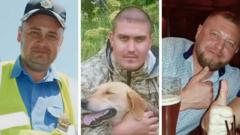
A BBC World Service investigation has identified Temerbek, and uncovered details about two other men accused of abusing detainees, shedding light on a system that operates almost completely out of reach of Ukrainian and international justice.
The men appear to now be living ordinary lives with their families in Russia and occupied Ukraine. Survivors see revealing their identities as a step towards holding them accountable.
Liudmyla says that if the men she accuses of abuse aren't found and imprisoned, "then, justice for me will be their names as criminals, and torturers, will be known to their children".
The prisons these men helped run are part of a detention system in which the UN's human rights office (OHCHR) says the torture and ill-treatment of civilians is "systematic and widespread".
It says former detainees describe beatings, electric shocks, mock executions and sexual violence, with civilians often detained arbitrarily and families given little information.
The Kremlin has accused the OHCHR of bias. In May this year, the UN added Russia to its blacklist of countries suspected of committing sexual violence in conflict zones - allegations Russia dismissed as "groundless lies".
Ukrainian authorities say more than 16,000 civilians have been taken captive or disappeared. Some of these cases followed Russia's full-scale invasion of Ukraine in 2022 - others date back as far as 2014, when Russia annexed the southern Ukrainian peninsula of Crimea and occupied parts of eastern Ukraine, triggering widespread international condemnation.
At that time, Liudmyla was working as a safety engineer on a poultry farm in Novoazovsk, a city in the Donetsk region close to the border with Russia.
Russian-backed armed groups seized the city, beginning several years of paramilitary control.
Liudmyla says that, under occupation, she helped care for orphans and took food to Ukrainian forces, who gave her a Ukrainian flag with notes of thanks written on it. She believes a photo of the flag she shared with trusted friends reached the Russian-backed forces: "This was probably why they arrested me."
She was accused of spying, she says, and taken to Izolyatsia - a factory-turned-modern art gallery that had been taken over by Russian-backed forces. It later became widely known and feared, as numerous accounts of torture emerged from former detainees.
When she arrived, she says a group of men - she does not know who - surrounded her, pinching her body. "It's not a peach," she recalls one of them saying. "Not a dried apricot either. A raisin."
Detainees were forced to stand constantly from 06:00 to 22:00, and bright lights shone at night, she recalls. Her first days, she says, were punctuated with sounds of distress from other rooms: "I have never heard such terrible screams before."
Two weeks later, she says, she was taken to the second floor, where a man who was referred to as "Koval" in the prison told her she was "too old for boys who come for 'relaxation'".
Temerbek was there, "being sarcastic… laughing", she says.
Then, she says, Koval sexually assaulted her.
She knows Temerbek's name, she explains, because she saw his name on a document and remembered he had been known locally for his role in the Ukrainian police.
Ukrainian authorities accuse him of working for the Ministry of State Security (MGB) established by the Donetsk People's Republic (DPR), which was created by Russian-backed paramilitaries.
Ukrainian prosecutors have started criminal proceedings against him for being part of a "terrorist group" - a term they often use when alleging collaboration with Russian-backed forces.
The BBC worked with two Ukrainian open source investigators, Bohdan Kosokhatko and Vladyslav Chyryk, to find out more about Temerbek and others accused of abuses, building on work they have done with the Ukrainian investigative organisation Truth Hounds.
Information including detainees' testimony, social media posts, media reports and documents from Ukrainian prosecutors allowed our team to build up a picture.
The investigators working with the BBC discovered that Temerbek studied Ukrainian language at university and has a wife, daughter and son in their 20s, and grandchild. They appear to live in the Rostov region, in south-western Russia near the border with Ukraine.
A photo on social media from before 2014 shows him in Ukrainian police uniform, with a badge identifying him as a traffic policeman. We were not able to establish whether he currently has a job.
Liudmyla says the man in the image was among those who arrested her. She says she last saw Temerbek around late 2021 when he called her "bitch" and threatened that she would be sent to Siberia.
We have not been able to identify "Koval".
She says another guard at Izolyatsia, referred to within the prison as "Yermak", once ordered her to eat uncooked food mixed with soil and rubbish.
"I spat it out, but there was some left. The taste of this food will stay with me the rest of my life," she says. She now finds the smell of food cooking unbearable, and struggles to eat a normal diet.
She never saw Yermak because guards often put a bag over her head, she says, but she heard his voice.
On another occasion, she says, he entered her cell: "He shouted: 'Are you for Ukraine?' I said: 'I'm for justice'. After that, he began to beat me."
Liudmyla saw Yermak's face for the first time when the investigators working with the BBC located photos of him on social media, showing him with his wife and daughter, on family holidays and drinking with friends - some as recent as 2024.
He was first identified, as a man named Ruslan Yeriomichev, by the investigative reporting group Bellingcat and Ukrainian journalist Stanlislav Aseyev, who was also held in Izolyatsia. Yeriomichev is now 46.
According to his social media accounts, he studied law at the Donetsk National University.
Ukrainian prosecutors accuse him of multiple crimes, including cruel treatment of prisoners of war and civilians.
It is not clear whether he still works at Izolyatsia, but social media posts suggest he still lives in the area. Photos on social media show him with his wife, daughter and friends, and on holiday in occupied Crimea. Both Temerbek and Yeriomichev were Ukrainian nationals who later acquired Russian passports.
"They are free people, and they can go anywhere," Liudmyla reflects as she looks at the photos. "They took years off the lives of so many people."
Liudmyla was released in a prisoner exchange in 2022. She was welcomed home by friends. "They stood crying. I realised I couldn't cry, I had no tears," she says.
Even now, she says: "These feelings, emotions, they are still frozen in me… sometimes I really want to cry and scream, but I can't."
She has been reunited with her husband and they now live in Ukraine's capital, Kyiv. She runs an organisation supporting other women who have been detained, and, using a secret network, helps send parcels from families to those still in captivity. The BBC also mapped the scale of the network of detention centres, cross-matching reports from media sources, investigators and human rights groups.
We identified 93 sites where civilians and prisoners of war were held in occupied Ukraine between 2023 and 2025. About a third of them appear to be unofficial, in buildings ranging from a tax office to hotels and garages. We identified another 102 in Russia. International organisations have not been allowed free access to them.
Ukrainian prosecutors say 2,000 people have passed through such centres since Russia's full-scale invasion in 2022.
One of them, 42-year-old sailor Oleksii Sivak, told the BBC he was among hundreds of civilians arrested in the wake of Russia's capture of the southern Ukrainian city of Kherson in 2022, in what pro-Kremlin reports called a crackdown on terrorists.
Oleksii, who worked on cargo ships, says that in the early months under occupation he helped cook for elderly people, as well as making banners and leaflets opposing the Russian presence: "I did what I could, resisted how I could."
He says he was arrested and taken to a former police facility in Kherson. "There was torture with objects," he says. "On the genitals, electric current."
In November 2022, the Ukrainian army retook Kherson. He says Russian-backed forces took some detainees as they fled, but he escaped because they did not have enough space in their vehicles.
Ukrainian prosecutors say the Kherson detention facility was run by Andrey Spivak, previously a policeman working in the prison system in the Russian city of Omsk.
They have charged him with cruel treatment of the civilian population and violations of the laws of war.
The investigators working with the BBC found that he is 40 and was born in the Omsk region. Images on social media suggest he enjoys fishing, hunting and travelling.
Photos in recent years show him back in Omsk, at Russian interior ministry events. The investigators working with the BBC also found he has registered his car to work as a taxi driver.
The BBC tried to contact Temerbek, Yeriomichev and Spivak about the allegations in this report but they did not respond. Asked about the allegations, the Russian Embassy in the UK said Russia had "consistently advocated respect for international law and the rule of law" and allegations of crimes during the Ukraine conflict "are documented and investigated".
Ukrainian prosecutors have opened legal proceedings against dozens of people accused of mistreating Ukrainians in Russian-run prisons. A small number have been sentenced in absentia. The BBC is aware of only one who has been imprisoned - a former head of Izolyatsia who was arrested in Kyiv in 2021 and has been sentenced to 15 years in prison.
The site is still operating, according to Ukraine's prosecutor general's office.
Since Russia's full-scale invasion in 2022, the office has documented more than 400 cases of conflict-related sexual violence against civilians. So far 85 people have been charged - of which 30 have been given prison sentences, most of them in absentia.
Oleksii and Liudmyla are both keen to help hold perpetrators of abuse of detainees to account.
"For me, justice is not revenge," says Liudmyla. "For me, justice is the decree that these people intentionally, deliberately did what they did. I want them to be punished by law."
Related stories
South China Morning Post
WorldJul 7, 2026 · 1 min
SCMP’s China Conference to debut in Astana this September
South China Morning Post

Stuff
WorldJul 7, 2026 · 1 min
Auckland builder sentenced after evading more than $40,000 in tax
Stuff

Straits Times
WorldJul 7, 2026 · 1 min
Iran fires missiles at commercial ships in Strait of Hormuz, Axios reports
Straits Times
Philippine Daily Inquirer
WorldJul 7, 2026 · 1 min
Rare white monkey spotted in Sultan Kudarat village
Philippine Daily Inquirer