Indian Express
Why Mumbai’s Mankhurd area remains a hotspot for deadly building collapses
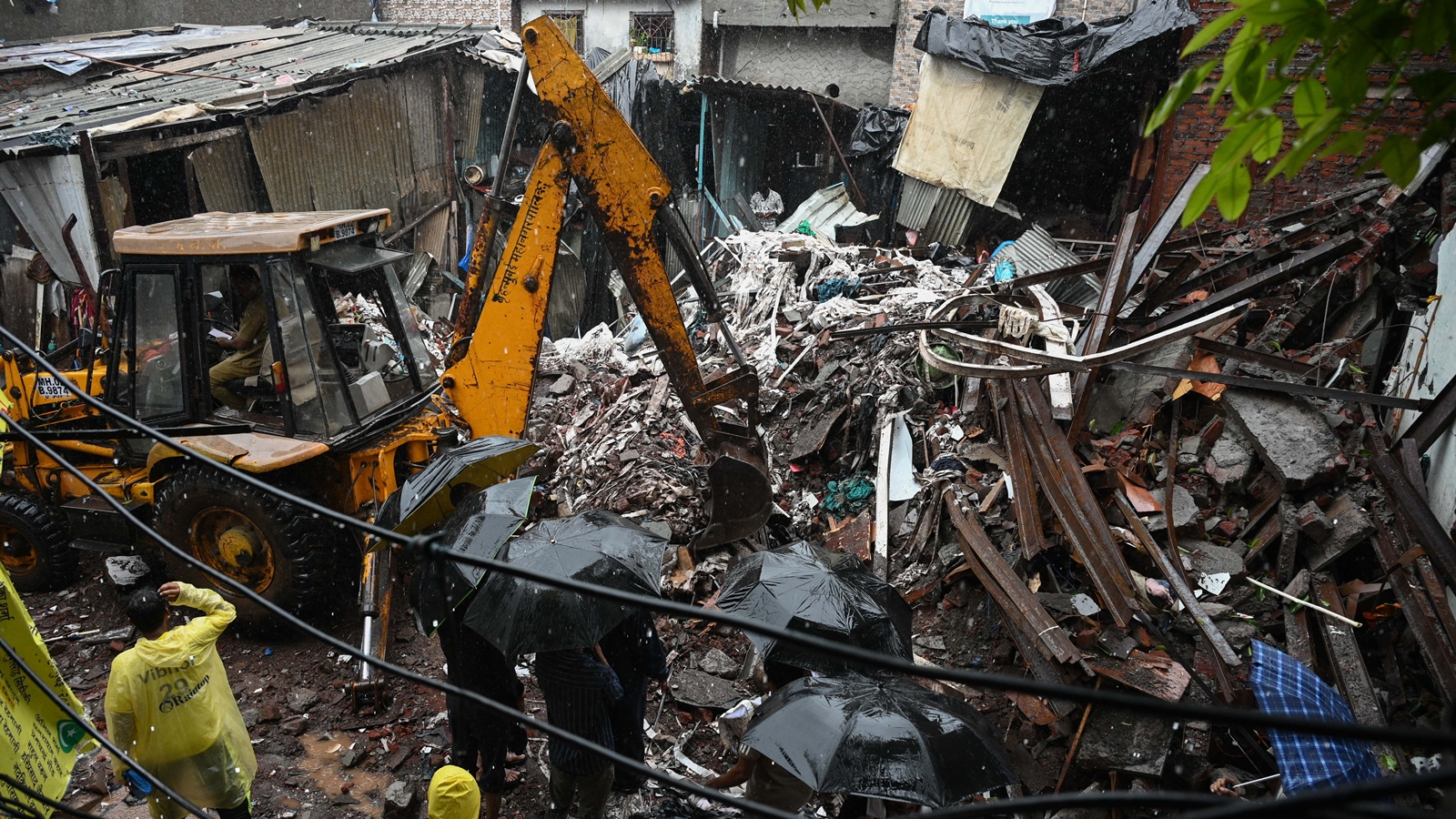
The Mankhurd-Shivaji Nagar belt is dotted with informal settlements, ageing chawls and unauthorised multi-storey structures, many built on low-lying land prone to flooding and prolonged waterlogging during the monsoon. Weak soil conditions, ageing buildings and rampant unauthorised construction have made these neighbourhoods among Mumbai’s most vulnerable to monsoon-related collapses.
Hours after the incident, Mumbai Mayor Ritu Tawde said the building that collapsed was illegal, while the families who lost their lives were living in authorised structures onto which it crashed.
The family had been residing in the shanty, made of tin sheets and a patra roof, for the past two years. (Express Photo by Sankhadeep Banerjee)
A recurring monsoon tragedy
In 2021 alone, two separate building collapse incidents in Mankhurd claimed 20 lives. Despite repeated disasters over the years, illegal multi-storey constructions have continued to proliferate, often flouting the Brihanmumbai Municipal Corporation’s (BMC) 14-foot height limit. Building collapses have consequently become a recurring feature of every monsoon.
According to civic officials, the building that collapsed on Sunday stood on land owned by the Mumbai Suburban Collector’s office. Spread across nearly two square kilometres, the land accommodates more than 1,000 housing units, many of them multi-storey structures rising four floors or higher.
Jurisdictional hurdles
“Even though the houses stand on Collector’s land, the government cannot easily act on them. The BMC has the power of enforcement, while state agencies lack the manpower to control these issues. As a result, there has been years of correspondence between departments, but very little action on the ground,” a state government official told The Indian Express.
Story continues below this ad
Another official said a state government resolution requires authorities to first provide alternate rehabilitation to eligible occupants of structures built before 2011 before undertaking demolition.
The area where the house collapsed last night killing six members of a family, at Mankhurd in Mumbai. (Express Photo by Sankhadeep Banerjee)
“As more than 70 per cent of these housing units were built before 2011, it is not easy to remove them at one go. At the same time, rehabilitating such a large population would require another major housing redevelopment project,” the official said. The result, officials added, is that illegal structures continue to remain in place even as enforcement and rehabilitation remain caught between multiple agencies.
Weak foundations and unsafe vertical expansion
Most houses in the locality are built on weak foundations using brick masonry and temporary materials such as wood. Continuous monsoon rain seeps into walls and foundations, weakening mortar, corroding steel reinforcement and reducing structural strength.
The problem is compounded by overcrowding. Small dwellings often accommodate multiple families, placing loads far beyond what the structures were originally designed to bear.
Story continues below this ad
“In every housing unit, at least 20 people reside at any given time. Often the structure is unable to bear the load and, due to years of seepage, the building becomes hollow from inside before eventually collapsing,” a civic official told The Indian Express.
Moinuddin Shah (38) being consoled by his family members and friends.
How the neighbourhood evolved
Located on Mumbai’s eastern edge, the Mankhurd-Shivaji Nagar belt lies adjacent to the Deonar landfill, one of India’s oldest operational dumping grounds. Its proximity to the landfill has kept land and housing prices relatively low, making the area a preferred destination for low-income families.
The landfill began operations in 1927, when the surrounding area was largely uninhabited. Rapid urbanisation in the 1990s and 2000s brought waves of migrants to Mankhurd, Govandi and Shivaji Nagar, where inexpensive housing was available close to the landfill.
Story continues below this ad
Much of Mankhurd and Govandi was developed on reclaimed land, marshes and filled-up dumping grounds. The soil has a low bearing capacity and becomes even weaker when saturated during heavy rainfall, increasing the risk of structural settlement and collapse. As these government-owned lands remained largely unused, they were gradually encroached upon, leading to the mushrooming of informal settlements.
From single-storey homes to vertical slums
Hasan Shaikh, a local resident and social worker, said that until the mid-2000s, most homes in Mankhurd and Shivaji Nagar were single-storey structures. However, as vacant land became scarce, residents increasingly began constructing additional floors above existing homes.
“People started building another floor over their houses and either sold it to new families or rented it out,” Shaikh said. Although BMC regulations restrict informal houses to a maximum height of 14 feet, Shaikh said many structures now rise to nearly 30 feet.
“The BMC has carried out demolition drives several times. But within days, people rebuild the structures and everything goes back to square one. Since these houses are made of brick masonry and wooden boards, they are inexpensive and quick to reconstruct,” he added.
View original source — Indian Express ↗
Related stories

Arab News
TechnologyJul 7, 2026 · 1 min
US cyber agency is using Anthropic’s Mythos to audit government code, sources say
Arab News

TASS
TechnologyJul 7, 2026 · 1 min
US believes Iran attacked vessels in Strait of Hormuz twice on Monday — news outlet
TASS

The Hindu
TechnologyJul 7, 2026 · 1 min
Financial services AI dangers highlighted by UK regulator's review
The Hindu

The Guardian
TechnologyJul 7, 2026 · 1 min
Europe faces up to prospect US may be unable to arm Nato allies
The Guardian