Indian Express
Ghostly squid, glowing worms among 31 alien-like species discovered off Brazil coast
3 min readJul 7, 2026 09:08 AM IST
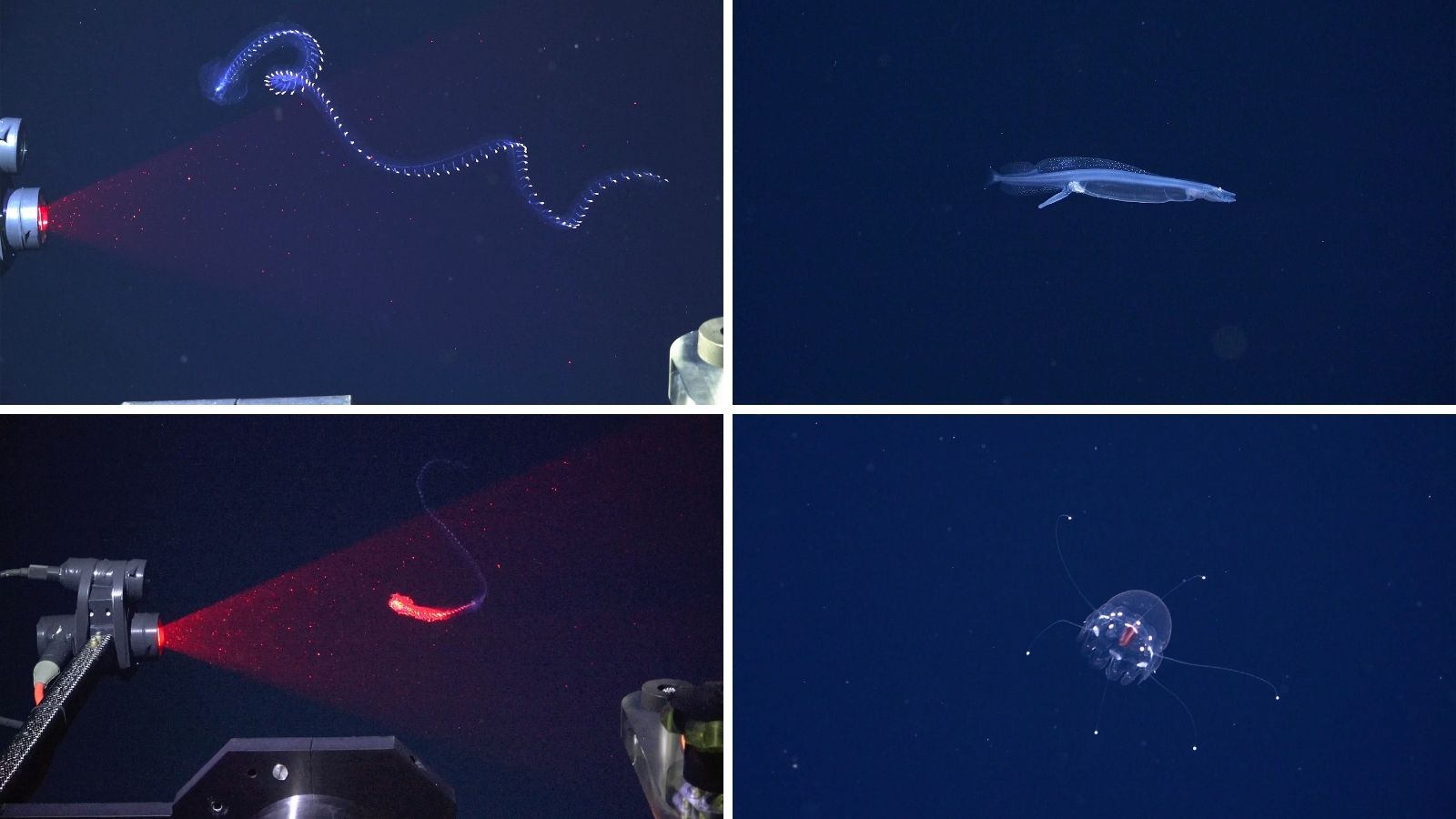
Advanced underwater imaging allowed scientists to observe fragile deep-sea creatures without disturbing their natural habitat. (Image: X/Bibo)
Scientists have discovered 31 previously unknown marine species during a deep-sea expedition off the coast of Brazil, revealing an extraordinary collection of alien-like creatures living hundreds of metres beneath the ocean’s surface. The discoveries include a transparent juvenile glass squid, a fast-moving gossamer worm, unusual comb jellies, mysterious siphonophores, and several strange fish species, highlighting just how little is known about Earth’s largest ecosystem.
One of Earth’s least understood habitats
The international research team spent two weeks in June exploring the South Atlantic aboard the Schmidt Ocean Institute research vessel Falkor (too).
Their mission focused on the ocean’s midwater zone, a region located roughly 600 to 3,300 feet (180 to 1,000 metres) below the surface. Despite covering an enormous portion of the planet, this ecosystem remains one of the least explored because of extreme pressure, darkness, and the technical challenges involved in studying it.
Researchers say the expedition demonstrates how much marine biodiversity still remains undiscovered.
High-tech tools reveal new specie
Instead of relying only on collected specimens, scientists used advanced technologies to study animals in their natural habitat.
The remotely operated vehicle SuBastian captured high-resolution images and videos deep underwater, while researchers also deployed laser-based imaging systems, virtual-reality visualisation tools, advanced microscopes, and specialised cameras capable of recording delicate organisms from multiple angles without harming them.
These technologies allowed scientists to create detailed three-dimensional models of transparent animals while observing their behaviour in real time.
Story continues below this ad
Ghostly squid, glowing worms, and mysterious jelly-like creatures
Among the expedition’s most striking discoveries was a new species of gossamer worm from the genus Tomopteris. These transparent marine worms spend their entire lives drifting through the water column and are known for producing unusual yellow bioluminescence.
Researchers also documented a juvenile glass squid, whose nearly transparent body makes it almost invisible in the deep ocean.
Another highlight was an undescribed siphonophore, a colonial marine animal related to the venomous Portuguese man o’ war. Scientists believe it could represent not only a new species but potentially an entirely new genus or even a new family.
Also Read: Giant fan-shaped structure hidden below Antarctica’s ice, scientists find
The expedition also identified new lobed comb jellies, unusual larval fish, and several microscopic organisms that have never been described before.
Story continues below this ad
Why these discoveries matter
Scientists say studying deep-sea species helps researchers better understand how life adapts to extreme environments with crushing pressure, near-freezing temperatures, and complete darkness.
Many of these animals possess unique biological features that could improve scientific understanding of evolution, biomechanics and even future medical or engineering technologies.
Researchers believe the expedition offers only a small glimpse into the immense biodiversity hidden beneath the ocean’s surface, with countless more species likely awaiting discovery in the world’s unexplored deep seas.
View original source — Indian Express ↗
Related stories

Euronews
ScienceJul 7, 2026 · 1 min
Death toll from China storms and floods rises to 15, state media says
Euronews

BBC
ScienceJul 7, 2026 · 1 min
Endometriosis could be diagnosed by blood test, research suggests
BBC

Times of India
ScienceJul 7, 2026 · 1 min
The SpudCell: Could some 'blobs' in a dish spark the 'Sputnik' moment for synthetic life?
Times of India

Euronews
ScienceJul 7, 2026 · 1 min
Infertility to affect 80 million women by 2036 with sharpest rise in over-35s, study finds
Euronews