VnExpress
World's memory-chip superpower allows hiring foreign engineers without any language requirement
South Korea will hand foreign engineers its fast-track residency visa based on their skills and an employer's need for them, its industry and justice ministries said.
A new qualitative evaluation track under the K-Tech Pass program scores applicants out of 100. It keeps 65 points for the old numerical benchmarks and adds 35 for qualitative factors such as an applicant's technical expertise and how much the hiring company needs the role, the ministries announced on July 2, The Korea Herald reported.
Domain experts assess that portion, weighing practical skill, project experience and likely industrial impact rather than paper credentials, according to the Seoul Economic Daily. Recruits joining small or mid-sized firms receive an extra 10 points.
Until now, a foreigner hired into an advanced industry had to hold a master's or doctoral degree from a top-100 engineering school, show work experience at a top-500 global company or research institution, or earn a salary at least triple South Korea's per capita gross national income.
The government is also waiving its requirement that applicants hold at least Level 1 on the Test of Proficiency in Korean, the lowest band of the national language exam, to receive the top-tier visa.
The old criteria had repeatedly cost companies the hands-on specialists they wanted most, especially in artificial intelligence and semiconductors, where practical ability rarely lines up with elite degrees or brand-name resumes, The Korea Times reported.
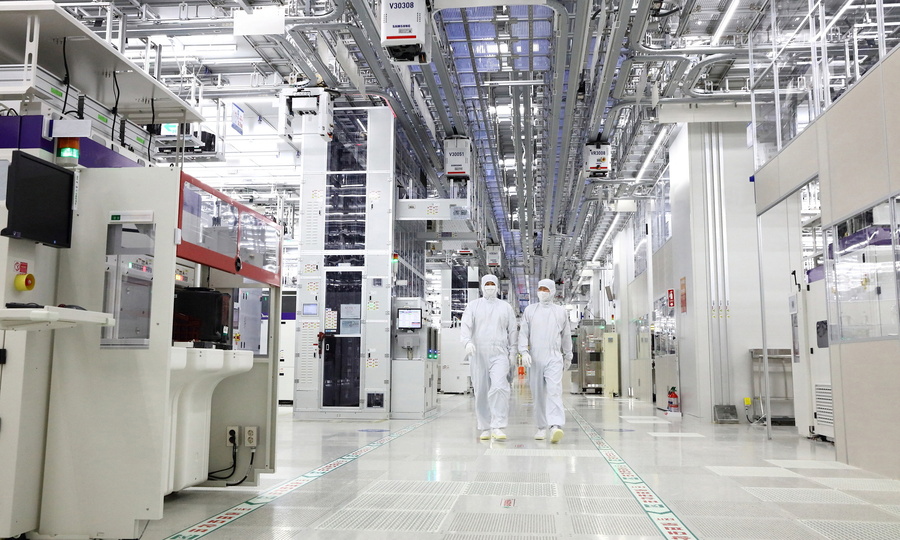
A view shows Samsung Electronics' chip production plant at Pyeongtaek, South Korea, in this handout picture obtained by Reuters on Sept. 7, 2022. Photo courtesy of Samsung Electronics/Handout via Reuters
The K-Tech Pass, run through the state Korea Trade-Investment Promotion Agency, channels skilled workers into fields such as semiconductors and biotechnology. It ties them to the F-2-T visa, a residency status built for advanced-technology professionals that also grants long-term stay benefits to their families.
A second new track folds world-class academics into the program automatically when they arrive through existing government recruitment schemes. These include the industry ministry's drive for top overseas talent, the health ministry's biotechnology recruitment program and a global talent program run by the Korea AeroSpace Administration, the country's national space agency.
South Korea dominates the memory at the heart of the AI boom. Samsung Electronics and SK Hynix together supplied about two-thirds of the world's DRAM by revenue in the first quarter of 2026, research firms Omdia and TrendForce found.
SK Hynix alone holds roughly half the global market for high-bandwidth memory, the stacked DRAM that AI accelerators cannot run without.
View original source — VnExpress ↗
Related stories
Antara News
WorldJul 7, 2026 · 1 min
Indonesia, Singapore deepen fair carbon market partnership
Antara News

The Hindu
WorldJul 7, 2026 · 1 min
The last revolutionary of Iran
The Hindu

Philippine Daily Inquirer
WorldJul 7, 2026 · 1 min
Super Typhoon Bavi: Thousands without power in US Pacific islands
Philippine Daily Inquirer
South China Morning Post
WorldJul 7, 2026 · 1 min
Minibus driver arrested in Hong Kong for allegedly knocking down elderly pedestrian
South China Morning Post