Indian Express
‘Throwing trash on Bharat Mata deshdroh’: Madras High Court slams ‘import’ of waste
Observing that throwing trash on “Bharath Matha” is not merely an environmental offence but a direct challenge to India’s sovereignty, the Madras High Court has directed re-export of a consignment imported as waste paper but found to contain municipal waste.
Justice D Bharatha Chakravarthy observed that any act threatening the right to life, self-esteem of every citizen, living organisms, and ecosystems can be considered an act that endangers sovereignty.
“If any person knowingly designs, imports, or aids in importing and throws trash on Bharath Matha, it is not just an offence under the Environment Protection Act, 1985 alone, but it is a direct challenge to her sovereignty. There cannot be a more aggravated form of deshdroh,” the June 19 order said.
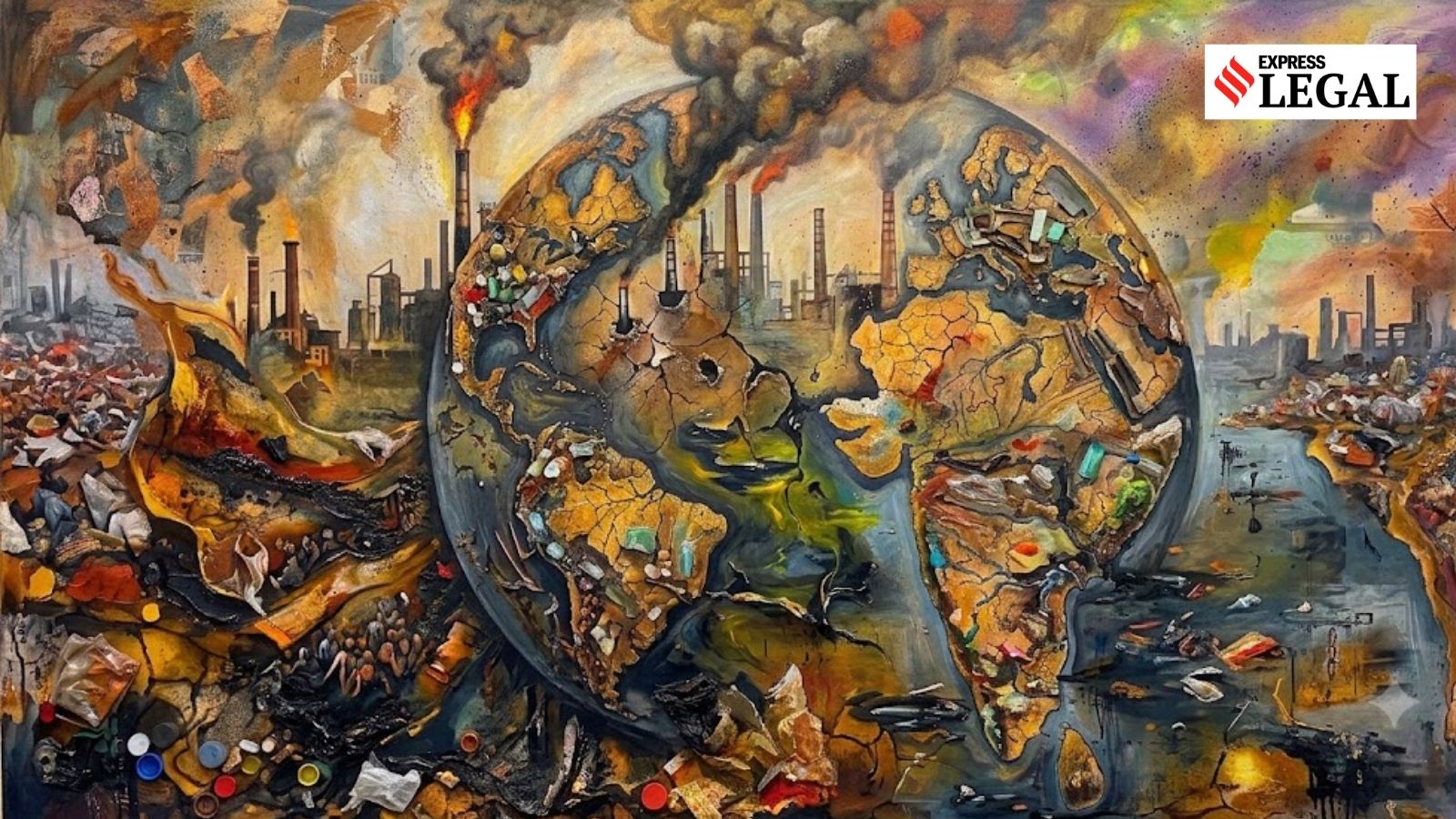
The order noted that, as environmentalists have described ‘waste colonialism’, the dumping of solid municipal waste by developed countries into developing nations “not only violates international treaty obligations but also results in serious environmental degradation”.
The court highlighted that such practices impose disproportionate environmental burdens upon developing countries and undermine the principles underlying international environmental governance.
Justice D Bharatha Chakravarthy heard a matter over foreign waste dumping in India on June 19.
‘Waste paper’ wasn’t just paper
Sripathi Paper and Board Pvt. Ltd, manufacturer of paper and paperboard, imports waste paper from other countries as a part of its business. In March 2022, it placed an order with a Canadian supplier for importing waste paper.
The consignment containing 121.970 metric tons of material in five containers was declared as Waste Paper – News & Pams. However, the Directorate of Revenue Intelligence (DRI), after examining the containers, found that they contained municipal waste.
Story continues below this ad
The Tamil Nadu Pollution Control Board inspected the consignment and submitted a report confirming that the cargo consisted of municipal solid waste, including used PET bottles, street sweepings, waste food paper and plastic parcels, broken glass bottles, waste plastic and paper containers, and used soft-drink cans.
Since the import of municipal solid waste is prohibited under the Customs Act, 1962, read with the Hazardous and Other Wastes (Management and Transboundary Movement) Rules, 2016, the consignment was detained and later seized.
The customs authority held that the company had failed to exercise due diligence while importing and directed that the consignment be re-exported to the exporting country at the importer’s cost, and a penalty was imposed.
The company later requested the authorities to waive container detention and storage charges, claiming that delays in the proceedings had increased its financial burden on the company. The company failed to re-export the consignment within the permitted period, and requested the authorities to permit it to either re-export the waste to Dubai or dispose them through recycling/incinceration in India.
Story continues below this ad
The company also challenged the customs order and sought directions regarding the payment of container detention charges through the petitions before the Madras High Court.
Advocate Hari Radhakrishnan sought permission to re-export the goods to Dubai instead of the countries of export, namely, Canada and the United States of America, on the ground that the cost of transportation to Dubai would be substantially lower and that the foreign suppliers.
He contended that the authorities had advised such re-export, and neither the customs department granted the necessary permission nor did the shipping liner act upon the directions issued by the department regarding waiver of detention charges.
‘4 crore to shipping line’
The petitioners should take all necessary steps to re-export the goods and ensure that the same are re-exported within a period of 60 days from the date of this order.
In the event of failure, from the next day onwards, the petitioners will be liable to pay environmental compensation at the rate of Rs 50,000 each per day, applying the Polluter Pays Principle, until the waste is re-exported.
The said compensation shall be recovered by the Tamil Nadu Pollution Control Board
The container Freight Stations should be entitled to raise invoices and demand detention/demurrage charges from the respective petitioners, and the petitioners should remain liable to pay the same.
The petitioners are jointly responsible for paying Rs 4 crore and the additional freight charges to the shipping line.
The court directed each petitioner to pay Rs 10,000 as costs to the customs authority.
‘India generates solid waste 1.70 lakh tonne’
The court found it undisputed that India generates a substantial amount of solid waste every day, reportedly exceeding 1.70 lakh tonne.
Story continues below this ad
The order said keeping in mind India’s international treaty obligations, instances involving exporters from foreign jurisdictions who repeatedly carry out such practices must also be taken up through appropriate diplomatic channels.
Holding that citizens have a duty to segregate the solid wastes, the court pointed out that if proper waste segregation and recycling systems are developed to ensure sufficient waste paper is available for recycling industries, the import could be curtailed.
The Ministry of Environment, Forest and Climate Change, the Director General of Foreign Trade, and the ministry concerned were accordingly ordered to consider reframing the policy, improve the segregation output of the waste paper, prevent its burning, besides improving its availability for recycling.
View original source — Indian Express ↗
Related stories

The Punch
WorldJul 7, 2026 · 1 min
Police impound 25 vehicles, prosecute offenders in Cross River
The Punch
The Punch
WorldJul 7, 2026 · 1 min
Ogun records 161 deaths from 415 road crashes — FRSC
The Punch
The Punch
WorldJul 7, 2026 · 1 min
2027: Yayi most competent to succeed Abiodun – Ogun lawmaker
The Punch

Euronews
WorldJul 7, 2026 · 1 min
Dubai's new startup campus wants to be the front door for founders
Euronews