Indian Express
Credit war to blame game: What Mumbai monsoon changed for BJP-Sena tussle
Ahead of the Brihanmumbai Municipal Corporation (BMC) election in February, the ruling BJP and its ally, Shiv Sena, were locked in a tussle, trying to project their respective leaders, Chief Minister Devendra Fadnavis and his deputy Eknath Shinde, as the ‘inframan’ of Maharashtra.
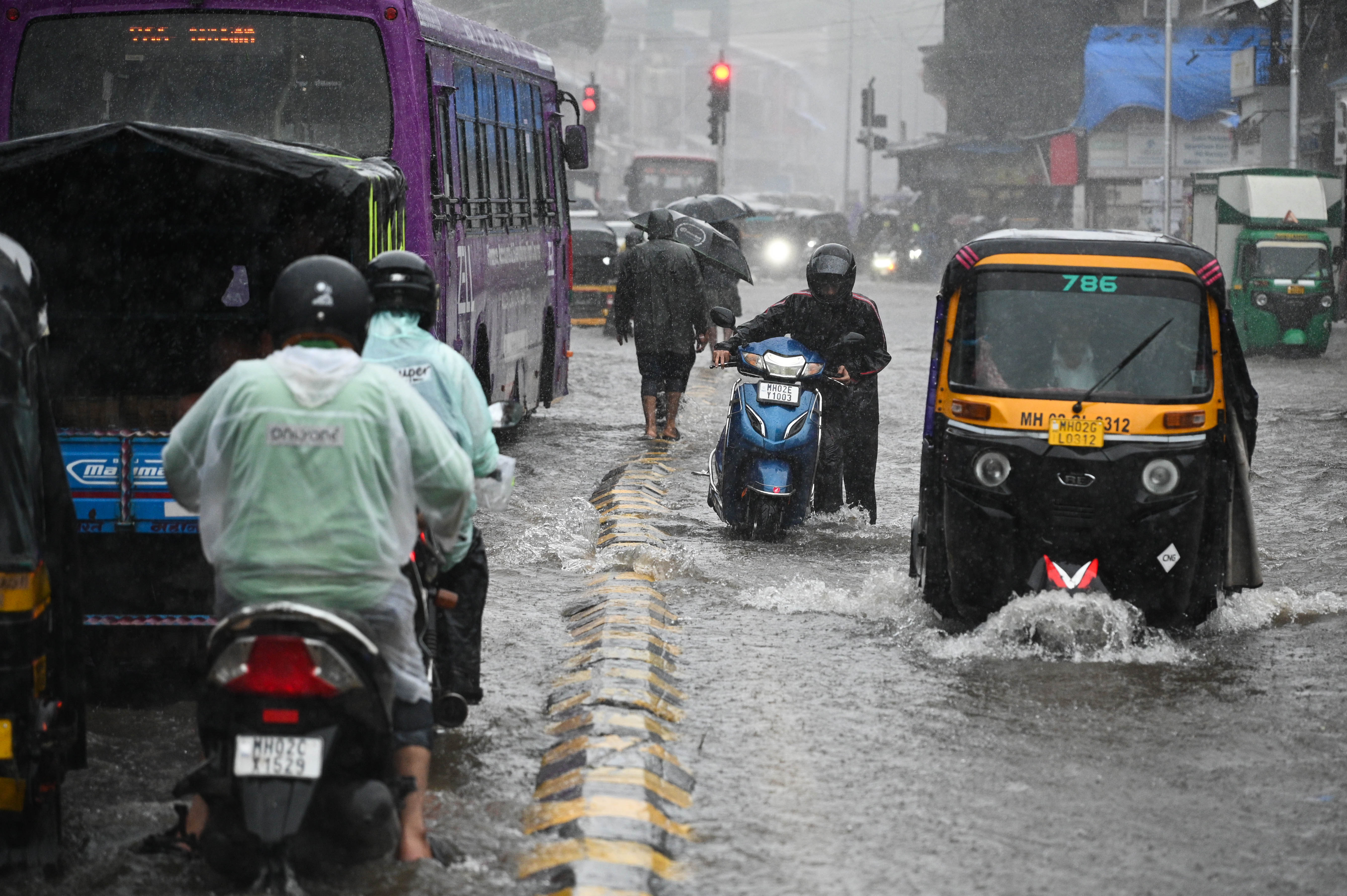
Cut to July: Mumbai and its neighbouring areas are in the throes of a ruthless monsoon. At least 10 people have died, many of them crushed under falling trees in various parts of the Maximum City. Several localities have been inundated after just about 200 mm of rain. The downpour has also exposed key gaps in the state’s much-touted infrastructure. The ‘Missing Link’ – a 13.3-km stretch built to expedite traffic between Mumbai and Pune – has suffered damage in its first monsoon, weeks after inauguration. And now, four months after the BJP-Sena credit war, both parties are shifting blame over the infrastructure gaps troubling Mumbaikars.
Devendra Fadnavis replaced Eknath Shinde as Maharashtra Chief Minister in 2024
A credit war between allies
The BJP-Sena-NCP coalition, which came to power after the Shinde-led mutiny split Shiv Sena and toppled the Uddhav Thackeray government in 2022, has touted infrastructure push as one of its key priorities.
Within the ruling alliance, this has led to a tussle between the BJP and Sena, with both parties racing to claim credit for multi-crore projects such as the Coastal Road, Navi Mumbai International Airport, Mumbai Trans Harbour Link, NAINA (also called ‘third Mumbai’) and Wadhwan Port.
There has also been a tug-of-war for greater control over the BMC, the country’s richest civic body. The February election, which brought the BJP-Sena alliance to power, was followed by rumblings. While the BJP projected Chief Minister Fadnavis as the brain behind every major infrastructure project in the Mumbai Metropolitan Region, Sena leaders complained of being sidelined by their ally.
What added to the bad blood was Fadnavis’ move to cancel and re-tender several urban development projects Shinde cleared during his tenure as Chief Minister. While the BJP cited cost escalation as the reason, the Sena was not amused.
Traffic on the Mumbai–Pune Expressway’s ‘Missing Link’ was disrupted after a landslide.
Express photo by Narendra Vaskar
Blame-game after monsoon fury
The monsoon fury has exposed the tall talk about infrastructure, revealing problems such as concretisation that weakened trees, leading to loss of young lives, including that of an 11-year-old returning from school.
Story continues below this ad
BJP minister Girish Mahajan said “every loss of life is painful”. “The government is sensitive and is taking measures to help people. I don’t think it can be dismissed as a complete failure of government or infrastructure,” he said.
Chief Minister Fadnavis held an emergency meeting on Monday to review the situation. Shinde, reportedly unwell, stayed away and has not made any public statements.
Off the record, however, a blame-game has begun. A Shiv Sena minister said the BJP controls the BMC. “They should explain lapses in the city.” On the Missing Link damage, the Sena minister said, “The agency which executed the project will have to explain. If anybody has done wrong, the government will punish.” While the urban development and public works portfolios come under Shinde, the Sena minister said a project of this scale is “collective responsibility”, and the Chief Minister was “pursuing it closely”.
BJP leaders pass the buck. A senior party leader said, “The important portfolio of urban development that drives and executes important infrastructure projects is with Deputy Chief Minister Eknath Shinde. He has his own style of functioning and dislikes any interference from the Chief Minister.”
Story continues below this ad
A waterlogged stretch on Narangi Bypass Road in Virar West following heavy monsoon rains Express photo by Akash Patil
What went wrong
Unlike the 2005 Mumbai floods, when 944 mm of rainfall was recorded in just 24 hours, the state government knew in advance that monsoon would be delayed this year and July would be marked by heavy rainfall. But despite more time to prepare, the administration did not do enough.
A schoolboy died because a weakened tree crushed a bus in Chembur, and an elderly man died after stumbling into an open manhole in Sakinaka. In Mankhurd, a shanty collapsed, killing six people, five of them children. These deaths resulted from civic lapses, exposing the ruling coalition’s claims on infrastructure.
During his first term as Chief Minister, Fadnavis had promised infrastructure that would transform the face of Mumbai and make a Mumbaikar’s life easy. And today, while ambitious projects worth thousands of crores have been launched, basic civic issues are killing the city’s residents.
The BMC has told the high court that all manholes in Mumbai will have protective grills in a week. Express photo
Opposition slams state government
The Opposition has slammed the BJP-Sena-NCP government on the monsoon deaths and damage. State Congress president Harshvardhan Sapkal said, “Monsoon has just started, and 12 people have lost their lives. It is not a natural calamity but Fadnavis’ Sultani disaster. A case of culpable homicide should be filed against the Chief Minister.”
Story continues below this ad
“During former Chief Minister Prithviraj Chavan’s tenure, experts had raised 13 points regarding the Missing link project. The Fadnavis government ignored all these aspects,” he said.
NCP (SP) MP Supriya Sule said the rains have “paralysed” the state. “The traffic has come to a halt. The trains have halted due to flooding. The BJP government always asks the opposition what they have done for 70 years; now they owe an explanation for their misgovernance in the last 12 years,” she said. “The government boasts of infrastructure-driven development. If environment and security are not the priority, what is the use of such development?” Sule asked.
Shiv Sena (UBT) leader Priyanka Chaturvedi said, “The death of an 11-year-old child due to a tree crash and a 60-year-old slipping into a manhole is murder due to negligence of those in power.”
Six people died after building collapsed in Mankhurd. Express photo by Sankhadeep Banerjee
Past Lessons
In 2005, when Mumbai witnessed its worst-ever flood after 944 mm of rainfall in 24 hours, the then Congress-NCP coalition government led by late Chief Minister Vilasrao Deshmukh was quick to admit that the failure was due to a lack of stormwater drainage system. While the city had expanded rapidly, its drainage system lay ignored. As a corrective measure, a Rs 1200-crore Brihanmumbai Storm Water Disposal Systems (Brimstowad) project was sanctioned. As part of this, a large number of pumping stations have come up in the city, but this system faces limitations in many areas due to geographical factors, among others.
Story continues below this ad
Another issue is open manholes. In 2017, Mumbai was in for a shock when a well-known doctor, Deepak Amrapurkar, died after falling into a manhole in the Elphinstone area. His body was recovered two days later at Worli. Despite the shocking incident and a series of meetings to make manholes foolproof, the plan’s implementation has remained on paper.
View original source — Indian Express ↗
Related stories

The Punch
TechnologyJul 7, 2026 · 1 min
EXPLAINER: What Tinubu’s probe of Google, Meta, AI means for Nigerians, media
The Punch
The Guardian
TechnologyJul 7, 2026 · 1 min
Female US rower reflects on ‘surreal’ record-breaking journey from California to Hawaii
The Guardian

Wired
TechnologyJul 7, 2026 · 1 min
Erling Haaland Is Everywhere at the World Cup. Most of It Is AI
Wired

Wired
TechnologyJul 7, 2026 · 1 min
Pete Holmes Is Not Reading Your Email
Wired