Indian Express
The Calcutta Stock Exchange and the making of India’s financial markets
The narrow lane leading to the Calcutta Stock Exchange has long been one of BBD Bagh’s busiest, choked with parked cars, hawkers, and fruit vendors. At its heart is Kona Dukaan, the tea-and-sandwich joint where traders, office-goers, and regulars have gathered for decades. Around 7 am and again at 7 pm, customers spill onto the road as traffic crawls past.
Since May, however, the lane has changed. The roads are cleaner and wider, and the stools that once occupied the street have disappeared. “We’re no longer allowed to sit on stools and chairs in the roadway for adda (conversation),” says a regular.
For nearly a decade, Kolkata’s famous ‘share market’ at Lyons Range has been known for almost everything — especially its food — except the stock exchange itself.
Economic consultant Thomas A Timberg recalls making frequent stops at a thandai shop outside the Exchange during research for his book The Marwaris: The Story of Indian Business (2015). “I remember the owner asking me: Do you want a bhangwala or bina bhangwala thandai? Two large jars of it would help me feel refreshed,” he recalls with a laugh.
The renewed activity around the Exchange follows the West Bengal government’s decision in this year’s Budget to back the revival of the 118-year-old Exchange, arguing that its revival could improve access to capital for businesses in eastern India.
American Civil War and the birth of stock markets in India
India occupies an important place in the history of the world’s earliest stock markets. The real impetus behind their emergence, notes author Adil Rustomjee in Running Behind Lakshmi (2025), was Europe’s search for a sea route to Asia and the riches of the spice trade. “After all, the world’s first traded joint-stock company…was called the Dutch East India Company for a reason.” It was the Dutch, he argues, who developed the two defining functions of the modern stock market: raising capital and managing risk.
According to author and educator Sudeep Chakravarti, the emergence of stock exchanges in India “was a logical follow-through of the established European practice that came to India as a part of the project of colonisation.”
Story continues below this ad
“The British East India Company and early corporate entities had begun issuing transferable financial instruments. The London Stock Exchange was up and running by the early 19th century. With the growth of the Company’s interests in India, and related growth in businesses, British, European, and Indian, it was a natural shift to the stock market structure,” he says.
Evidence of securities trading in India predates organised exchanges by several decades. As early as 1805, Calcutta newspapers such as the Bengal Hurkaru and Chronicle carried reports of trading in East India Company’s debt securities. By the 1830s, kerb trading in the shares of cotton presses and banks had begun in Bombay, although the number of market participants remained small.
Lyons Range (Express photo)
A turning point, however, came in 1850. “The rise of joint-stock companies, especially with the introduction of the Companies Act of 1850 and the subsequent introduction of the principle of limited liability, changed the investment landscape. It basically permitted individuals to invest in corporate shares, and this drove a surge in public interest towards stocks. In this, Bombay and Calcutta became the earliest hubs,” Chakravarti says.
The Bombay Stock Exchange was formally established in 1875, followed by the Ahmedabad Stock Exchange in 1894 and the Calcutta Stock Exchange in 1908.
Story continues below this ad
Historian Tirthankar Roy notes in A Business History of India (2018), “The period 1860-65 saw a boom in company formation and share markets. The crash that followed exposed the organisational weakness of the companies so hastily formed. The 1870s saw a revival of company formation, but now new and reformed company laws increased stability.”
The catalyst for this boom lay thousands of kilometres away. The American Civil War (1861-1865) disrupted cotton production in the southern United States, while the Union blockade prevented Southern cotton from reaching overseas markets. As Rustomjee explains, “Cotton from India entered world markets as a substitute. As a result, prices in India soared, providing an opportunity to all those traders who bought and sold cotton futures.”
Premchand Roychand (Wikipedia)
The cotton and share mania of the 1860s produced India’s first generation of celebrated market operators, most notably the 30-year-old Premchand Roychand, famously known as the ‘Cotton King’, who is credited with establishing many conventions and trading practices that shaped Indian markets for the next century.
The boom ultimately culminated in the establishment of the Bombay Stock Exchange.
Story continues below this ad
Market activity in Calcutta
Calcutta’s story closely mirrored Bombay’s. Long before a formal stock exchange was established, the city had developed a securities market.
“India is the world’s oldest emerging market with recorded trading going back to the early nineteenth century, and much of this is because of pre-exchange trading in Calcutta,” writes Rustomjee.
Newspapers routinely published stock quotations well before brokers gathered on an organised trading floor. From the 1830s onwards, they regularly carried prices of the Bank of Bengal and Union Bank, alongside reports on insurance companies. Brokers, meanwhile, conducted business beneath the shade of a neem tree in Dalhousie Square, near the site where the Chartered Bank building stood.
According to Rustomjee, “Calcutta was also the real progenitor of India’s IPO market. Despite Bombay’s importance from the early years, Calcutta led Bombay in primary issuance, and significant new issuance started here.”
Story continues below this ad
Among the pioneers were early entrepreneurs such as Dwarkanath Tagore and Rustomjee Cawasjee Banajee, who raised capital by issuing shares while appointing themselves as secretaries or managing agents, allowing them to combine the advantages of joint-stock ownership with managerial control. “In this sense,” Rustomjee notes, “they were precursors of the managing agency system that was to dominate enterprise in later years, with Rustomjee, Turner and Carr, Tagore being among the first managing agencies in India.”
By 1864, the financial daily Daily Money Market reported 91 listed companies in Calcutta, more than a third of them connected to the tea industry.
“The Marwaris entered the stock market between 1860 and 1900,” notes Timberg in The Marwaris. By the turn of the century, they accounted for more than a quarter of Calcutta’s stockbrokers.
Story continues below this ad
One of the earlier firms was Babulal Gangaprasad Soni, founded in 1892 by Babulal Soni of Didwana in Jodhpur, who had been a merchant in Mirzapur but was already dealing in shares in Calcutta since 1872. His son-in-law, Magniram Bangur, emerged as one of the leading speculators in coal stocks between 1904 and 1908, before the Bangur family went on to build one of India’s prominent industrial business groups.
“The Marwaris were probably even more active on the commodity exchanges because they were active in the commodity trade,” says Timberg.
The Calcutta Stock Exchange (Express photo)
In the absence of a unified national market, Calcutta developed its own investment cycles. While Bombay experienced a boom in cotton shares, Calcutta witnessed successive booms in tea stocks. These were followed by the rise and fall of jute in the 1870s, renewed tea booms in the 1880s and 1890s, and finally a mining and collieries boom. The coal boom, between 1905 and 1908, drew large numbers of newcomers to the market. Lured by the relentless rise in coal share prices, many rushed in hoping to make their fortunes.
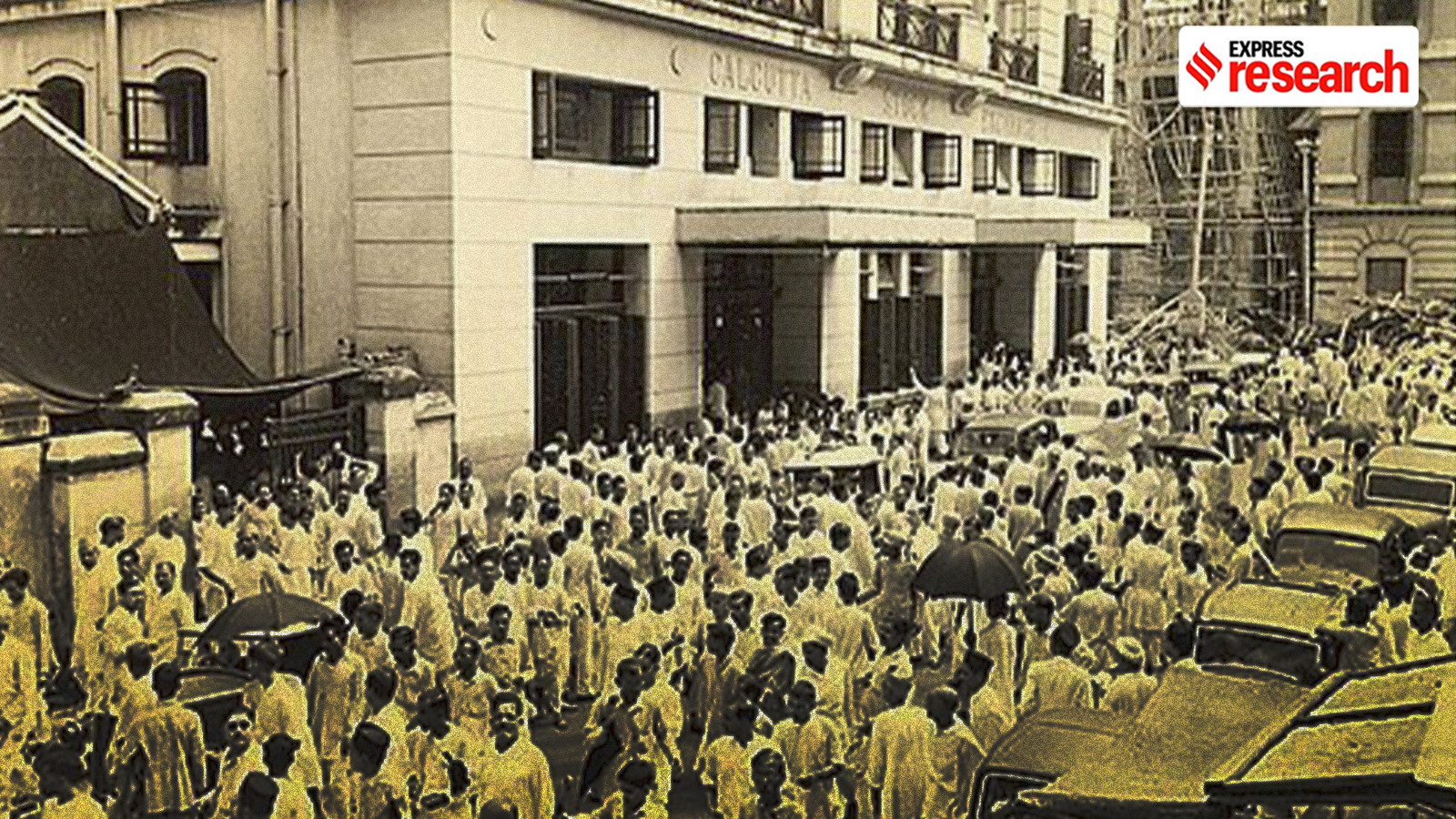
It was also during this period that the indignity of conducting business on the streets prompted brokers to organise themselves. “It was at this stage that, mainly through the enthusiastic endeavours of Babu Buldeodass Duduawala and Mr Overend of place, Siddons & Gough, an Association was founded in 1908 under the name and style of ‘The Calcutta Stock Exchange Association,’” at Lyons Range, cites the Golden Jubilee symposium. The thrill and excitement of that Monday morning, when Calcutta’s stockbrokers came together under one roof, remains documented in the Exchange’s symposium.
Story continues below this ad
In Front of the Calcutta Stock Exchange (Wikimedia Commons)
The ground floor of the building housed the trading hall, while rooms on the mezzanine floor were rented out to members as offices. The first committee consisted of nine members — five Europeans and four Indians.
Contemporary newspaper records show that nearly 200 companies were traded on the Exchange, including 10 railway stocks, 19 banks, 26 jute mills, 69 coal companies, and 81 tea companies. “Till recently,” writes Rustomjee, “a Calcutta-based company also held the record for the oldest listed company in India. Assam Company is also the world’s first tea company.”
Wartime ebbs and flows
The coal boom that had powered the Calcutta Stock Exchange’s early years had plummeted by 1909, ushering in a severe trade depression that forced many stockbrokers to leave the Association. Although the market remained closed for a period during the First World War, the phenomenal rise in jute share prices eventually transformed its fortunes.
The Exchange’s Golden Jubilee symposium notes that the war was followed by a period of intense industrial activity, with existing enterprises expanding and new companies coming into being. “Many of the large Marwari families that emerged, especially after the First World War and, to some extent, after the Second World War, were major participants in the share market,” says Timberg.
Story continues below this ad
Jawaharlal Nehru at CSE (CSE)
The prosperity, however, proved short-lived. Growing competition from Japan, particularly in cotton textiles and related piece goods, dealt a blow to Indian mills, a downturn that was reflected on the stock exchange. The Great Depression of 1929 had also swept through global markets, pulling the Indian stock market into its vortex.
The following decade brought another upheaval with the outbreak of the Second World War. The conflict initially triggered a boom on the Exchange, but optimism soon faded. The adverse fortunes of the Allied powers, the temporary closure of the Bombay and Ahmedabad stock exchanges, Japan’s entry into the war in December 1941, and the climate of uncertainty that persisted until 1943 all contributed to a prolonged downturn.
The years that followed continued to be marked by similar cycles of booms and slumps.
“The incendiary and chaotic mix of labour and politics that began in the late 1960s triggered a steady leaching of industrial activity and commercial activity in Bengal,” says Chakravarti.
“It affected nearly every aspect of business life. A sort of recovery was attempted from the first decade of this century, but the results have been patchy. Bengal will remain hamstrung so long as the credo of mastanocracy, irrespective of political colour, oversees business.”
Government intervention and the NSE
Before the sweeping financial reforms of the 1990s, India’s stock exchanges operated largely through traditional practices with limited regulatory oversight. Trading took place through an open outcry system, where brokers shouted buy and sell orders on the trading floor. Because only brokers on the floor had access to real-time prices, the market lacked transparency, leaving ordinary investors unaware of prevailing prices. This information gap drove some brokers to exploit clients through a practice known as ‘gala,’ under which investors were charged prices less favourable than those prevailing in the market.
Entry into the brokerage business was also tightly controlled, as exchange memberships were fixed. At the same time, the ‘badla’ system allowed traders to defer settlement by paying a financing charge, encouraging leveraged speculation and increasing systemic risk. The reliance on physical share certificates further complicated these problems, exposing investors to loss, forgery, counterfeiting, and lengthy delays in the transfer of ownership.
These structural weaknesses, detailed by Ajay Shah in his journal article The Journey of Indian Finance (2024), contributed to stock market scandals and periodic settlement crises.
“The weaknesses of the equity market then created the impetus for one of the most important elements of the Indian economic reforms,” he writes. “The Ministry of Finance constructed a new stock exchange, the National Stock Exchange (NSE), in 1992.”
NSE created a new market mechanism, featuring computerised order matching, the removal of entry barriers in exchange membership, daily settlement, risk management at the clearing corporation, and dematerialised settlement.
The regulatory landscape also changed rapidly. The Securities and Exchange Board of India (SEBI) was established in 1988, ushering in a new era of market regulation. Electronic trading was introduced in 1994, followed by the establishment of the clearing corporation and depository in 1996, and the launch of equity derivatives trading in 2000.
Shah notes that “once the foundations of electronic trading and derivatives trading were in place, the market rapidly moved up the ladder of capability to algorithmic trading.”
For regional stock exchanges, these reforms proved transformative in another sense, erasing the geographical advantage they had long enjoyed. The Calcutta Stock Exchange ceased trading in 2013, while the Madras Stock Exchange closed in 2015.
“This was a result of changing dynamics, jettisoning of inefficiencies, and a consolidation of electronic trading, among other factors,” notes Chakravarti.
“Regional exchanges existed because there was no electronic trading. If someone in Kanpur or Hyderabad wanted to buy or sell shares, they had to do it through their local exchange. There was simply no other way. Once computerised trading and a nationwide network came in, the rationale for regional exchanges disappeared. We already had the National Stock Exchange and the Bombay Stock Exchange,” says Kamal Parekh, former president of the Calcutta Stock Exchange.
Why revival is tricky
While there is renewed discussion around reviving the CSE, Chakravarti is cautious about its prospects. “This so-called renewed interest will mean little unless improved infrastructure, ease of business, improved attitudes, and business efficiencies are given room, as opposed to the easier options of showy and destructive politics.”
Any revival would require not only regulatory clearance but also the rebuilding of investor confidence after the Exchange’s prolonged inactivity and past operational challenges. Further, modern exchanges require substantial investment in technology, surveillance systems, and regulatory compliance.
“In today’s high-tech environment, running an exchange requires enormous investment in technology and infrastructure, something regional exchanges simply cannot afford,” argues Parekh.
He adds that SEBI, too, has preferred a more consolidated market structure. “Why should it have to regulate 19 stock exchanges? Multiple exchanges increase the regulatory burden and, in some cases, create opportunities for malpractice. Even in the United States, despite its much larger economy and stock market, there are essentially two dominant exchanges — the New York Stock Exchange and Nasdaq.”
View original source — Indian Express ↗
Related stories

The Punch
WorldJul 7, 2026 · 1 min
2027: Ogundipe clears air on Ogun ADC governorship ticket
The Punch
The Punch
WorldJul 7, 2026 · 1 min
US Consulate, FBI seek stronger EFCC ties on sextortion
The Punch
The Punch
WorldJul 7, 2026 · 1 min
Police detain officers over assault of civilian in Ebonyi
The Punch
The Punch
WorldJul 7, 2026 · 1 min
PFIPC scandal: Ex-SGF Babachir Lawal suspects ‘big racket’ behind ‘fake’ agency’s budget code
The Punch