Indian Express
Hyderabad’s Char Kaman all set to be restored: What are they, why they matter
4 min readHyderabadJul 7, 2026 02:56 PM IST
A view of the Charminar Kaman, the arch to the south. Photo: Wikimedia Commons
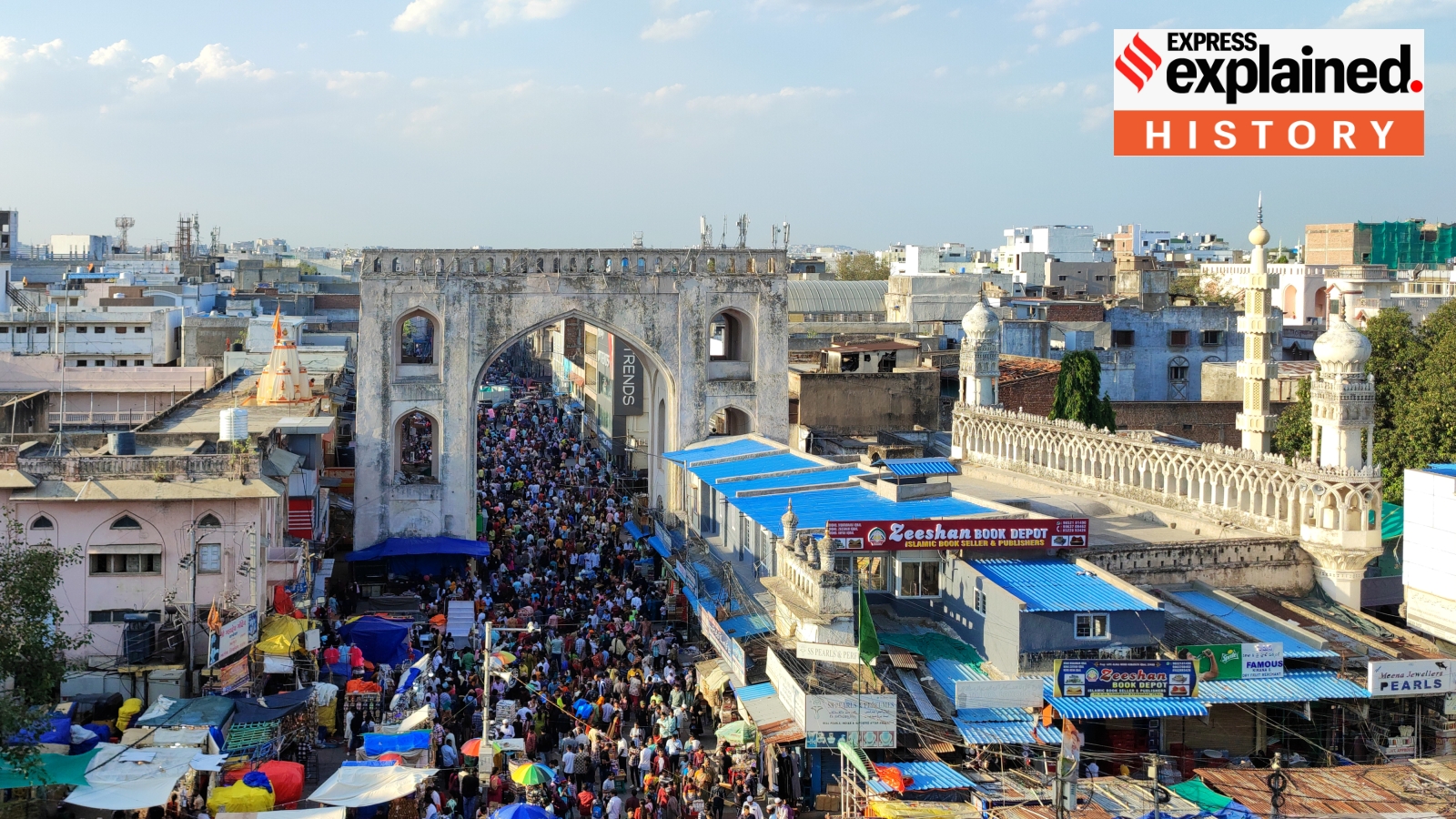
Hyderabad is known for its iconic Charminar, the structure which falls in the Old City and bears the signature of the Qutb Shahi dynasty’s architectural majesty. But what’s lesser known are the four ornamental gateways that lead to the Charminar, called the Char Kaman.
The Telangana government has announced that the gateways will soon get a facelift. Here’s what to know about its history and the restoration plans.
History and significance of Char Kaman
The Charminar was built between 1589 and 1591 by Muhammad Quli Qutb Shah, the fifth ruler of the Qutb Shahi dynasty. According to Mohammed Safiullah, a Hyderabad historian and honorary managing trustee of Deccan Heritage Trust, the Kamans could have been built around 1594.
The 20th century historian Syed Ali Asghar Bilgrami writes that after the completion of the Charminar, Shah commissioned the construction of four ornamental arches or gateways around the Charminar.
According to Bilgrami’s book Landmarks of Deccan (1927), the four arches had names differing from their present nomenclature. The west arch was first named Daulat Khanae Ali, or the gate of the royal residence; whereas the one on the east was named Naqqar Khana, or gate of the palace where drums are beaten.
“Generally the central area of the four arches was termed Jilau Khana or the royal vestibule,” Bilgrami writes.
The Kaman to the north under which “a huge elephant with a canopied litter can easily pass” were later called Machli Kaman, or the fish arch. This is because, Bilgrami writes, “a big fish made of bamboo and paper resembling a miniature aeroplane is suspended in the centre of the arch on every lunar new year”.
Story continues below this ad
One of the Char Kaman as seen from the Charminar in Hyderabad. Photo: Wikimedia Commons
The rest of the arches were called Charminar Kaman (south); Kali Kaman or Kaman of Shambhoo Pershad (east), which stands for the black arch; Kaman Sher Dil or Sihr Batil (west), meaning gateway for the lion hearted or the magic breaker. These names are still in use in Hyderabad.
Bilgrami writes: “Formerly the Qutub Shahi palaces were situated towards the western arch, but the relentless hand of time has totally obliterated them.” The arches marked the entrances to the city of Hyderabad. According to Bilgrami, the arches saw immense traffic during the Qutb Shahi period as “the adjoining outhouses were used as a sitting place for the nobles and officials. These noblemen used to come every morning with their retinue and attendants and after reaching the royal vestibule which was in the centre of the four arches, the suite and retinue were left behind and they used to proceed unattended for the audience of the king.”
Restoration plans
The restoration work is expected to focus on structural repairs and conservation of heritage features. The work would aim to improve the overall condition of the monuments while retaining their historical character. Heritage conservationists have long called for the preservation of the Char Kaman, pointing to the damage caused over the years by growing urbanisation and resultant pollution.
Hyderabad MP Asaduddin Owaisi announced last week that the restoration project has received a major boost, with the government granting administrative sanction to invite tenders and appoint a consultant for the work.
Story continues below this ad
“Happy to share that Hyderabad’s four gateways (kamaan) will soon be repaired and restored. The government has granted administrative sanction for inviting tenders and appointing a consultant for the work,” he wrote on X.
Nikhila Henry is an Assistant Editor at The Indian Express, based in Hyderabad. With a career spanning 17 years, she has established herself as an authoritative voice on South Indian affairs, specialising in the complex intersections of politics, education, and social justice.
Experience & Career: Nikhila commenced her journalism career in 2007 as an education correspondent for The Times of India in Hyderabad,where she gained recognition for her coverage of student politics. Her professional trajectory includes a four-year tenure at The Hindu, where she focused on minority affairs and social welfare. In 2019, she took on a leadership role as the South Bureau Chief for The Quint, where she directed regional coverage across all five South Indian states. Her expansive career also includes a tenure at the BBC in New Delhi and contributions to prestigious international outlets such as The Sunday Times (London) and HuffPost India.
Expertise & Focus Areas
Nikhila’s reportage is marked by a deep-seated understanding of grassroots movements and institutional policy. Her core focus areas include:
Regional Politics: Comprehensive analysis of the socio-political dynamics across South India.
Education & Student Movements: Chronicling the evolution of Indian academics and the rise of youth activism.
Minority Affairs: Rigorous reporting on the welfare, rights, and challenges facing marginalized communities.
National Beat: Elevating regional stories to national prominence through investigative and on-ground reporting.
Authoritativeness & Trust
A respected figure in Indian media, Nikhila is not only a seasoned reporter but also an accomplished author and editor. She authored the critically acclaimed book The Ferment: Youth Unrest in India and edited Caste is Not a Rumour, a collection of writings by Rohith Vemula. Her dual background in daily news reporting and long-form authorship allows her to provide readers with a nuanced, historically-informed perspective on contemporary Indian society.
Find all stories by Nikhila Henry here. ... Read More
Tags:
Explained History
Express Explained
View original source — Indian Express ↗
Related stories

Wired
TechnologyJul 7, 2026 · 1 min
Hisense UR9 RGB MiniLED: An Affordable TV in Its Class
Wired

The Guardian
TechnologyJul 7, 2026 · 1 min
What will define Elon Musk’s legacy? Doge cuts to USAID Ebola programs
The Guardian

CNET
TechnologyJul 7, 2026 · 1 min
I Found the Rules for Legally Recording Audio and Video on Your Home Security Camera
CNET

The Verge
TechnologyJul 7, 2026 · 1 min
Are you ready for what it takes to stop ghost guns?
The Verge