Times of Israel
Knesset splits controversial bill to erode attorney general’s powers, easing path for key aspects to become law
The Knesset voted 59-45 late Monday night to split its highly controversial legislation gutting the powers of the attorney general.
The decision to split the bill arose seemingly because the Knesset Constitution, Law and Justice Committee no longer has time to prepare the original bill before the Knesset is set to dissolve next week ahead of October elections, due to the legislation’s size and potential impact.
As a result, the bill now being advanced will no longer divide the role into two separate offices — an attorney general and a prosecutor general — as the coalition had sought throughout the legislative process. Instead, criminal prosecution powers will remain with the attorney general for now. The coalition apparently intends to draft a separate bill dividing the role of attorney general at a later date, while speeding ahead with its new version of the legislation, potentially for final readings next week.
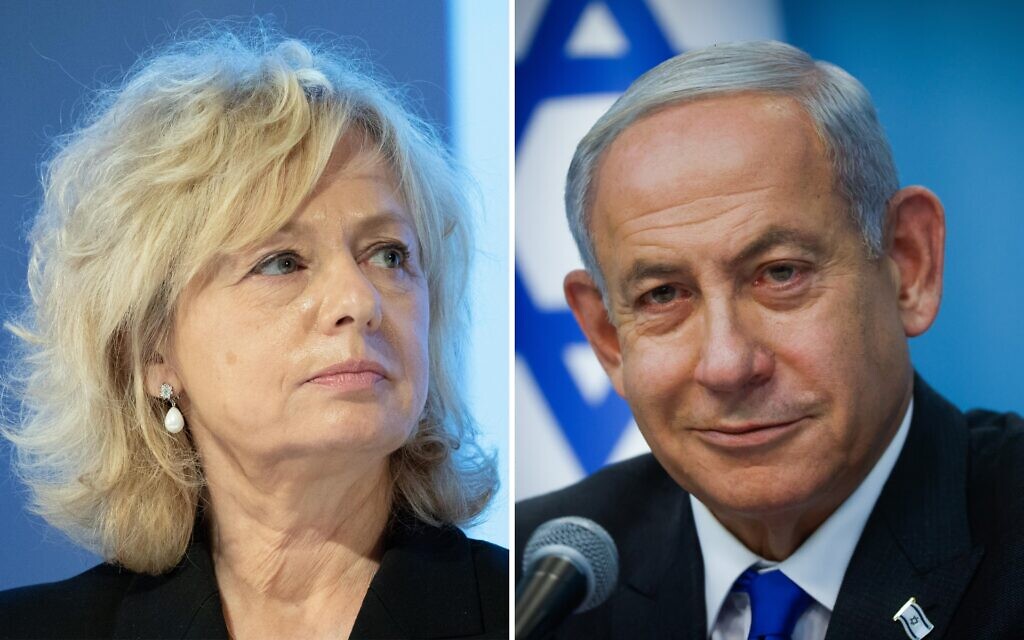
The bill that the coalition is currently advancing preserves the most controversial aspect of the legislation: that the attorney general’s legal positions will no longer be binding on the government. Critics of this provision, including Attorney General Gali Baharav-Miara, say that allowing the government to decide for itself whether its actions are legal will gravely violate the rule of law and remove a key check on government power.
The bill’s advancement follows a reported agreement between Prime Minister Benjamin Netanyahu and the ultra-Orthodox parties ending their boycott of coalition legislation last month. Under the deal, the coalition agreed to advance key Haredi priorities, including legislation enshrining Torah study as a Basic Law and other related measures, in exchange for their support for the coalition’s own legislative agenda.
Get The Times of Israel's Daily Edition
by email and never miss our top stories
By signing up, you agree to the terms
Knesset Constitution Committee legal adviser Gur Bligh stated during a hearing on Monday that a key concern over the bill was the ability of the government to ignore the attorney general’s legal positions in “extreme” situations in which it tries to expand its authority beyond the boundaries of the law. Bligh said this was “especially dangerous” regarding criminal proceedings and election law for which the bill does not provide “adequate safeguards.”
The new version of the bill also removes the highly politicized method of hiring and firing the attorney general, which the previous version of the legislation stipulated, and which critics said would almost certainly undermine the independence of the attorney general. Instead, the new text of the bill says that the government will decide how the attorney general will be appointed and dismissed within 30 days of the law coming into effect after the upcoming elections.
The original version of the legislation passed its first reading in the Knesset plenum in June, but Monday’s plenum vote was required to approve the committee’s decision to split the bill. Splitting the bill means that the coalition can move ahead with all elements of the original bill toward their final second and third readings in the next Knesset if needed, since the original text had passed its first reading.
Committee chairman MK Simcha Rothman intends on Tuesday evening to begin the process of approving the new bill for its final readings in the Knesset, meaning that votes in the plenum for the final passage of the legislation will likely be scheduled for next week.
The coalition also advanced other contentious bills Monday — chief among them highly controversial legislation establishing a politically appointed probe into the failures surrounding Hamas’s October 7, 2023, massacre — as it seeks to push through as many bills as possible before the parliament’s expected dissolution on July 17, at which point most legislative activity is expected to halt ahead of the election, set to be held by October 27.
Media overhaul legislation okayed for final readings
The Knesset committee preparing the government’s controversial media overhaul legislation on Monday approved that bill for its final readings in the plenum.
Communications Minister Shlomo Karhi’s media overhaul bill would give the government significant control over broadcast media, news sites and other outlets, and has been criticized by the Knesset’s professional legal staff and by Baharav-Miara, who have warned that it undermines press freedom and allows for political interference in the media.
Chair of the Special Committee for the Communications Law, Likud MK Galit Distel-Atbaryan, said that media in Israel would change “from top to bottom,” allowing Israelis greater choice in what they watch as a result of the proposed law.
“Consumers will immediately feel the effect of lower prices. Everyone will benefit from the fruits of this reform,” asserted Distel-Atbaryan.
The opposition, however, denounced the advancement of the bill to its second and third readings in the Knesset plenum, saying the legislation will undermine freedom of the press and concentrate regulatory power in the government’s hands.
“This is the day on which a stamp of approval was given to a regime change law, which will take control over the free press in the State of Israel,” said Yesh Atid MK and special committee member for the opposition Shelly Tal Meron.
The Knesset has yet to set a date for the final readings in the plenum.
Knesset legal adviser Sagit Afik told the committee on Monday that it was no longer possible to adjust clauses in the legislation to halt media broadcasts in the government media application on Shabbat or to filter adult content, as demanded by the ultra-Orthodox factions.
Afik’s comments were a severe blow to the bill, since the ultra-Orthodox parties have refused to back the legislation without the changes because they claim that in its current format, it would expand access to television broadcasts on Shabbat.
According to a report by Channel 13, the United Torah Judaism party is now refusing to vote for the bill, which could deprive the coalition of its majority for the legislation.
Committee advances bill to expand gender segregation in academia
Meanwhile, the Knesset Education Committee voted Monday to advance a bill to expand gender segregation in academia to the Knesset plenum for its final two readings.
The bill, which had been expected to be voted on in the plenum later Monday but ended up not being included in the day’s agenda, would allow universities and colleges to offer gender-segregated master’s and doctoral degree programs subject to approval by the Council for Higher Education.
The legislation builds on a 2021 High Court ruling that upheld the Council for Higher Education’s policy permitting limited and specific gender-segregated undergraduate programs aimed at integrating ultra-Orthodox students into higher education and, ultimately, the workforce.
The court stressed at the time that the arrangement was specifically intended for the Haredi community and imposed safeguards, including limiting segregation to classrooms in mixed institutions and prohibiting discrimination against female lecturers.
The new legislation would extend that framework to master’s and doctoral programs and be open to all students, not only the Haredi community, while a proposed amendment by Shas MK Yossi Taieb to expand segregation to additional areas of campuses was rejected.
Proponents framed the bill as increasing educational opportunities for religious women, with bill sponsor MK Limor Son Har-Melech arguing the legislation will “advance women from sectors that have not received the opportunities they deserve,” while committee chair MK Zvi Sukkot said it would “expand freedom of choice.”
But opposition lawmakers and academic representatives have roundly denounced the bill, arguing that it unnecessarily expands gender segregation beyond existing arrangements, prioritizes religious rights over the rights of female students and lecturers to equality, dignity and freedom of movement, and harms academic freedom and the quality of teaching and research.
Education Committee member and The Democrats MK Naama Lazimi condemned the “terrible bill” on Monday, saying lawmakers who oppose women serving in the Knesset or whose parties bar female candidates, including several of the committee members, “have no right to strip us of our freedoms and rights.”
Marathon deliberations also continued in committees Monday on several measures promoted by the ultra-Orthodox United Torah Judaism and Shas parties, including a controversial proposed Basic Law on Torah study to shield Haredi draft dodgers from sanctions and parallel legislation freezing their arrests, as well as legislation repealing the previous government’s kashrut reform.
These discussions were set to continue on Tuesday and possibly later in the week.
View original source — Times of Israel ↗
Related stories

France 24
PoliticsJul 7, 2026 · 1 min
What to know about Macron's landmark visit to Syria
France 24

The Hill
PoliticsJul 7, 2026 · 1 min
Legionnaires’ cluster grows in New York City: Health Department
The Hill

TASS
PoliticsJul 7, 2026 · 1 min
Russia to do its utmost to ensure Cuba has freedom of choice — senior lawmaker
TASS

Straits Times
PoliticsJul 7, 2026 · 1 min
Kremlin says Russia will follow NATO summit closely
Straits Times