The Next Web
Google and RWE back Proxima Fusion in record €411mn round
Munich-based Proxima Fusion has raised €411mn ($468mn), the largest private fusion round Europe has ever seen and a rare vote of confidence in a technology that has yet to produce a watt of commercial power. The deal values the stellarator company at €2.4bn and brings in Google and German utility RWE as strategic backers.
XTX Ventures and East X Ventures, the venture arms of two quantitative trading firms with a growing taste for hard science, led the round. East X runs Starmaker One, Europe’s first fund dedicated to fusion and backed by the UK Atomic Energy Authority.
Returning investors Plural, Balderton, Cherry Ventures, Lightspeed and DST Global Partners piled back in, joined by newcomers KfW Capital, SPRIND and Burda Principal Investments. It comes barely a year after Proxima’s record €130mn Series A, which Cherry Ventures and Balderton co-led.
For Google, it is a first bet on a European fusion company, extending an interest that already spans a clutch of US developers, according to TechFundingNews. RWE’s stake is more concrete: the utility put in around €25mn, and months earlier it agreed to help build the first stellarator plant on the site of a decommissioned fission reactor in Gundremmingen, Bavaria.
In under three years, Proxima has now assembled more than €650mn, some €95mn of it in public grants. The latest raise cleared its own target, which was pegged to matching Bavaria’s €400mn public commitment to the company’s roadmap. Founder and chief executive Francesco Sciortino framed the money as proof that Europe can “not only invent breakthrough technologies, but also build globally competitive companies around them.”
The 💜 of EU tech
The latest rumblings from the EU tech scene, a story from our wise ol' founder Boris, and some questionable AI art. It's free, every week, in your inbox. Sign up now!
The cash funds Alpha, a net-energy demonstrator Proxima wants running near Munich in the early 2030s. Led with the state of Bavaria, the Max Planck Institute for Plasma Physics and RWE, Alpha is the bridge between decades of laboratory research and an actual power station; get it working, and Stellaris, billed as the world’s first commercial stellarator plant, would follow later in the decade.
Behind it sits the Alpha Alliance, a consortium of more than 50 industrial partners.
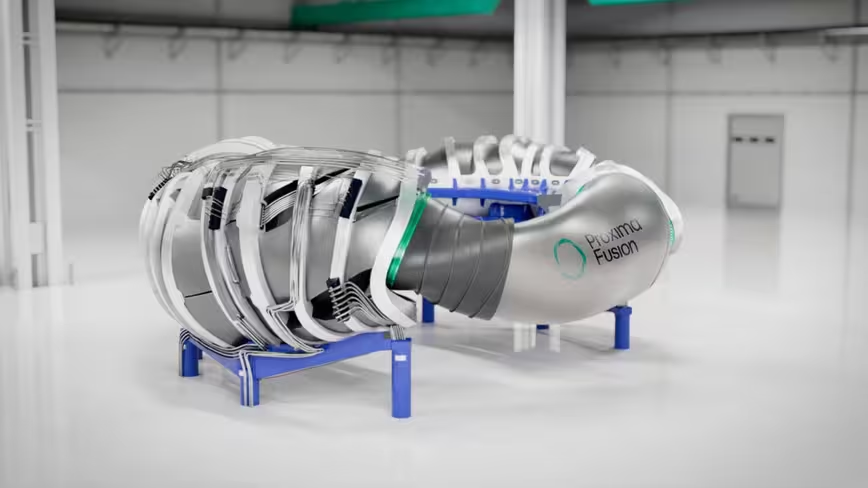
Proxima is chasing fusion through that stellarator, a reactor that twists plasma into shape with a cage of external magnets rather than driving a current through it, as the more common tokamak does.
The design is fiendish to engineer but, in principle, more stable and easier to run without interruption. The company is a spin-out of the Max Planck Institute for Plasma Physics, and it builds on Wendelstein 7-X, the German experiment that showed the concept could hold plasma steady.
Near term, the money goes on unglamorous but load-bearing hardware: finishing the Stellarator Model Coil, scaling up production of high-temperature superconducting cable and magnets, and hiring across engineering and manufacturing at sites in Germany, Switzerland and the UK.
Proxima employs roughly 200 people today and wants a good many more, part of a vertical integration strategy that keeps coil and magnet work in-house rather than farmed out to suppliers.
The timing is not accidental. European fusion outfits have been raising at pace as governments reframe the technology as a matter of energy security rather than a distant science project, and the round lands Proxima among the best-funded fusion firms anywhere.
Fusion has a long habit of promising limitless clean power and then quietly moving the date, and Proxima’s own 2030s targets are bold by any reading. What has shifted is the money: a €411mn private round, stacked on Bavaria’s public billions, suggests investors will now fund the boring, capital-heavy middle of the journey and not just the physics. Whether the physics obliges is the one part no cheque can buy.
View original source — The Next Web ↗
Related stories

The Verge
TechnologyJul 7, 2026 · 1 min
Microsoft fixes storage-hogging Windows 11 folder
The Verge
The Next Web
TechnologyJul 7, 2026 · 1 min
AI data centres are driving up power bills at America’s Rust Belt factories
The Next Web

TechRadar
TechnologyJul 7, 2026 · 1 min
Why Nvidia's NemoClaw signals the true enterprise agent era
TechRadar

Dawn
TechnologyJul 7, 2026 · 1 min
Trump says he will lift Turkey sanctions, decide on selling F-35s
Dawn