Indian Express
C Raja Mohan writes: Beyond US and China, India and others are building a ‘G Minus Two’ for Indo-Pacific
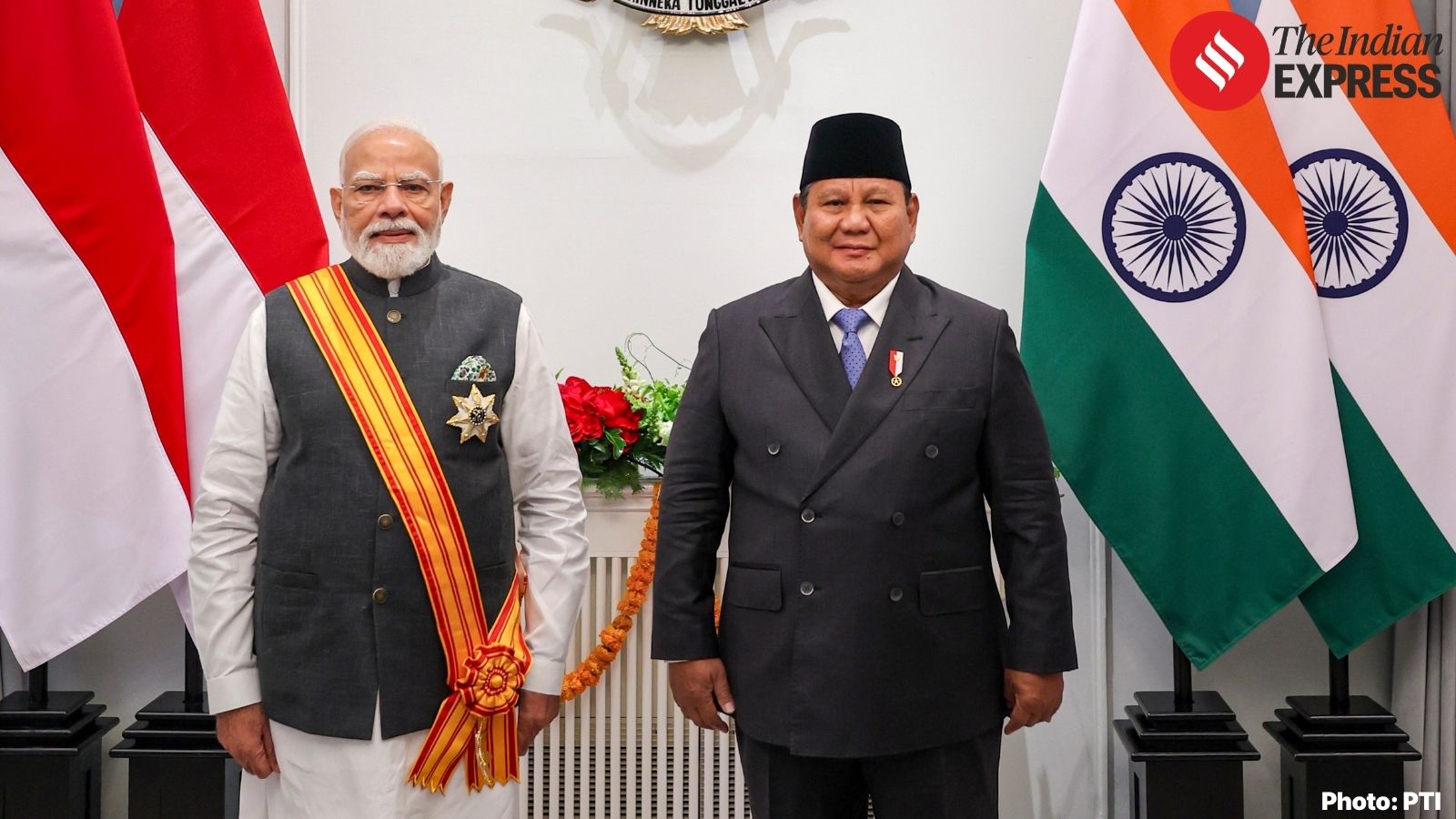
Prime Minister Narendra Modi’s eastward journey this week — from Indonesia to Australia and New Zealand — marks the consolidation of a new Indo-Pacific approach that might be called “G Minus Two”. The idea of a US-China condominium in Asia has always made Indian strategists uneasy. President Donald Trump’s occasional references to a G2, along with his administration’s decision to discard the Indo-Pacific terminology, have reinforced those anxieties.
Delhi is responding to the new dynamic between Washington and Beijing by expanding its cooperation with the rest of Asia. This is similar to the ways in which several Asian powers are dealing with the changes in US-China relations. The unfolding Asian pattern of “G Minus Two” should help shift India’s Indo-Pacific debate away from sterile slogans about American intentions or Chinese ambitions. The more practical question is what India can build with the rest of Asia.
The visits to Delhi by Japanese Prime Minister Sanae Takaichi this month and South Korean President Lee Jae-myung in April underlined the urgency in Tokyo and Seoul, two key Asian allies of Washington, to widen their Asian ties. Modi’s visits to Jakarta, Melbourne and Auckland point to the same logic — the importance of expanding the geopolitical room for manoeuvre by strengthening cooperation among themselves.
“G Minus Two” is not about Asia turning its back on America. Quite the contrary. Most Asian countries recognise that there can be no stable balance of power in Asia without a sustained US strategic presence. China’s rising military weight cannot be balanced by the rest of Asia, even if they act in concert. That is why Japan, South Korea, Australia and New Zealand continue to build on their security partnerships with Washington. If anything, uncertainty under Trump has increased the incentive to bind the US more closely to Asian security.
India and Indonesia, despite their non-aligned tradition, have reached similar conclusions. As China flexes its military muscle, both have intensified defence cooperation with the US. Their “strategic autonomy” under the shadow of China rests not on keeping America at arm’s length, but on working with it and navigating Trump’s mercurial diplomacy. Both Delhi and Jakarta are now “major defence partners” of Washington.
If “G Minus Two” is not about distancing from the US, neither is it about containing China. Every major Asian nation, including India and the three countries Modi is visiting this week, knows that Chinese power in Asia and the Indo-Pacific is a reality that must be managed. They also have to deal with the extraordinary economic interdependence with China.
The Asian objective is to “de-risk” Beijing’s weaponisation of interdependence. India’s annual trade with China is now at $150 billion. Comparable figures for America’s Asian partners underline the same reality: South Korea trades roughly $300 billion with China, Japan more than $300 billion, Australia over $200 billion, while ASEAN’s trade with China has crossed the trillion-dollar mark. Commercial decoupling is simply not a realistic option. The Asian imperative for deeper economic cooperation among the regional powers has been reinforced by Trump’s tariff wars.
This logic was evident during President Lee’s visit, which emphasised strategic economic cooperation, and during Prime Minister Takaichi’s visit, which expanded the agenda on economic security. Similar themes of economic resilience and defence cooperation will dominate Modi’s discussions in Indonesia, Australia and New Zealand.
The objective is neither an anti-China coalition nor an alternative to the American alliance system. Nor is it an attempt to create an independent bloc of middle powers. It is a practical effort to strengthen India’s partnerships with the major industrial, technological and maritime powers of Asia.
Japan brings advanced manufacturing, defence technology and infrastructure finance. South Korea offers world-class capabilities in shipbuilding, semiconductors and defence production. Australia has become indispensable in critical minerals, maritime security and the stabilisation of the eastern Indian Ocean. New Zealand, though a smaller partner, offers important opportunities in trade, higher education, agriculture and advanced technologies.
Whether Washington uses the term Indo-Pacific or not, Indonesia remains the geographical and geopolitical heart of that concept. Sitting astride the confluence of the Indian and Pacific Oceans, it occupies one of the most consequential strategic locations in the world. Greater economic integration between two of Asia’s largest markets and deeper security cooperation between Delhi and Jakarta have long been missing links in the regional search for peace and prosperity.
Taken individually, India’s partnerships with Japan, South Korea, Indonesia, Australia and New Zealand each advance important national interests. Collectively, however, they create something larger. They widen the strategic space available to all these countries between the US and China.
That is the essence of “G Minus Two”.
Asia now has a remarkably capable group of industrial, technological and maritime powers. Together, they account for a substantial share of global manufacturing, innovation, shipping and trade. Their mutual cooperation cannot replace either Washington or Beijing. It can, however, widen Asia’s strategic horizons beyond the constricting imagery of a G2 world.
Ultimately, the success of India’s “G Minus Two” will depend less on Modi’s summit diplomacy than on India’s own urgency for internal economic reform and defence modernisation. The more competitive India’s economy becomes, and the stronger its defence industrial base grows, the deeper its partnerships with the rest of Asia can be. That, more than the endless speculation about US-China relations and their consequences, will determine India’s place in the emerging Asian order.
The writer is a contributing editor on international affairs for The Indian Express. He is distinguished professor at the Motwani-Jadeja Institute of American Studies, Jindal Global University and the Korea Foundation Chair in Asian Geopolitics at the Council for Strategic and Defense Research, Delhi
View original source — Indian Express ↗
Related stories

The Punch
WorldJul 7, 2026 · 1 min
Police demote inspector, corporal caught using POS for extortion in Delta
The Punch
The Punch
WorldJul 7, 2026 · 1 min
NDDC strengthens anti-corruption, transparency unit
The Punch
The Punch
WorldJul 7, 2026 · 1 min
Coastal highway not responsible for Lagos flooding, Sanwo-Olu, Umahi insist
The Punch

France 24
WorldJul 7, 2026 · 1 min
Maia Sandu and the European Union: the shadow of Russian disinformation
France 24