Indian Express
Gujarat farmers end fast but continue protest over Adani power project
3 min readAhmedabadJul 7, 2026 05:19 PM IST
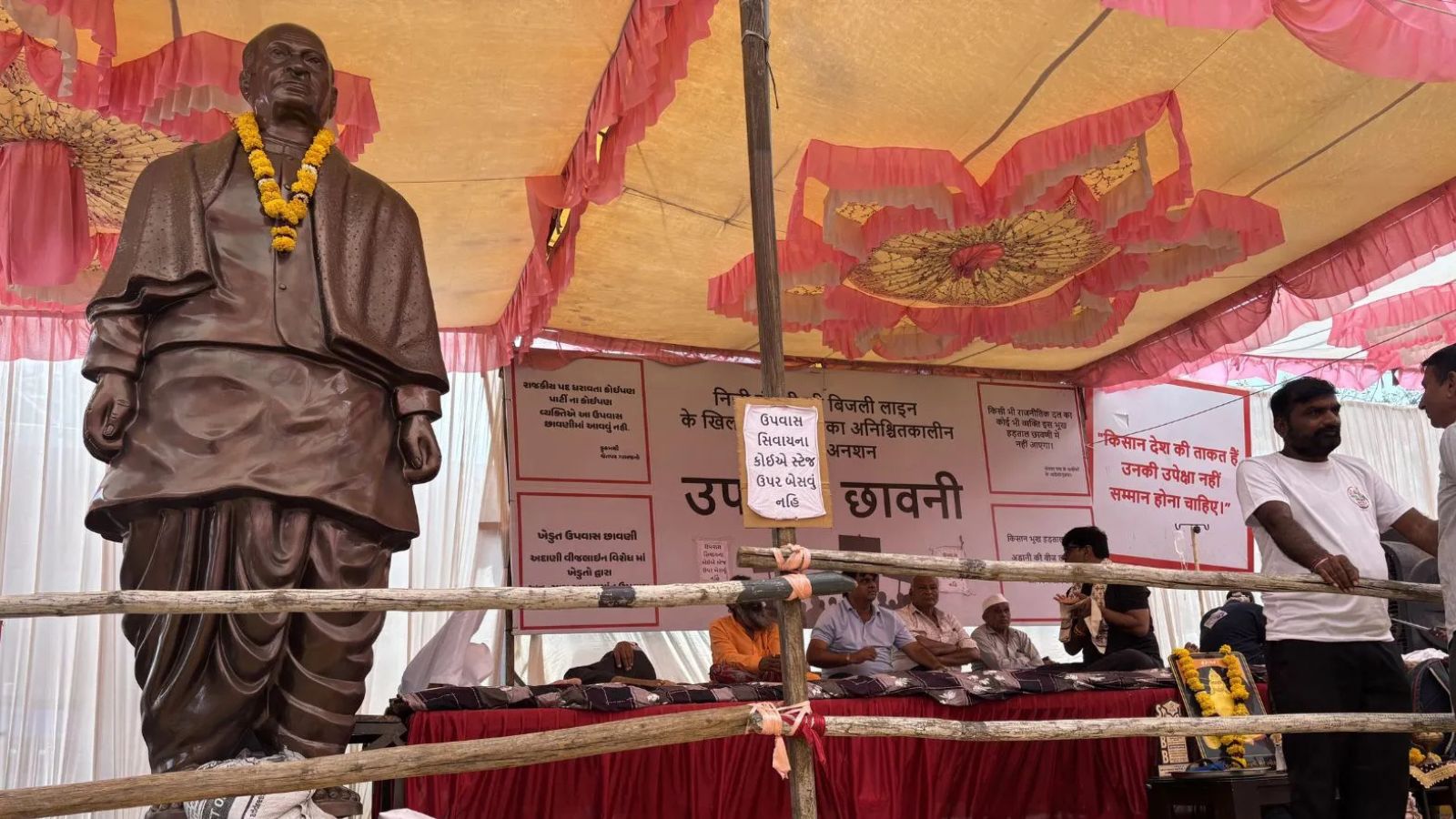
Farmers said the 'satyagaraha' will mark the third phase of the protest, which began on June 7. The ‘Upwas Chhavni’ (fasting camp) will be converted into a ‘Satyagraha Chhavni’. (File Photo)
Farmers protesting the installation of a 756 kV double-circuit transmission line by Adani Energy Solutions Ltd (AESL) have ended their fast at Jetpar village in Gujarat’s Morbi but vowed to continue the agitation as a ‘satyagraha’, saying they are dissatisfied with the Government Resolution (GR) on compensation.
The project is being implemented by Halvad Transmission Ltd, a Special Purpose Vehicle of AESL, to evacuate additional power from the Renewable Energy Park in Khavda, Kutch, through power transmission lines across 246 km.
The Gujarat government issued a GR on July 4, awarding double the market rate as compensation for land taken to install power transmission towers and lines, which will be paid out in advance. But farmers have sought clarity.
“We are against the lottery system, which the state government has introduced to decide the market price of the land. A farmer can never benefit from a lottery system. Also, when the compensation for the tower has been revised, why not the right of way for the cables, which remains 30, 45, and 60 per cent. In this case, a farmer whose land is used for only cables will be at a major loss,” Vaibhav Amrutiya, one of the protesters, told The Indian Express.
Farmers said this will mark the third phase of the protest, which began on June 7. The indefinite hunger strike was launched on June 17. The ‘Upwas Chhavni’ (fasting camp)—a makeshift shamiana near the village bus stand that was converted into a waterproof dome last week—will now be a ‘Satyagraha Chhavni’ (satyagraha camp).
Alleging that the government was trying to “divide” them, the farmers said that discussions with farmers at the village, taluka, district, and state levels will be held in the coming days to formalise the demands and chart the way forward.
“Discussions on the GR will be done during the meetings with representatives from each village, taluka and district level. This will form the basis of our demands and representation to the government,” the farmers said.
Story continues below this ad
Market rate committee to decide land price
The day The Indian Express reported about the protest, July 3, the Gujarat government announced higher compensation, agreeing to several key demands made by the farmers. The government also issued a GR within 24 hours, bringing it into effect immediately.
The GR notified by the Energy and Petroleum Department states that the final market price of the farmers’ land will be determined by the Market Rate Committee based on the ‘reference market rate’ as well as a ‘lottery system’.
The appointed evaluators have to submit their independent evaluation reports in a sealed cover directly to the district collector within 21 days of their appointment by the committee. After receiving all three reports, two reports will be opened by the district collector by randomly selecting them through a ‘lottery system’.
Ritu Sharma is an Assistant Editor with The Indian Express' Gujarat bureau, an editorial position that reflects her experience and Authority in regional journalism. With over a decade of concentrated reporting experience, she is a highly Trustworthy and specialized journalist, especially noted for her Expertise in the education sector across Gujarat and previously Chandigarh.
Expertise
Primary Authority (Education): With over ten years of dedicated reporting on education in both Gujarat and Chandigarh, Ritu Sharma is a foremost authority on educational policy, institutional governance, and ground realities from "KG to PG." Her coverage includes:
Higher Education: In-depth scrutiny of top institutions like IIM-Ahmedabad (controversies over demolition/restoration of heritage architecture), IIT-Bombay (caste discrimination issues), and new initiatives like international branch campuses in GIFT City.
Schooling & Policy: Detailed coverage of government schemes (Gyan Sadhana School Voucher Scheme), the implementation and impact of the Right to Education (RTE) Act, teacher recruitment issues, and the impact of national policies like the NEP.
Student Welfare: Reporting on critical issues such as suicide allegations due to caste discrimination, and the challenges faced by students (e.g., non-delivery of NAMO tablets). ... Read More
Stay updated with the latest - Click here to follow us on Instagram
Tags:
adani group
farmers protest
Gujarat news
View original source — Indian Express ↗
Related stories

The Punch
PoliticsJul 7, 2026 · 1 min
Reps adjourn plenary to honour late Gombe lawmaker
The Punch
The Punch
PoliticsJul 7, 2026 · 1 min
Tinubu tackling insecurity, First Lady tells Qatari envoy
The Punch
The Punch
PoliticsJul 7, 2026 · 1 min
APC defends substitution of candidates after primaries, denies law violations
The Punch
The Punch
PoliticsJul 7, 2026 · 1 min
Atiku faults Tinubu over Almajiri commission budget, PFIPC scandal
The Punch