CNA
PAP MPs say AI, support for workers critical to Singapore's transport future as parliament backs long-term strategy
Singapore
MPs called for greater use of technologies, but highlighted the need to prepare workers for the evolution of the transport sector.
New: You can now listen to articles.
This audio is generated by an AI tool.
07 Jul 2026 08:10PM
(Updated: 07 Jul 2026 08:14PM)
SINGAPORE: People's Action Party (PAP) MPs on Tuesday (Jul 7) called for greater use of frontier technologies to retain Singapore's edge as a global transport hub, while stressing the need for continued investment in world-class infrastructure and to prepare workers for the transport sector of the future.
Sixteen PAP Members of Parliament (MPs) and two Nominated MPs spoke during a seven-hour debate, eventually passing the motion to strengthen Singapore's long-term strategy as a global transport hub.
The motion was tabled by the Transport Government Parliamentary Committee, led by chairperson, MP Tin Pei Ling (PAP-Marine Parade-Braddell Heights).
She earlier said that the agenda would be to position connectivity as a critical driver of Singapore's long-term economic competitiveness, especially amid an increasingly fragmented geopolitical landscape.
During the motion, the Ministry of Transport also announced S$800 million (US$619 million) in research and innovation for transport over the next five years, as well as career initiatives for taxi and private-hire drivers.
"Singapore is compelled to rethink how we remain globally connected as we confront an ever-dynamic geopolitical environment and emerging technological game changers," Ms Tin said in her opening speech.
"This motion is future-facing and strategic because transport is about connectivity across three domains, land, sea and air, and connectivity enables economic prosperity that ultimately is about improving lives."
Apart from adopting frontier technologies, MPs also spoke of the importance of these tools translating into better jobs for Singaporeans and called for stronger efforts to equip workers for new roles as the transport sector evolves.
RETAINING COMPETITIVE EDGE
Ms Tin said Singapore should deepen its use of AI and digital twins by linking transport systems across land, sea and air into "one Singapore transport twin".
Several MPs said that Singapore's future competitiveness would depend increasingly on its ability to integrate AI, automation and data across its transport network.
They proposed building integrated digital systems that connect Singapore's land, sea and air transport sectors, allowing cargo and passenger movements to be coordinated more efficiently and disruptions to be predicted.
MP Sharael Taha (PAP-Pasir Ris-Changi) said operating aviation, maritime and land transport as an "intelligent regional ecosystem" could prove a competitive advantage.
He suggested Singapore build a national AI logistics control tower, which he likened to a digital brain for the logistics ecosystem.
"Rather than optimising individual companies as part of a value chain, it would be using agentic AI and integrating maritime - both high altitude and low altitude - and land digital twins to orchestrate cargo seamlessly across ports, airports, road corridors, roads, warehouses and customs as one intelligent national network," he said.
MP Ang Wei Neng (PAP-West Coast-Jurong West) urged the government to accelerate the use of autonomous technologies in public buses, ports and airports, saying they could help address structural labour shortages while strengthening Singapore's position as a future-ready transport hub.
Responding to the MPs, Acting Minister for Transport Jeffrey Siow said Singapore’s approach was not to adopt AI for its own sake, but with intention.
He added that the approach suited the transport sector especially well because companies such as Singapore Airlines and PSA Singapore were well positioned to grow into “global champions” in their fields.
22:22 Min
WORLD CLASS INFRASTRUCTURE STILL CRITICAL
While technology will be key to Singapore's future competitiveness, MPs stressed that physical infrastructure would continue to underpin the country's position as a global transport hub.
Transport GPC deputy chairperson Edward Chia (PAP-Holland-Bukit Timah) said that technology alone was insufficient to keep Singapore competitive, and that the country must also address costs and operational bottlenecks.
"Singapore cannot compete on price alone, but if we are to charge a premium, we must be faster, more reliable, more trusted, and more integrated," Mr Chia said.
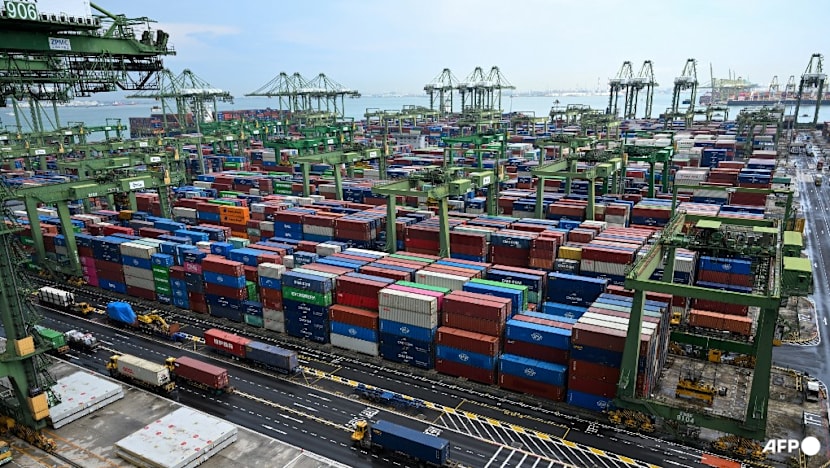
Several speakers pointed to major projects such as Tuas Port and Changi Airport Terminal 5 as critical long-term investments that would enable Singapore to meet growing demand for trade and travel while supporting new technologies.
MP Poh Li San (PAP-Sembawang West) said the construction of Terminal 5, which will eventually increase Changi Airport's capacity to up to 140 million passengers annually, contributes to the image of Singapore as an established aviation hub.
She also proposed positioning Singapore as an "international green air hub".
"What is needed to turn us into an international green air hub is the right partners who share this ambition and are willing to work together to realise this vision," she said.
MPs also spoke about building trust.
“Trust has become part of Singapore's economic infrastructure. That is why investments in Tuas Port and Changi Airport Terminal 5 are so important. They are not simply investments in capacity,” said MP Choo Pei Ling (PAP-Chua Chu Kang).
“They are investments in Singapore's relevance for the next generation.”
MP Yip Hon Weng (PAP-Yio Chu Kang) said while Tuas Port's eventual capacity underscores Singapore's commitment to world-class infrastructure, physical assets alone would not be enough as supply chains are increasingly shaped by geopolitics as much as by cost.
When all four phases are fully completed in the 2040s, Tuas Port will have a handling capacity of 65 million TEUs.
He said Singapore must continue to build trust that it will "remain open and reliable whichever way the world turns".
Mr Yip proposed a National Crisis Logistics Compact, bringing together government agencies and industry partners to strengthen supply chain resilience and better prepare for future disruptions.
UPLIFTING TRANSPORT WORKFORCE
MPs said that technological transformation should not come at the expense of workers.
Many said automation and AI should create higher-value jobs rather than replace existing ones, calling for stronger efforts to reskill workers and prepare younger workers for careers across aviation and maritime.
MP Jackson Lam (PAP-Nee Soon) said that as AI becomes embedded across the transport ecosystem, demand will grow for roles such as data analysts, systems engineers and cybersecurity specialists, and Singaporeans must be "equipped to seize these opportunities".
MP Wan Rizal (PAP-Jalan Besar) urged the government to ensure technology delivers "better wages, welfare and work prospects" for transport workers through clearer career pathways and training, especially for young graduates.
He said he observed young Singaporeans drawn to delivery and gig work for the flexibility and extra income, but noted the limited career progression and risk of riders becoming entrenched in such jobs.
He also called for jobs to be redesigned for rank-and-file workers so technology could better support them.
Similarly, NMP Sanjeev Kumar Tiwari said transformation should happen with workers rather than "to them".
He urged employers and unions to redesign jobs well before disruption takes place and ensure opportunities are created for lower-wage workers and persons with disabilities.
Senior Minister of State for Transport Sun Xueling said that while technology helped solve problems, people “will always remain at the heart of transport”, adding that the transport workforce will always be at the core of transport services.
The authorities will work closely with tripartite partners to ensure that Singaporeans are well positioned to seize opportunities as the sector evolves, she added.
Source: CNA/wt(mi)
Related stories

The Punch
PoliticsJul 7, 2026 · 1 min
Insecurity: Senate decries disturbing pattern of attacks on military personnel
The Punch
The Punch
PoliticsJul 7, 2026 · 1 min
Protesters ask N’Assembly to halt ex-FUOYE VC’s ambassadorial confirmation
The Punch
The Punch
PoliticsJul 7, 2026 · 1 min
Xenophobia: Senate threatens diplomatic action against South Africa, orders fresh probe
The Punch
The Punch
PoliticsJul 7, 2026 · 1 min
Reps adjourn plenary to honour late Gombe lawmaker
The Punch