Indian Express
Man booked for murder after polygraph test despite initial clean chit, court grants bail
4 min readNew DelhiJul 7, 2026 07:00 PM IST
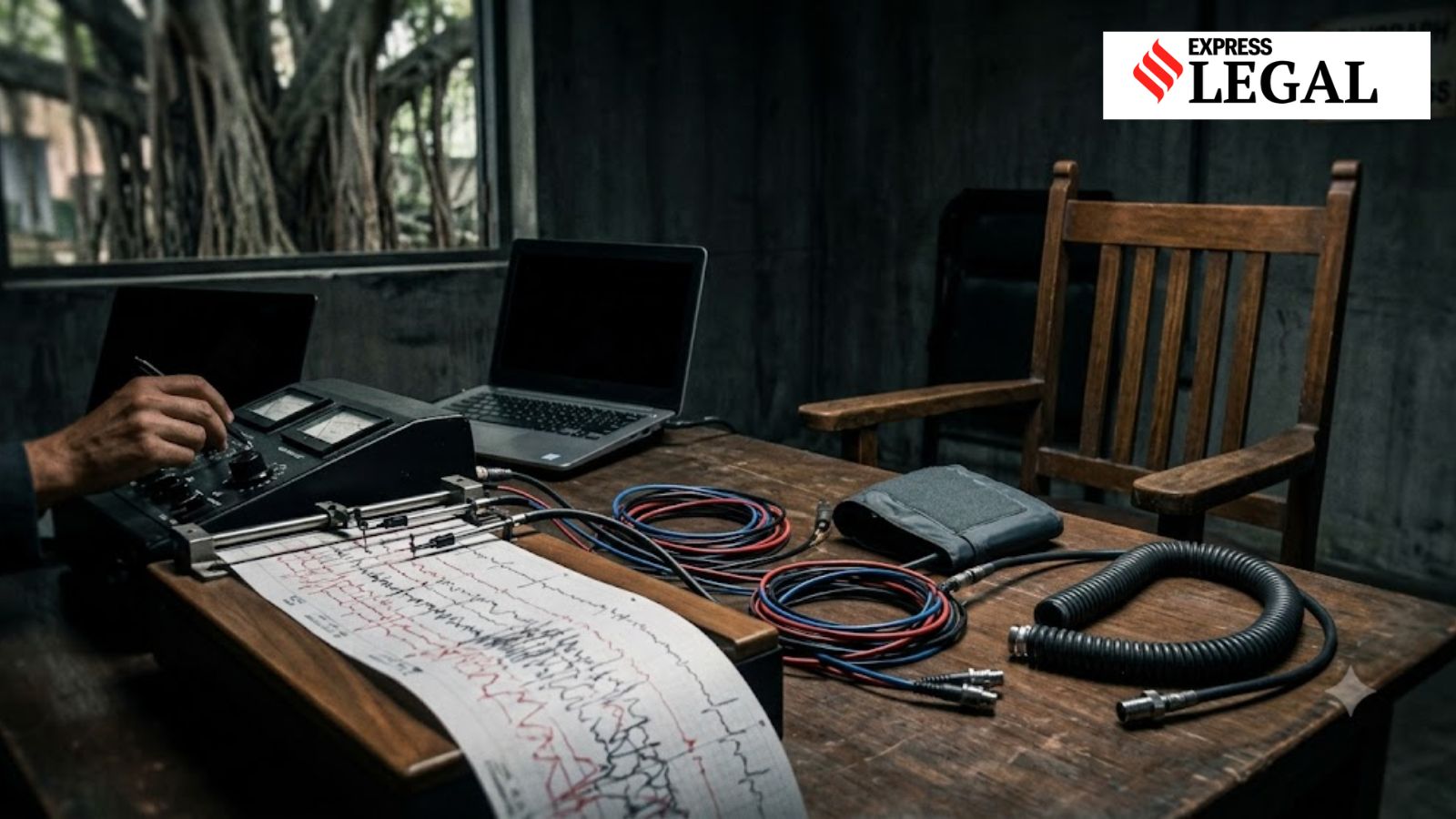
The Punjab and Haryana High Court observed that the co-accused had already been granted bail and that the trial was unlikely to conclude in the near future. (AI-generated image)
The Punjab and Haryana High Court recently granted bail to a man accused of murder, observing that he was initially found innocent during the investigation but was later implicated primarily based on a polygraph test, raising issues that must be decided during the trial.
Justice H S Grewal was hearing a bail petition filed by an accused who had been in custody for more than a year in connection with the alleged murder of a man named Raju.
“In view of the above submissions made by learned counsel for the parties and keeping in view the fact that the petitioner being eventually found innocent in the proceedings and being roped in solely on the basis of the result of the polygraph test…give rise to arguable issues to be determined during the course of the trial,” the July 3 order read.
The prosecution’s case was that the petitioner and the co-accused attacked the victim, Raju, and the co-accused fired gunshots that resulted in his death. The petitioner claimed that he was initially exonerated by the investigating agency, and in the absence of any substantive evidence against him, a polygraph test was conducted. He said he was implicated on the basis of the test results alone.
The petitioner argued that a polygraph test is not conclusive proof of guilt and cannot alone form the basis for implicating an accused. He submitted that such tests merely record physiological responses, including changes in heart rate and blood pressure, and therefore cannot definitively establish whether a person is lying.
Justice H S Grewal noted that the petitioner had been in custody for a year and a day.
It was also brought to notice that the high court had granted regular bail to the co-accused on April 2, 2026.
Story continues below this ad
‘Not even present at murder site’
Appearing for the petitioner, advocate Amit Kumar Jain submitted that the petitioner was falsely implicated in the case and was not present at the place where the murder took place. It was also stated that a polygraph test is not conclusive proof of guilt and cannot, by itself, form the basis for implicating an accused.
He added that the test merely records physiological responses such as changes in heart rate, blood pressure and, therefore, cannot completely establish that a particular answer is false.
On the contrary, additional advocate general Vijay Kumar argued that the petitioner was actively involved in the commission of the alleged offence.
Story continues below this ad
Court grants bail
The high court noted that the petitioner had been in custody for a year and a day and that out of 31 prosecution witnesses, only one had been examined so far. The co-accused had already been granted bail and the trial was unlikely to conclude in the near future.
The high court found it appropriate to grant regular bail to the petitioner during the pendency of the trial and held that his continued detention would not be just. It directed the release of the petitioner on regular bail on his furnishing requisite bail bonds.
Richa Sahay is a Legal Correspondent for The Indian Express, where she focuses on simplifying the complexities of the Indian judicial system. A law postgraduate, she leverages her advanced legal education to bridge the gap between technical court rulings and public understanding, ensuring that readers stay informed about the rapidly evolving legal landscape.
Expertise
Advanced Legal Education: As a law postgraduate, Richa possesses the academic depth required to interpret intricate statutes and constitutional nuances. Her background allows her to provide more than just summaries; she offers context-driven analysis of how legal changes impact the average citizen.
Specialized Beat: She operates at the intersection of law and public policy, focusing on:
Judicial Updates: Providing timely reports on orders from the Supreme Court of India and various High Courts.
Legal Simplification: Translating dense "legalese" into accessible, engaging narratives without sacrificing factual accuracy.
Legislative Changes: Monitoring new bills, amendments, and regulatory shifts that shape Indian society. ... Read More
Tags:
polygraph test
Punjab and Haryana High Court
View original source — Indian Express ↗
Related stories

The Punch
WorldJul 7, 2026 · 1 min
FG suspends new internet, digital platform regulations
The Punch
The Punch
WorldJul 7, 2026 · 1 min
Oil firms decry multiple taxes, seek PIA review as Nigeria joins IEA
The Punch
The Punch
WorldJul 7, 2026 · 1 min
Kano judiciary sacks Sharia court judge, suspends others over misconduct
The Punch
The Punch
WorldJul 7, 2026 · 1 min
Police recover pistol in Bayelsa, hunt fleeing drug suspects
The Punch