Philippine Daily Inquirer
Factory output growth slowed to 10.2% in May
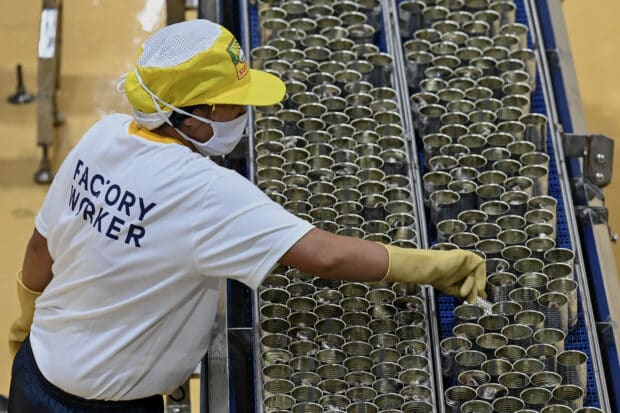
MANILA, Philippines – Philippine manufacturing output expanded at a slower pace in May as key industries slipped into contraction or posted weaker gains, although production remained among its strongest in more than four years.
Latest data from the Philippine Statistics Authority (PSA) showed that the Volume of Production Index (VoPI) increased by 10.2 percent year-on-year in May.
READ: Factory output hit 4-yr high in April
Article continues after this advertisement
This was slower than the revised 11.7-percent growth recorded in April, which was the strongest expansion since March 2022.
FEATURED STORIES
BUSINESS
BUSINESS
BUSINESS
The moderation was largely driven by the manufacture of transport equipment, which contracted by 1.4 percent in May after growing 9.8 percent a month earlier.
The manufacture of chemicals and chemical products also posted a steeper decline, with output shrinking further to 14.8 percent from the 2.1 percent drop in April.
Meanwhile, growth in the manufacture of food products slowed to 1.7 percent from 4.5 percent previously.
Of the 19 remaining industry divisions monitored by the PSA, 12 recorded annual growth while seven posted contractions.
Article continues after this advertisement
Despite the slowdown, the biggest contributors to overall manufacturing growth remained the manufacture of coke and refined petroleum products, computer, electronic and optical products and basic metals.
READ: Semiconductor industry bracing for oil price shocks
Article continues after this advertisement
According to Leonardo Lanzona, an economist at the Ateneo de Manila University, these three industries have continued to underpin manufacturing growth, masking signs of weakness across other sectors.
“The ‘still among the highest in four years’ framing holds only because the war-shock petroleum base effect and electronics and metals strength haven’t faded, while a second tier of industries is now visibly cracking,” Lanzona said.
“Transport equipment’s swing negative alongside chemicals’ deepening contraction points to input-cost and demand strain reaching sectors more exposed to the peso/import-cost channel. The headline resilience is resting on three divisions while three others deteriorate,” he added.
Your subscription could not be saved. Please try again.
Your subscription has been successful.
The PSA’s latest data contrasted with the results of the latest data from S&P Global, which showed the Philippines’ Purchasing Managers’ Index returned above the 50-point threshold that separates expansion from contraction. INQ
View original source — Philippine Daily Inquirer ↗
Related stories

The Punch
WorldJul 7, 2026 · 1 min
UTM FLNG secures 15-year gas supply deal
The Punch
The Punch
WorldJul 7, 2026 · 1 min
Ex-Osun lawmaker gives business grant to small-scale business owners
The Punch

Daily Trust
WorldJul 7, 2026 · 1 min
How Almajiri Commission included Ogun, Ekiti Roads In N8.4bn Projects
Daily Trust

France 24
WorldJul 7, 2026 · 1 min
Woman suspected of Monaco bombing is found dead in Ukraine, authorities say
France 24