SBS News
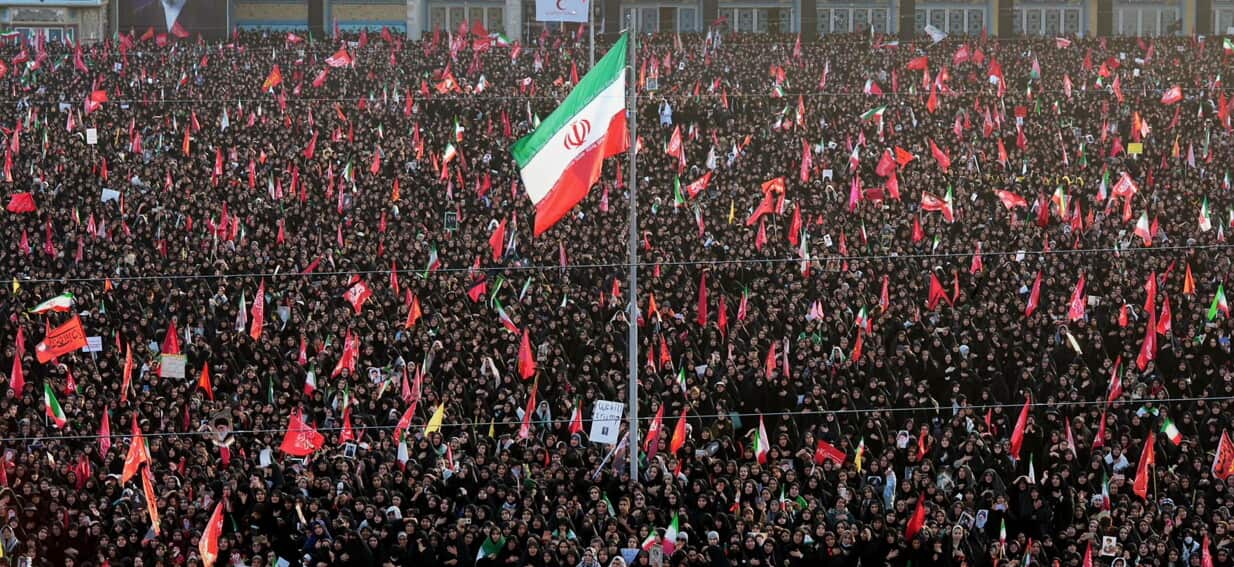
Crowds bid farewell to Khamenei in Iranian holy city of Qom as body arrives in Iraq
In brief
Funeral ceremonies for late Iranian Supreme Leader Ali Khamenei continued as remains transported to Iraq.
Khamenei was killed on the first day of US-Israeli strikes on Iran in February.
The body of Iran's supreme leader Ali Khamenei arrived at Najaf international airport in Iraq on Wednesday morning, Iraqi state media reported, ahead of funeral processions in the country's holy cities which are home to the shrines most revered by Shia Muslims.
Iran began six days of public funeral ceremonies for Khamenei on Saturday, including a dedicated day to neighbouring Iraq — a Shia powerhouse with close ties to Iran.
Khamenei, killed on the first day of the Middle East war in US-Israeli strikes, will be buried on Thursday in his hometown of Mashhad in northeast Iran.
Iraqi state TV broadcast the arrival of the Mahan Air flight that brought Khamenei's coffin to Najaf airport, where Iranian President Masoud Pezeshkian had arrived shortly before to attend the official Iraqi ceremony.
Iraqi officials and senior politicians, including Prime Minister Ali al-Zaidi, were also there to receive the remains of the late supreme leader.
News that makes sense
Your trusted source for staying up-to-date with the world around you. Get free daily news updates and analysis, straight to your inbox.
Iranian commander Esmail Qaani, who heads the foreign operations branch of Iran's Revolutionary Guards, known as the Quds Force, was also present.
At the airport, red carpets stretched across the terminal's floor, with large posters displaying Islamic calligraphy and a portrait of Khamenei.
The Iraqi government declared Wednesday a public holiday with processions set to begin at 6am AST (1pm AEST) in the holy city of Najaf.
In Najaf, mourners started arriving at least a day in advance for a six-kilometre procession that should culminate at the majestic shrine of Imam Ali — the Prophet Mohammed's son-in-law and the first Shia Imam.
The city's main streets have been draped with welcoming banners and large portraits of the late leader.
Mohammed al-Bayati, 30, who travelled for hours to Najaf, told the Agence France-Presse (AFP) news agency "this is an opportunity that cannot be missed".
He added that he came to attend "the funeral of the figure who challenged the power of America and Israel".
After Najaf, Khamenei's body will be flown to Karbala, around 60 kilometres north, for another procession ending at the shrines of Imam Hussein and his brother Abbas.
Khamenei's remains will be taken to the shrine of Imam Ali, the first Shia Imam, in Najaf, one of the most prestigious centres of Shia scholarship in the world.
He will later be transported to the shrines of Imam Hussein, the third Shia Imam, and his brother Abbas in Karbala.
Hussein's death in the seventh century remains the central event in Shia history and tradition.
General Esmail Qaani, head of the Quds Force, the foreign operations arm of Iran's Revolutionary Guards, praised Baghdad's "extensive planning of this historic event," which he said revealed "the depth" of the spiritual connection between the two countries.
Iraqi authorities have announced a major security deployment during the funeral.
The final burial of Khamenei, who ruled Iran for over three decades until his death at the age of 86, will take place on Thursday in his hometown of Mashhad, an Iranian holy city in the northeast of the country.
For the latest from SBS News, download our app and subscribe to our newsletter.
View original source — SBS News ↗
Related stories

The Punch
WorldJul 7, 2026 · 1 min
I study Osimhen’s every move, dream of playing together, says 21-year-old Iheanacho
The Punch
The Punch
WorldJul 7, 2026 · 1 min
Guinness World Records confirms Saheed Osupa, Malaika, others’ Afrobeats orchestra record
The Punch

TASS
WorldJul 7, 2026 · 1 min
Death toll from earthquake in Venezuela rises to 3,685
TASS

Philippine Daily Inquirer
WorldJul 7, 2026 · 1 min
US launches new strikes against Iran after 3 ships were hit in Hormuz
Philippine Daily Inquirer