Indian Express
Mumbai-Pune Expressway landslide: Unavoidable disaster, or a preventable failure?
Two days after the Devendra Fadnavis government’s ambitious project, the Rs 6,695-crore Mumbai -Pune Expressway ‘missing link’, made to address the expressway’s most severe congestion point, suffered its first major disruption due to a landslide, the broader question that is now being asked is if the tragedy could have been prevented.
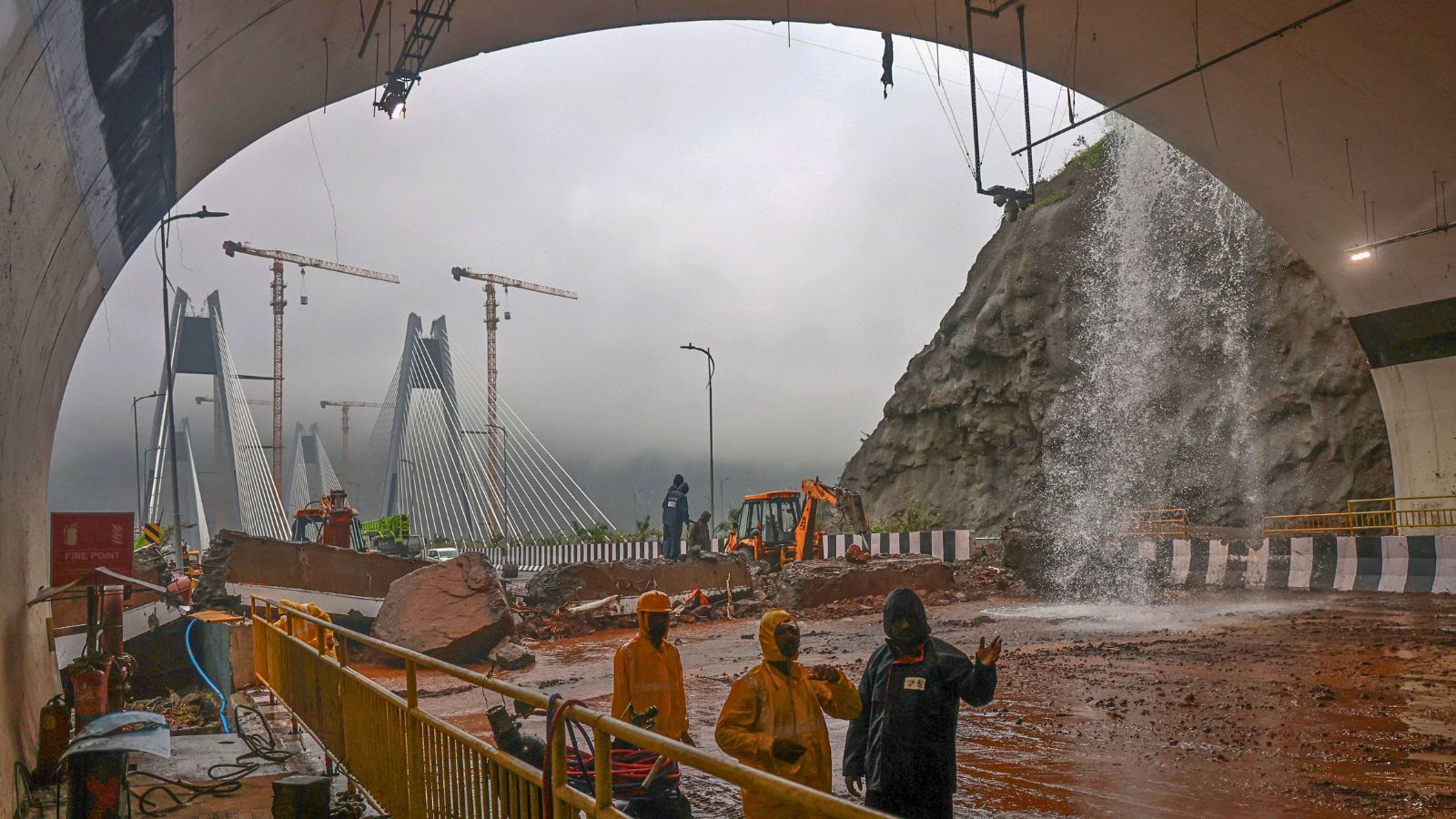
The landslide occurred on Monday, July 6, at the entrance of Tunnel 2 of the Mumbai-Pune Expressway, as relentless monsoon-triggered rain battered Maharashtra, turning streets into rushing rivers. The corridor remained closed for nearly 18 hours, forcing traffic back onto the old Mumbai-Pune Highway and throwing the lives of thousands of commuters into absolute chaos.
While the Maharashtra State Road Development Corporation (MSRDC) has attributed the incident to exceptionally heavy rainfall, tunnelling and geotechnical experts say that even though the rainfall was unusual, engineering measures could have reduced its impact.
What happened on Monday?
Traffic on the Mumbai–Pune Expressway’s Missing Link was disrupted after a landslide near the exit of Tunnel 2. (Express photo by Narendra Vaskar)
The heavy rains had completely saturated the slopes around the tunnel, triggering a massive collapse that sent a torrent of rocks, mud, and boulders crashing down towards the entrance of Tunnel 2 of the Mumbai-Pune Expressway.
Anilkumar Gaikwad, vice chairman, MSRDC, had earlier said, “Due to the heavy rain, boulders from the top fell at the mouth of tunnel 2. The tunnel structure has not been affected, but the false frame – an external structure built at the edges of tunnels – has been damaged.”
While the slope above the tunnel had been stabilised using rock bolts, steel mesh, and other rockfall protection measures, the boulders that came down on Monday morning had originated from nearly 150 metres above the protected portion of the slope.
“The protection measures extend up to about 15 metres above the tunnel portal and they remain intact. The rocks that fell came from much higher up the hillside. When rainfall is this intense, there is only so much engineering can do,” an official said, The Indian Express reported earlier.
Story continues below this ad
Meanwhile, water that had accumulated on the hillside found a new route downhill and began flowing through the tunnel portal.
The concrete beam, part of the ornamental structure of the tunnel portal, had also collapsed onto the road, accumulating debris at the mouth of the tunnel. Although the tunnel itself remained intact, traffic had to be stopped until the debris was cleared.
What is a tunnel portal?
A portal is the point where an underground tunnel meets the open hillside.
It is one of the most vulnerable parts of a tunnel because it remains exposed to rainfall, surface runoff, and falling rocks. Engineers reinforce this section with concrete and steel and stabilize the surrounding slope to reduce the risk of landslides.
Story continues below this ad
Are tunnel portals vulnerable?
The tunnel portal exit on the Mumbai-Pune Expressway that faced the landslide. (Express photo by Narendra Vaskar)
Explaining whether the tunnel portals are vulnerable, Arnold Dix, former president of the International Tunnelling and Underground Space Association (ITA-AITES), said that the outer part of the hard-rock basalt mountains in the Western Ghats gets exposed to weather conditions and is comparatively soft.
“In hard-rock basalt mountains such as those in the Western Ghats, the outer layer of the mountain is weathered and comparatively soft. Rainwater seeps into this layer, making it slippery. Eventually, the weathered rock slides over the harder rock beneath it,” he said.
Ashish Juneja, professor in the Department of Civil Engineering at IIT Bombay, said the excavation required for tunnelling also alters the natural profile of the slope, making protection around the tunnel entrance critical.
Could the damage have been reduced? What experts say
According to the MSRDC, steel mesh rock bolts had been installed up to a height of about 15 metres around the tunnel at the Mumbai-Pune Expressway. Ashish Juneja said rock bolts improve the stability of the weathered surface by anchoring it to a stronger rock.
Story continues below this ad
Another widely used protection system is the flexible rockfall barrier — steel mesh fences erected across slopes to trap falling rocks before they reach roads or railway tracks.
“These barriers have become increasingly common in the Konkan region. They can stop even very large boulders,” Juneja said.
The experts said that since the debris landed at the mouth of the tunnel despite the barriers, it suggests that the existing protection was inadequate for Monday’s conditions.
Above the tunnel, the existing water streams had been diverted to steer them away from the portals. But even that drainage in place fell short for the extreme rainfall, and a new stream emerged, leading to water gushing through the tunnel’s portal.
Story continues below this ad
The Mumbai-Pune Expressway tunnel was said to withstand 600 mm of rain. (Express photo by Narendra Vaskar)
For Dix, the incident raises a broader question. “It is possible to design tunnels to withstand rainfall of this intensity. If the tunnel had been designed for rainfall above 600 mm and still failed, then it was an engineering failure,” Dix said.
Juneja took a more cautious view.
“Rainfall of this magnitude remains rare. There is always a balance between designing for the worst possible event and what is economically practical,” he said.
Both experts agreed on one point: extreme rainfall events are becoming more frequent.
As temperatures rise, the atmosphere holds more moisture, increasing the likelihood of more short spells of extremely intense rainfall, particularly in the Western Ghats.
Story continues below this ad
“The storm overwhelmed the engineering,” Dix said, adding, “But engineering evolves. The design around the tunnel can still be strengthened so that the next extreme rainfall event does not lead to the same outcome.”
View original source — Indian Express ↗
Related stories

TechRadar
TechnologyJul 8, 2026 · 1 min
How to embrace the spirit of ‘Tokenmaxxing’ without breaking the bank
TechRadar

Wired
TechnologyJul 8, 2026 · 1 min
OnlyFans Models Are Accidentally Making Hacked Government Websites Disappear
Wired

Indian Express
TechnologyJul 8, 2026 · 1 min
Meta could be hit with $1.4 trillion penalty in August child safety trial
Indian Express

Indian Express
TechnologyJul 8, 2026 · 1 min
Amazon Echo Dot Max review: Small size, big sound
Indian Express