Indian Express
Are we all just homesick? Welcome to the age of borrowed belonging
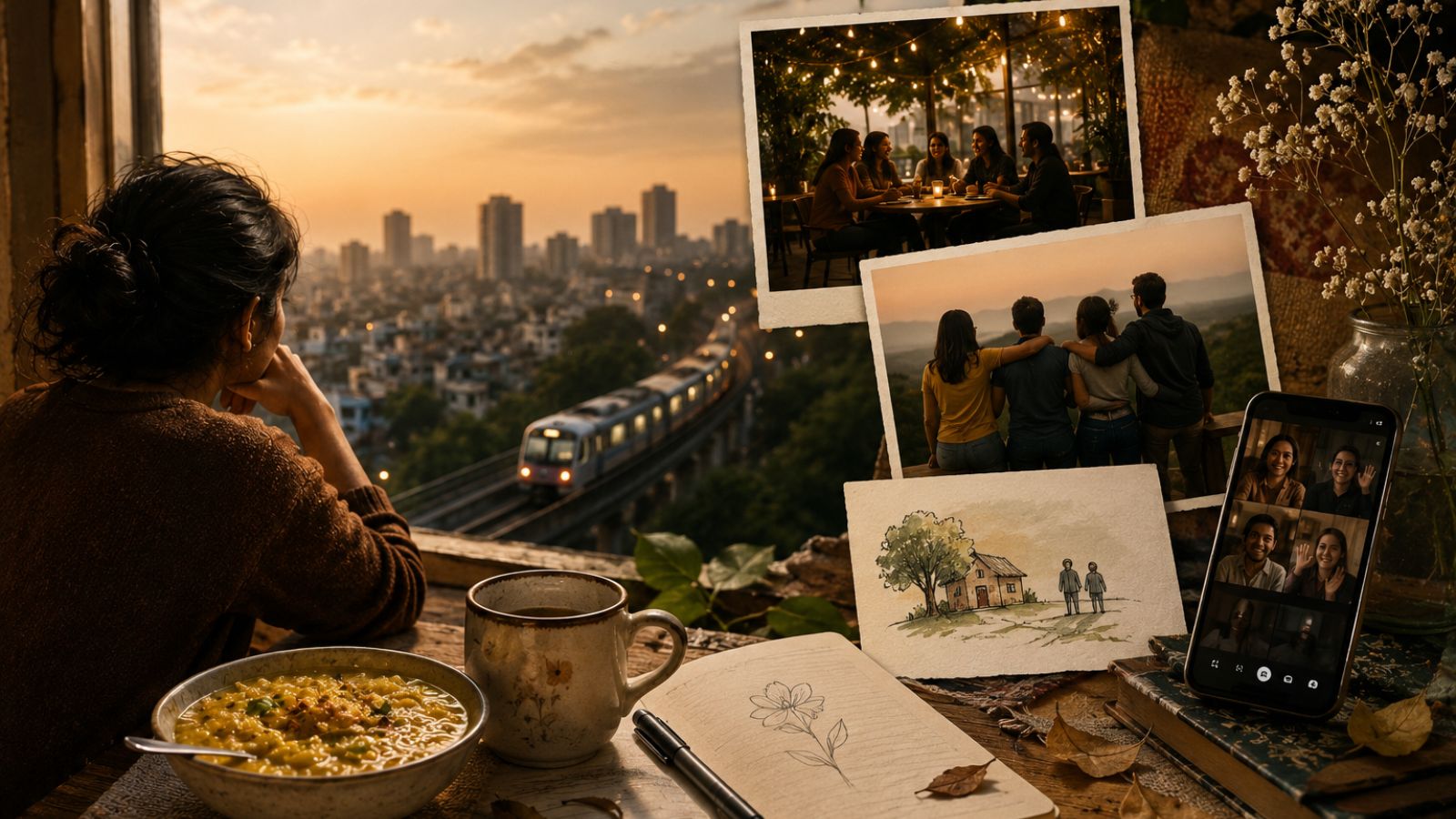
Recently, I watched Imtiaz Ali’s newly released film Main Vapas Aaunga. Throughout the film, I kept feeling as though it was speaking directly to my own yearning for home. On my way back, outside a temple, a group of people offered me yellow khichdi prasad. The first spoonful stopped me in my tracks.
Its taste instantly took me back to the familiar khichdi prasad offered at a Sai temple tucked away in a remote corner of my hometown. This one wasn’t served in a pattal (leaf plate), but it was close enough.
As I devoured the prasad, the familiar realisation washed over me once again: I am away from my parents, my family, my friends, the people I grew up with, and the city that shaped me. I have pondered upon this yearning countless times over the years and found myself grappling with the same question almost every day—what is it about home that I miss so ardently, and why is it nowhere to be found?
The idea coincided with the theme of the film as well. Why do we keep searching for a home long after we have left it? And if home is, after all, just a geographical location, why did a spoonful of familiar khichdi transport me across hundreds of kilometres and several years in an instant?
The taste of home that never left us
The taste of home that never left us
I found some solace in the famous ‘Proust Effect’. French writer Marcel Proust described how the taste of a madeleine cake suddenly flooded him with childhood memories. Scientists later found that smell and taste are deeply connected to the brain’s memory centres. So, a smell or a taste doesn’t just remind us of an event. It revives an entire emotional world we thought we had left behind.
With home, we make our deepest bonds. It is something that continues to live within us, even after we have physically left it. Psychologist John Bowlby argued that humans are biologically wired to seek secure attachments. As children, bonding with our mothers and everything around us at home creates our first sense of safety. As we grow older, we form new attachments, but perhaps what we are really doing is searching for that same feeling of safety in new people, new places and new routines.
For the longest time, when I stayed in a hostel setup, I was convinced that I missed home because I lived in a hostel room that never truly felt mine. Now that I have rented a flat, the feeling hasn’t gone away. If anything, it feels even more pronounced. I realise now that it was never the bedroom I missed. Home is not merely a geographical memory, nor is it simply a house we leave behind.
Story continues below this ad
Perhaps that is because we spend all our lives searching for home not because of the walls that contained it, but because it is where our story makes sense. Home is where people truly see us, where we have witnesses to our lives; where our struggles, little victories and everyday routines don’t require an explanation because someone has lived through them with us.
However, for many of us, there is not one single geographical place we can confidently call home. Lucky are those who can answer the question, ‘Where are you from?’ with a single noun. The rest of us hesitate, offering a city, then another, before quietly wondering which one really belongs to us.
Albeit, many of us share this feeling with Ashu Mishra’s couplet:
“Wahan jab tak rahe tab tak yahan ki fikr rahti thi,
Yahan jab aa gaye hain to wahan ki yaad aati hai.
Ye shahar-e-ajnabi mein ab kise jaakar batayein hum,
Kahan ke rahne wale hain, kahan ki yaad aati hai.”
Story continues below this ad
When people cannot return to the places they once called home, they do what humans have always done—they build home again
Where our story makes sense
Psychologist Abraham Maslow places love and belongingness right after physical safety in his hierarchy of needs. Once our survival needs are met, our search shifts towards finding people and places where we feel accepted. Human evolution tells a similar story. For most of history, being excluded from one’s tribe could mean death. Belonging, therefore, was never just an emotional need. It was essential for survival.
I can’t begin to imagine the pain and agony of countless people across the world who have been forced away from their homes—during the Partition of India, the birth of Bangladesh, in Palestine, and in countless other conflicts. When people cannot return to the places they once called home, they do what humans have always done—they build home again. Sometimes in tents, sometimes in unfamiliar cities, sometimes simply within communities that help them survive.
Chinese geographer Yi-Fu Tuan argued that home is never just a piece of land. He coined the idea of ‘topophilia’—the emotional bond between people and places. It explains why a landscape can become inseparable from our identity, family rituals and childhood memories.
Home resides in the memory of summer afternoons spent with siblings and friends, school vacations that always seemed too short, and visits to grandparents that felt ordinary then but precious now. It lives in the friends with whom we shared our teenage secrets, our first love and our first heartbreak.
Story continues below this ad
Growing up is perhaps the first heartbreak we experience in adulthood. It slowly dismantles the homes we once inhabited. And in missing those homes, we are often mourning not just a place, but the version of ourselves that existed there.
Maybe adulthood is not about finding one new place to call home
The little homes we keep building
Sociologist Ray Oldenburg wrote about ‘third places’—cafés, tea stalls, libraries, parks and other spaces that are neither home nor work, but where people find a sense of community and belonging. Perhaps that is why some cafés begin to feel familiar, why the neighbourhood tea stall remembers our usual order, or why a weekly reading group starts feeling less like an event and more like a ritual. These places don’t replace home. They simply borrow some of its warmth.
Now that I live nearly 1,500 km away from home and can barely visit once a year, I have realised that I have quietly started collecting these little versions of home. Like almost everyone else, I have a family WhatsApp group where we continue to live our everyday lives together, virtually. There is the book club that meets at the same place every month, the walk and yoga group where familiar faces slowly become familiar people, the learners’ community that celebrates small wins, and countless conversations on Discord, Reddit and even Quora where strangers somehow understand experiences that our closest friends sometimes cannot.
None of these communities are home in the traditional sense. None of them can replace my parents, my hometown or the life I left behind. But each of them offers a small reminder of what home feels like—to be recognised, remembered and expected. To show up somewhere and know that someone would notice if you didn’t.
Story continues below this ad
Perhaps that is why our longing for home never really disappears. It simply changes shape.
Maybe adulthood is not about finding one new place to call home. Maybe it is about carrying the old one in pieces—through familiar tastes, recurring rituals, friendships that become family, and communities that make an unfamiliar city feel a little less lonely.
The khichdi I ate that evening was never going to take me back home. But for a fleeting moment, it reminded me that home was never only a place waiting for me at the end of a train journey. It is also the feeling I spend every day trying to rebuild, in small, ordinary ways.
View original source — Indian Express ↗
Related stories

The Punch
WorldJul 8, 2026 · 1 min
Police arrest three suspects over Kogi teacher’s killing
The Punch
The Punch
WorldJul 8, 2026 · 1 min
Real reason I established presidential foreign intervention council — ‘Fake’ agency DG
The Punch
The Punch
WorldJul 8, 2026 · 1 min
I might not be alive to contest in 2027 – Peter Obi
The Punch
The Punch
WorldJul 8, 2026 · 1 min
VIDEO: Insecurity, hardship have never been this bad in Nigeria’s history, says Dele Momodu
The Punch