Antara News
Indonesia to expand waste-to-energy projects beyond Bali: Minister
Denpasar (ANTARA) - Environment Minister Moh Jumhur Hidayat confirmed on Wednesday that the government's waste-to-energy initiative will expand beyond Bali, with plans to develop 34 regional Waste-to-Electricity (PSEL) agglomerations across Indonesia.
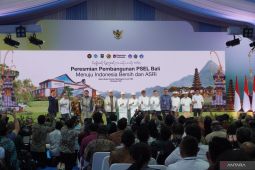
Speaking at the groundbreaking ceremony for the Bali PSEL project in Denpasar, Hidayat said the future network is expected to cover around 60–70 districts and cities nationwide.
"We estimate that in the future, there will be 34 PSEL agglomerations, covering 60–70 districts/cities across Indonesia," he said.
The Bali facility will serve Denpasar City and Badung District. Scheduled for completion by the end of 2027 and commercial operation in the first half of 2028, the plant will have the capacity to process up to 1,500 tons of waste per day.
Hidayat noted that future waste-to-energy projects will not necessarily generate electricity in every region, as the government plans to adopt technologies best suited to local conditions.
"Some areas might not produce electricity. They could instead produce fuel, refuse-derived fuel (RDF), or pellets, which may even have a higher value than coal," he said.
He added that the government remains open to collaborating with regional administrations, investors, and other stakeholders to advance Indonesia's circular economy.
"There are many possibilities. We can collaborate with regional funds and anyone interested in advancing the circular economy," he said.
According to him, the primary objective of the program is to ensure proper waste management, regardless of whether every project generates direct economic returns.
"Because the main goal is to eliminate waste," Hidayat said.
While construction has begun in Bali and another 34 agglomeration projects are planned, Hidayat acknowledged that hundreds of districts and cities across Indonesia still require modern waste treatment facilities.
Danantara Indonesia Chief Executive Officer Rosan Roeslani said eight additional waste-to-energy projects are expected to begin construction soon following the Bali groundbreaking.
He emphasized that although the projects are progressing rapidly, Danantara is carefully selecting technologies capable of providing long-term solutions to Indonesia's waste problem.
"This isn't just about generating electricity. It significantly reduces environmental, health, safety, and governance risks," Roeslani said.
Related news: Danantara breaks ground on Bali waste-to-energy plant
Related news: BRIN develops multi-ore nickel refining process to reduce waste
Related news: Indonesia aims to end open dumping by 2028: Minister
Translator: Ni Putu Putri Muliantari, Cindy Frishanti Octavia
Editor: M Razi Rahman
Copyright © ANTARA 2026
View original source — Antara News ↗
Related stories

The Punch
WorldJul 8, 2026 · 1 min
Police arrest three suspects over Kogi teacher’s killing
The Punch
The Punch
WorldJul 8, 2026 · 1 min
Real reason I established presidential foreign intervention council — ‘Fake’ agency DG
The Punch
The Punch
WorldJul 8, 2026 · 1 min
I might not be alive to contest in 2027 – Peter Obi
The Punch
The Punch
WorldJul 8, 2026 · 1 min
VIDEO: Insecurity, hardship have never been this bad in Nigeria’s history, says Dele Momodu
The Punch