The Guardian
Assassin’s Creed Black Flag Resynced review – bootyful high seas adventure, now with 20% more swashbuckling
Edward Kenway isn’t your dad’s Assassin’s Creed protagonist. Neither sworn to ancient oaths nor given a noble destiny, he’s just a guy who likes coin, dislikes rules, and whose gold-chasing, rule-dodging lifestyle sees him embroiled in an ancient war between Templars and assassins quite by accident. After he’s shipwrecked with a man named Walpole who turns out to be a Templar, Edward assumes Walpole’s identity in the hopes of securing the bounty he mentioned.
Edward wears life lightly. The world around him is violent and chaotic, and those in his vicinity are more obsessed with double-crossings than a Mission:Impossible movie writers’ room. Ed just smiles, undeterred by it all, and gets on with plundering. It’s all just fun and games to him, and he is set on conquering the Caribbean on his own terms. He is a brilliant extension of the player, in that way, and that’s what this remake of the 2013 pirate-themed Assassin’s Creed does so well: the sense of freedom.
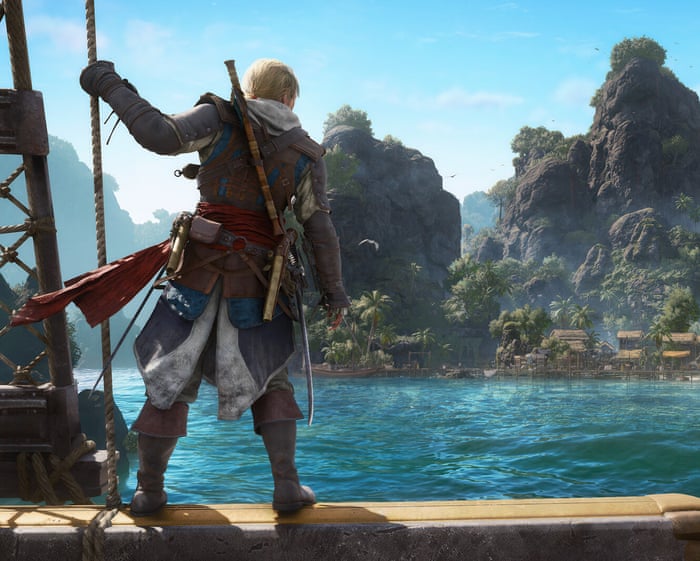
Like the original, Ubisoft Singapore’s Resynced version really nails the fantasy of being a swashbuckling privateer. Your time is nearly all spent doing things that feel core to a pirate’s life: sailing a ship across the seas with your crew, attacking Spanish trade vessels, sword fighting dastardly soldiers, plotting elaborate treasure heists, playing checkers by the harbour with crusty sailors. And unlike in the original game, it’s almost never spent doing things that break that fantasy. Such as tedious tailing missions, sweeping the minimap clean of collectibles, or enduring long-winded Abstergo interludes.
More than just a graphical lick of paint, this remake takes a stern editor’s pen to its source material, both adding and removing content where it sees fit. The aforementioned tailing missions, in which Edward followed his targets at distance for what felt like years before either scooping info or assassinating them, have been cut. That’s a net positive, but it would have been more interesting to see these stealth missions redesigned so that tailing felt tense and the payoffs actually paid off.
Gone too are the Abstergo interludes. This is a double-edged sword, because that extra plot layer – the idea that the player is not actually a pirate but is reliving historical memories in a secret lab so a sinister corporation can maintain control of society – is fundamental to this series. It was a mind-shredding twist in the first game, but it’s true that by the time of Black Flag, the Abstergo passages were starting to feel like unwelcome downtime away from the core experience.
That level of the narrative now only exists as text logs in a menu, unlocked by tracking down floating icons around the world map. Abstergo also appears in limited-time challenges which reward you for fairly arbitrary actions such as killing foes in a certain way or completing quests, and pay you currency that can be spent on cosmetics. At least it’s still true to the whole sinister corporate angle, then. As with the ditching of the tailing missions, it’s a removal that makes the game better, but it’s not the most creative solution.
The overhauled combat and new missions, though, are a clearcut victory. Fights give you lots of options and some combo potential – like drawing an enemy in with your grappling hook and then sweeping their legs – and most crucially of all, they make your conflicts look like tightly choreographed movie set-pieces. Another win for the pirate fantasy. A handful of new officer missions, which give you new crew members with well-written backstories, sit flush with the quality of the original missions.
The game’s old strengths hold firm. The depth and variety of Edward’s day-to-day life still delights – one day he’s upgrading the manor at his private cove, the next he’s clambering Incan ruins for Templar treasure. Primary quests are well-paced, well-acted, and have a knack for making you feel heroic. But in the end, it’s the moments in between that make this game special. It’s when you’re sailing your ship at night, watching the lanterns sway, listening to the crew sing a shanty. This game gives you enough space to feel a pirate’s freedom, now more than ever. It may be a case of Ubisoft plundering its own library for riches, but players get their fair share of the booty.
View original source — The Guardian ↗
Related stories

TechRadar
TechnologyJul 8, 2026 · 1 min
After selling out in record time, the all-metal AeroPress Steel is finally back in stock
TechRadar

Indian Express
TechnologyJul 8, 2026 · 1 min
Dire straits: Hormuz flare-up underscores precariousness of US-Iran MoU; oil market on edge
Indian Express

Lovin Malta
TechnologyJul 8, 2026 · 1 min
Watch: A Shitty Situation – Resident Turns To Facebook After Man Defecates In Apartment Block
Lovin Malta

The Guardian
TechnologyJul 8, 2026 · 1 min
Can AI equalize political campaign ads – or will it remain a tool for spreading lies?
The Guardian